Showing posts with label obama. Show all posts

Sunday, December 19, 2010

Assessing Obama

On his widely read blog, The Daily Dish, Andrew Sullivan argues that Barack Obama is not a weak liberal, but rather a tactical and cautious president who reads the country's mood and compromises to get what he can. Then he lists what Obama has accomplished in his first two years:
...universal health insurance, the rescue of Detroit, the avoidance of a Second Great Depression, big gains in private sector growth and productivity, three stimulus packages (if you count QE2), big public investments in transport and green infrastructure, the near-complete isolation of Iran, the very public exposure of Israeli intransigence and extremism, a reset with Russia (plus a new START), big drops in illegal immigration and major gains in enforcement, a South Korea free trade pact, the end of torture, and a debt commission that has put fiscal reform squarely back on the national agenda. Oh, and of yesterday, the signature civil rights achievement of ending the military's ban on openly gay service members.

It certainly is an impressive list, and though I was hoping for more bold legislation with a Democrat in the White House and large majorities in both houses of Congress, I do understand that political logistics must be taken into account when hashing out domestic policy.

As I've said before, it is in other areas that I have significant problems with Obama's leadership: the wars, the secrecy, the assault on privacy and civil rights, and Guantanamo Bay. In these areas the change in White House residents has given us little if any modification in policy. That is disturbing.

Sunday, December 5, 2010

The reluctant president

In the last week a trio of liberal newspaper columnists expressed disappointment in Barack Obama's presidency -- a feeling that the left has been tormented by for months. Paul Krugman and Frank Rich of The New York Times and The Washington Post's EJ Dionne call out the president for his seeming reluctance to take a stand and fight the Republicans -- who use bellicosity as a strategy, no matter the issue and the lack of connection to reality of their position.

Dionne:
And what will Obama do about all this? Ronald Reagan ... found a way to stand strong, to fight back and to win. We will soon know whether our current president has this in him. 
Krugman:
It’s hard to escape the impression that Republicans have taken Mr. Obama’s measure — that they’re calling his bluff in the belief that he can be counted on to fold. And it’s also hard to escape the impression that they’re right. 
Rich:
The cliché criticisms of Obama are (from the left) that he is a naïve centrist, not the audacious liberal that Democrats thought they were getting, and (from the right) that he is a socialist out to impose government on every corner of American life. But the real problem is that he’s so indistinct no one across the entire political spectrum knows who he is. A chief executive who repeatedly presents himself as a conciliator, forever searching for the “good side” of all adversaries and convening summits, in the end comes across as weightless, if not AWOL.
They're right. Two years ago Democrats won in grand fashion, but they've struggled since then to control the agenda and to communicate with the public. Most of the responsibility for that falls on Obama's shoulders. There have been some gains, some important legislation -- health care and financial reform, for example -- but in each of those cases, and in others, the policies that became law were much weaker than we'd hoped. The Democrats emerged from those battles bruised and limping, checking their pockets with the strange feeling that their wallets had just been lifted.

This reminds me of a scene from the TV show The West Wing -- in fact, it's almost exactly where we find ourselves. Look at the episode's summary from Wikipedia:
The staff begin to realize that the Bartlet administration has been ineffective because it has been too timid to make bold decisions, focusing instead on the exigencies of politics. 
If only the Obama administration were to reach the conclusion that the fictional administration reaches:
Finally, Leo confronts President Bartlet with his own timidity, challenging him to be himself and to take the staff "off the leash." -- in other words, he seeks to "Let Bartlet be Bartlet." The President and his staff resolve to act boldly and "raise the level of public debate" in America.
Please ... let life imitate art.

Monday, April 19, 2010

Moving forward with an eye to the past

Those who would commit mass murder on American soil don't all live in faraway failed states. Sometimes they are closer than we want to believe.

Fifteen years ago today, Timothy McVeigh -- born in upstate New York and decorated with a Bronze Star for his actions in the US Army during the Gulf War -- killed 168 people and wounded more than 600 when he exploded a truck outside the Alfred P. Murrah Federal Building in Oklahoma City. He was executed by lethal injection on June 11, 2001.

America's political atmosphere today is increasingly hostile. The Secret Service is fielding threats like never before, and in February Andrew Joseph Stack flew his single-engine plane into an IRS office building in Texas, killing himself and one federal employee. Conservative talk radio and Fox News bear some of the responsibility for this explosion in anger across the country. They've gone too far and this is the result.

When I see people on TV saying, "I want my country back," I want to tell them to look down at the ground. It's still there. Barack Obama -- unlike George W. Bush in 2000 -- was elected by an undisputed majority of electoral and popular votes. I wish that Obama was as radical a president as those on the right complain that he is. He is a pragmatic incremental moderate and closer to the previous administration on a number of national security, presidential powers and privacy issues than I imagined. He is not a socialist or a fascist -- and most of the people I see using those terms have no idea what they mean. He is, however, the legally elected chief executive of this country.

So, let's have a spirited debate on issues -- one with facts and opinions, but without hysterics and violence.

AP photo via Boston.com

Tuesday, March 23, 2010

My fellow Americans?

Results of a Harris poll just released:

*67% of Republicans polled believe that Barack Obama is a socialist.
*57% of Republicans polled believe that Barack Obama is Muslim.
*45% of Republicans polled believe that Barack Obama "was not born in the United States and so is not eligible to be president.
*38% of Republicans polled believe that Barack Obama is "doing many of the things that Hitler did."
*24% of Republicans polled believe that Barack Obama "may be the Antichrist."

How does one react to such ignorance?

Sunday, March 21, 2010

The ayes have it

The House of Representatives appears poised to pass health care reform tonight, effectively ending a yearlong melodrama and bringing to fruition a dream of progressives for eons. I am sure there will be many kinks in this legislation -- the old sausage-making analogy comes to mind -- but the status quo would be worse and that is unacceptable. Give President Obama credit for sticking with something he's been advocating since the campaign, despite the likely high political cost.

And remember, the bill that the Democrats "rammed through" (after a year of attempts to bring in some Republican votes) is less ambitious that what President Nixon proposed during his second term -- but that was when there were some in the GOP who were not completely insane. Ezra Klein, blogging on The Washington Post site, wrote:
If I'd told you that the Obama administration was going to release a health-care bill that would attract every Senate Democrat -- from Bernie Sanders and Barbara Boxer to Ben Nelson and Joe Lieberman -- and either endorsements or neutrality from the American Medical Association, the hospital industry, the pharmaceutical industry, AARP, labor, and much of the insurance industry (though they're press releases have become more oppositional recently), you'd have thought that was a pretty moderate, consensus-oriented bill. Which it is! But most Americans don't think that because the Republicans decided to treat it as the second coming of fascism.
Meanwhile, Paul Krugman at The New York Times offers a reminder as to why the health insurance industry needs to be reformed:
Right now, we have a system that creates huge incentives for bad, one might say demonic, behavior [by health insurance providers]. We can end all of that — not in some indefinite future, but with a single vote right now.
Count the votes!

Monday, March 8, 2010

Class struggle

Recent research in the field of education has coalesced around the idea that the value of a good teacher trumps most everything else -- class size, the socioeconomic status of a particular child, the location of a given school, etc. It's also now accepted that the college degrees and educator certificates that a teacher has are virtually no factor in determining his or her success in the classroom. In fact, Malcolm Gladwell -- writing in The New Yorker in December of 2008 -- concluded that it is almost impossible to predict beforehand who will find that success.

We can, however, look at data in retrospect to determine how far teachers are moving their students forward over the course of a year. The best teachers can advance their charges 1.5 or more grade levels in one school year, while the worse sometimes clock in at 0.5. After several years of mediocre teachers, a child is left with quite a disadvantage.

Now, the holy grail has become the search for specific factors that make a teacher "good." If those qualities and techniques can be identified, the thinking goes, then they can be taught to others so that they, too, can become effective educators. The New York Times had a long story on the topic in yesterday's magazine section. In addition, there are a few video clips that show what researchers feel are some excellent teachers at work.

Some feel that President Obama's Race to the Top, an education initiative with a component designed to improve teachers, will end up being the most important legacy of his administration.

Wednesday, February 17, 2010

Democracy woes

There's quite a bit of anger at Washington these days. The citizenry appears to be up in arms and the voices getting the most media play are those associated with the libertarian-leaning Tea Party movement. After President Obama was able to get a stimulus package passed by Congress a year ago, everything seems to have ground to a halt. Have we come to a point where the structures of government have completely failed?

First, it's important to remember that all of this is nothing new. Mark Twain, writing in the late 19th century, took frequent shots at Congress -- "Fleas can be taught nearly anything that a Congressman can," and Congressmen are "the smallest minds and the selfishest souls and the cowardliest hearts that God makes," and "there is no distinctly native American criminal class except Congress."

Going back further, the nation was so divided by 1861 that more than one-third of the states opted out of the union, resulting in the Civil War. Go back more than two centuries -- when the Founding Fathers were still running the show -- and there were political games, savage personal attacks and governmental dysfunction. Don't forget that Aaron Burr, then the sitting vice president, shot and killed Alexander Hamilton (and was indicted for murder in two states) in a duel precipitated by attacks on Burr's character and politics.

The country has always had its political tensions, its unhealable divisions, its calculating demagogues, its divisive leaders, its obstructionist blocs, its fringe elements, its existential threats. The names and faces have changed -- as have the speed and breadth of communication channels -- but the machinations of those in elected office and the fickleness, and sometimes foolishness, of the general public remain intact.

While no one is happy that the nation's unemployment rate is hovering close to double-digits, a look at the dramatic slowing of job losses in the past year would seem to indicate that Obama's economic policies are on the right track, yet polls show people increasingly unhappy with the president. The mainstream media allows the discussion to be dominated by cranks like Sarah Palin, who seems absolutely incapable of rendering even a single truth constructed as a complete sentence, and Dick Cheney, who is clearly wishing, hoping and praying for a massive terrorist attack on American soil so he can say that he told us so. (Oh, and what was his job during the last massive terrorist attack on American soil?)

As for what the people want -- Who can tell? I agree with a recent piece in The New Yorker by James Surowiecki, which says:
...this new populism has stitched together incompatible concerns and goals into one “I’m mad as hell” quilt. The people may have spoken. It’s just not clear that they’re making any sense.

Sunday, September 6, 2009

Time to go

Intelligent conservatives like former Sen. Chuck Hagel and Washington Post columnist George F. Will have publicly called at least for a reevaluation of America's goals in Afghanistan (the former) and in some cases for an end to the mission there (the latter). Liberals have been uncomfortable, if not adamantly opposed, with Obama's apparent willingness to extend the mission and to send in more troops.

It's understandable that, politically and intellectually, this is a tough nut to crack -- the hawkish right will call the president a coward and a quitter; the military will grumble that the mission isn't complete and that the US lives already lost cannot have been in vain; the insurgents will boast that America has shown a lack of fortitude as in Vietnam; future troubles in Afghanistan, as there are bound to be, will be laid at the feet of the Administration; and if there should be a large terror attack against the US, whether launched from Afghanistan or not, Obama will be tagged as an enabler -- but there are real lives at stake here, and whether American military personnel complain about the decision, their lives and sanity are in the president's hands and must be safeguarded whether they approve or not.

Further, all sides recognize the paramount importance of Pakistan in the whole terrorism house of cards. American foreign policy has to focus on how to best stabilize that country, which possesses nuclear weapons that cannot be allowed to fall into the wrong hands. (I would start by intensively brokering a relaxation of tensions between Pakistan and India, which is domestically Pakistan's biggest security concern. We have pull with India. Show some American good will while freeing up Pakistani resources to secure the northwestern tribal areas.)

But the reality here is that eight years into the US mission in Afghanistan, it looks more and more like the oft-repeated historical lesson about invading the central Asian nation (the British failed; the Soviets failed; no one can do it) is more true than not. I'm not saying that all the answers are clear here, but I am saying that diverting more blood and treasure to Afghanistan at this time now seems pointless, and it is time to get out.

Sunday, June 21, 2009

Takin' it to the streets

The developments this week in Tehran are, by turns, stirring and disturbing. The people of Iran are standing up against their theocratic dictatorship and wide fissures among the country's leadership have been exposed. Meanwhile, some police and militia in the streets have beaten many and killed some.

The role of modern technology in all of this is fascinating, and some of the best places to follow the story are Andrew Sullivan's blog on The Atlantic Monthly's web site, a site based in the US called Tehran Bureau, the BBC, The New Yorker magazine's News Desk blog, and The New York Times blog The Lede.

Though a few blowhards on the right are shouting that President Obama needs to offer more public support for the Iranian protesters, most observers -- including conservatives George F. Will, David Brooks and Pat Buchanan -- have said, correctly, that the US cannot allow Iran's government to tie the unrest in the streets of Tehran to foreign elements. Of course they will do that anyway, but this is a movement that began domestically, and everyone inside and outside Iran knows it. Obama's comments so far have been just right, and there is no doubt that his administration is monitoring the ordeal closely.

There's also no doubt that the US would like to see the reactionary duo of President Mahmoud Ahmadinejad and Supreme Leader Ayatollah Khamenei out of the picture, but if Obama were to stand up and shout that it would only negatively impact the outcome. We are not, after all, about to send in the American military to defend the protesters or to fight the Revolutionary Guard. Therefore, our maneuvers here require wisdom, tact and patience -- and thankfully we have the right guy in charge on Pennsylvania Avenue.

Wednesday, June 10, 2009

Cleaning up Gitmo

If I was unjustly imprisoned for years by an individual, a drug cartel, a rebel army or a sovereign government, I'm sure that fury and hatred would have long ago boiled over in my brain and that taking violent action against my oppressor could be something I'd agree to. The fact that The New York Times reported last month that an unreleased Pentagon study showed that one in seven terror suspects released by the US were back in the fight against this country isn't surprising. The mystifying part is that the other 86% have seemingly been able to put the experience behind them enough to move on with their lives. (In the days after the NYT story it was reported that the actual figure was probably less than one in seven.)

In the past 48 hours we've heard that one suspected terrorist has been transferred from Guantanamo Bay to New York City to stand trial and that the tiny island nation of Palau, formerly a US protectorate, has agreed to take up to 17 Chinese Muslims -- a group that has been held since 2002, even after a federal judge found that they have not been connected to any crimes.

The saga of those held at Gitmo is shameful, complex and ongoing, but the crux of the matter is that the US government has been holding people -- some dangerous, but most not -- for years without charges in violation of both our Constitution and the Geneva Conventions. Some on the right are in a tizzy about the actions of the Obama Administration, but the president recognizes that something needs to be done with the remaining 240 detainees. We cannot, and we should not, continue to hold them indefinitely without some sort of legal process.

The clock cannot be turned back, but the Bush Administration completely boggled this issue. As I see it, individuals held for violating criminal statutes need to be processed through the justice system of the government where the alleged infractions took place, whether in the United States, Iraq or Afghanistan. If someone is captured as a prisoner of war, then international law applies and that person has to be released when the battle is over (in these cases, when Baghdad or Kabul fell), unless the individual is charged with war crimes. Then an international war crimes tribunal should handle the case. There are no other categories and governments cannot just create a classification ("enemy combatant") to suit their needs.

It is time for America to move forward on this matter and for the Right to stop playing the fear card.

Saturday, June 6, 2009

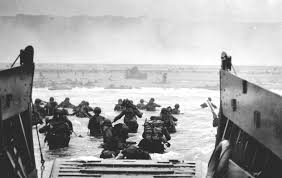
The Day

Under overcast skies and through high seas, Allied forces crossed the English Channel and landed on the Normandy coast 65 years ago today to free Western Europe from German occupation. It may have been the single most important day of the 20th Century.

President Obama visited the site of the invasion today and paid tribute to the American military personnel who, along with soldiers from Britain and Canada, established beachheads on D-Day and moved across France toward Berlin.

Monday, January 12, 2009

An eight-year nightmare

President Bush, in his final press conference, said today that Iraq "not having weapons of mass destruction was a big disappointment." Imagine feeling let down because a brutal maniac like Saddam Hussein did not possess weaponry that could have been used to commit mass murder.

If he had half a brain and any humility, Bush would have said that his decision to launch an invasion of Iraq -- based on intelligence that was shoddy and trumped up by his own administration -- ranks as a disappointing episode in his presidency, an eight-year reign that certainly has no shortage of disappointments, outrages and other low points.

One week from tomorrow Barack Obama will speak the words that usher out this regrettable and damaging era in American history. Looking through the litany of wrongheaded and failed policies -- as well as watching the evening news -- leaves me shaking my head. How could my countrymen (and women) have elected this guy? (Twice!)

Here is just some of what we witnessed during Bush's two terms:
*The 9/11 terrorist attacks (Say what you will, but the August 6, 2001, intelligence brief, if nothing else, should have inspired a more vigorous response.)
*The illegal and poorly conceived invasion and occupation of Iraq
*The woeful response to Hurricane Katrina
*Tax cuts that benefit the wealthy and bankrupt the treasury
*A denial of fact and science that negatively affected public policy from sex ed to climate change
*A complete politicization of the rank-and-file legal professionals at the Justice Department
*Weak and incompetent oversight and regulation in areas from imported toys to the financial industry

Who knows how Obama's presidency will turn out, but I am thankful that Americans rose to the occasion and chose the smarter, more forward-looking candidate. Still, I have a hard time forgiving those who voted for Bush in either 2000 or 2004 for what they did to my country.

Friday, December 19, 2008

Obama so far

One month from tomorrow, at high noon, Barack Obama will repeat the 35-word oath of office, which is prescribed specifically in the Constitution, on the steps of the US Capitol. He will likely tack on the postscript of "So help me God," as has been the practice of all recent presidents. In the weeks since Election Day, the president-elect has overseen an extremely orderly transition, taking the podium almost daily to name top appointments and to take questions from the media. It is all somewhat reassuring. Meanwhile, the nation's economic condition slides into even deeper distress and the current chief executive's only newsworthy action in the past six months was to duck from a flying piece of footwear flung furiously in his direction.

Obama's picks have disappointed some on the left, and I do long for a dream team of progressives taking over the controls of our government's mammoth bureaucracies. I am, however, inclined at this stage to sit back and give wide berth to the incoming president. He is, as most have acknowledged, a pretty bright guy, and he does operate -- as evidenced by the campaign and the transition -- in a smartly-conceived and well-executed manner. He gets to select who surrounds him, and by all accounts he's selected an exceptionally qualified and able group. If they aren't liberal enough on face, then I expect that they will be carrying out the policies of this president, and therefore will generally do the right thing.

But, of course, it has been clear all along that Obama does have many centrist, bridge-building tendencies. Those of us on the left will, I suspect, find ourselves in disagreement with the new administration from time to time. There will be attempts to find common ground rather than ramming through Democratic party ideas just because our party's nominee won the top spot. It's a bit frustrating because the Republicans, especially under George W. Bush, have done (and are still doing in last-minute executive orders) exactly that. Again and again, they talk bipartisanship and then lunge to the right. I take Obama at his word when he says he wants to change that culture.

The most extreme example may be the revelation that Rick Warren will be delivering the invocation at the inauguration. The minister of America's most well-known megachurch (Saddleback in Orange County, Calif.) and the author of the bestselling book"The Purpose-Driven Life," Warren is the new face of evangelical Christianity. Less outwardly prim and proper, he has been a key part of a movement that has focused on some good things in recent years, like working against poverty and hunger in Africa or embracing environmentalism. Still, in many ways, the new boss is the same as the old boss: homosexuality is seen as sinful; atheists are evil; etc.

Warren is a maddening choice for many who voted Democratic in November, and still it may be a brilliant selection in other ways. Obama has made the usual claim of being president of all Americans, not just those who voted for him; maybe this is one way to demonstrate that. He is also showing quite clearly that he will not hesitate to anger his base when he wants to. He is repaying Warren for inviting him to the Saddleback Forum, the pre-election interviews that Warren did with Obama and John McCain at the church in August (where McCain gave brief talking-point answers that he knew the crowd would applaud and Obama gave longer, more intelligent, nuanced responses that sometimes flew in the face of what the audience wanted to hear).

Finally, there is the "Team of Rivals" strategy, as discussed in the Doris Kearns Goodwin book as it relates to Abraham Lincoln. In other settings, with slight tweaks, it might be understood as the "Keep your friends close and your enemies closer" strategy. Obama wants to accomplish important things, and after the first 100 days -- maybe more, maybe less -- the novelty, the honeymoon and the perception of a mandate will all wear off and the broad support of the public will be necessary to overcome the usual gridlock, partisanship and the lack of a filibuster-proof Senate.

A year down the road the 44th president might turn to the two Republicans in his cabinet (Robert Gates and Ray LaHood) or to the senator whose committee chairmanship he saved (Joe Lieberman) or to his former Democratic opponent turned cabinet member (Hillary Clinton) or, even, to the leader of one of the largest evangelical congregations in the country. Each of them, to varying degrees, will feel some obligation to jump on board with the president.

Is Obama thinking that far ahead? Is he really that smart? I think he is.