Showing posts with label heroes. Show all posts

Wednesday, February 16, 2011

Eastie in the news

***An article on The Daily Beast web site talks about the role of East Boston resident Gene Sharp in the recent overthrow of Egypt's prime minister, as well as other non-violent revolutions. Sharp runs the Albert Einstein Institute out of his house in the neighborhood, and his books and pamphlets are read and passed around throughout the world. Update: BBC online also profiles Gene Sharp.


***The Boston Preservation Alliance released a report on places in East Boston that are historically notable and should be preserved, including the First Presbyterian Church on London Street and the Temple Ohabei Shalom Chapel on Wordsworth Street.

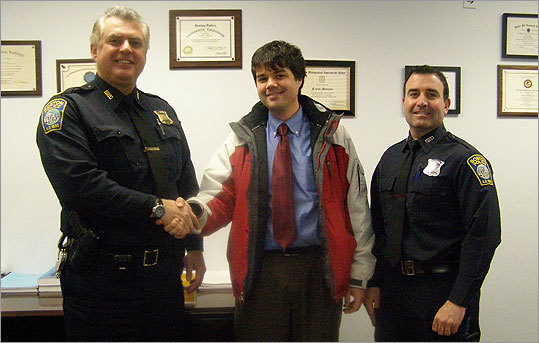
***Boston.com notes that the Boston Police of Station 7 in East Boston have been recognized for their work fighting underage tobacco use.

***Ryan Lee, the Eastie resident who found a bag of money and returned it to the rightful owner, was honored today by the Boston City Council.

Photo of  the Temple Ohabei Shalom Chapel courtesy of Wikipedia.

Friday, February 11, 2011

Doing the right thing

What would you do if you found a bag of money by the side of the road? Ryan Lee of East Boston picked it up and brought it to the police station, where it was then returned to the rightful owner. Lee was all over the TV last night and today there's a Globe story on his choice to do the right thing.

The bag contained $2,500 that belonged to the owner of the Shell gas station on Meridian Street, across from Station 7 and not far from where the money was found. Mayor Menino has proclaimed today Ryan Lee Day.

Lee, 32, is from Maine, and he met his wife while in the Peace Corps. He's currently working for Project Bread, recruiting people to take part in the Walk for Hunger. The news is filled with people every day who do the wrong thing, but there are many more who do the right thing. Let us all remember that as we go forward today. You may not find a bag of money in your travels, but you will certainly discover a moment where a small action on your part -- mine, too -- will make the world a better place.

Photo courtesy of Boston.com.

Thursday, January 27, 2011

Time's winged chariot rolls on

Jan. 31 will mark one year since our friend Wally Bowe passed away. Wally was one of the good guys, and everyone who knew him still feels the pain of his absence. There will be a Mass in his memory this Sunday at 10 a.m. at Sacred Heart Church in East Boston.

Wednesday, December 8, 2010

It was 30 years ago today...

At Savio High School I wrote my senior thesis on The Beatles and their influence on culture and society. I got an A. I'd been a fan of the group since freshman year -- so much so that on the day after John Lennon was shot there were students who offered condolences to me.

Like many artists and celebrities who die young, Lennon is not encumbered by widespread images of his "fat phase" or sad commercials for life insurance. He'll always be the rebel -- including his surprising choice to ditch fame to be a homebody dad.

Thirty years have passed since a madman murdered Lennon and we've all gotten that much older. I'm not longer the high school kid who has the records and the bootlegs and who knows the release dates and other arcane information. I'm just sitting here watching the wheels go round and round...

Saturday, November 13, 2010

Walk on

I first learned about Aung San Suu Kyi when U2's album All That You Can't Leave Behind included a song, "Walk On," that was about her. The courage and tenacity she's shown in the face of Burma's military dictatorship has gone above and beyond what most of us could bear, and she has spent 15 of the last 21 years under house arrest for leading the pro-democracy movement in her country.

Today Aung San Suu Kyi was set free, but that is just the first step toward freedom for the people of Burma. Her life is likely in danger and she could be imprisoned again, but she has never backed down and has said that she will resume her political activities. Though she is but one of many people around the world oppressed and imprisoned for expressing their political views, she is a symbol of the struggle against governments that would silence their citizens. Tonight we remember their struggles and admire their strength and selflessness.

Sunday, October 17, 2010

Why we still need newspapers

***The Globe has a wrenching article about the night five months ago that two men jumped into the Charles River from the Mass Ave. bridge:
Put yourself in this horror for a minute. Despite your best efforts, your closest friend has just jumped off a bridge, right before your eyes. What do you do? Call 911? Scream into the night for help? Collapse in a heap of despair?
Vilgrain Richemond, a 27-year-old father of two, chose a different option: He jumped in to try to save his friend. The Globe's Neil Swidey tells the harrowing story.

***Today's Globe also has the first of two parts on improvements to athletic programs in the Boston schools, a response to a Globe series last year that chronicled the woes of athletics programming in the city's public school system.

***Eastie freelance writer Steve Holt has a piece on being married in his 20s in today's Globe. Steve and his wife are also in the process of adopting.

Sunday, August 29, 2010

The song remains the same

I didn't listen to anything Sarah Palin or Glenn Beck said yesterday. Their lying and idiocy make me angry, which is not good for my blood pressure. I did note the choice of day and venue and instead watched, again, video of Martin Luther King's "I have a dream..." speech. One can see why it was chosen by scholars as the greatest American speech of the 20th century. Both the writing and delivery are exceptional, with concepts and metaphors ground in and taken from the Bible, the Declaration of Independence and the Constitution, and the power and rhythm of a Baptist sermon adding to the words' strength.

Well, back to yesterday. Those who claim that they "want their country back" are forgetting -- or ignoring -- a couple of things. First, Barack Obama was elected by clear margins whether using the Electoral College (+192), popular vote (+10 million) or percent (+7). This leads to point #2: The country struggled through eight years of leadership (?) by a man whose party stole the election right before our eyes and then he proceeded to drag the country into ruin. Where were these so-called "patriots" then?

Those who gravitate toward the Tea Party movement -- and what a misnomer...Samuel Adams is rolling in his grave -- don't seem to recognize how they are being played by the same old forces: the wealthy. The New Yorker has a piece on the billionaire Koch brothers, who have spent millions -- including backing the "anti-corporate" Tea Party -- fighting Obama's policies for the usual reasons: they want to be even richer. The outline of history never changes. The rich keep the rest of us fighting amongst ourselves so we don't unite against them. Same old song and dance, my friends.

Monday, June 7, 2010

Doubting Thomas silenced

Helen Thomas is a giant in the field of journalism -- a groundbreaking woman and a thorn in the side of those in power for five decades. Thomas, who will be 90 years old this summer, was forced to retire today after insensitive remarks about the Middle East. Her legacy is much bigger than this last misstep, and tonight -- without Thomas sitting in the front row of the White House press room -- our democracy is that much weaker.

Photo from OpEdNews.com.

Saturday, May 29, 2010

Eastie update

***Two people died and two others were injured in an overnight fire at 64 Gove Street, which caused an estimated $250,000 in damage. The fire broke out before 3 a.m. and is still under investigation. The fatalities are the first fire-related deaths in the city in 17 months. Photo courtesy of The Boston Herald.

***The East Boston Times reports that State Sen. Anthony Petruccelli managed to acquire the remaining funds necessary to complete the study by the state's Department of Public Health on the effects that Logan Airport has on local residents. According to the legislation added to the state budget by the Eastie senator, Massport will pay the final $195,000 to complete the $1.3 million study into the consequences of breathing in jet fuel exhaust and other pollutants. The Times story points out a conclusion reached by WBZ-TV two years ago when parts of the unfinished study were leaked: "Lung cancer rates are higher the closer you get to the airport."

***Firefighter and Eastie resident Danny Gomes acted heroically earlier this month when he treated a stab victim, summoned emergency responders and helped catch the perpetrator -- while at the same time making sure not to lose his dog and the Mother's Day flowers he'd just purchased. Talk about multitasking. I'm reminded of the Seinfeld episode where Kramer takes over driving for an incapacitated bus driver while at the same time fighting off a violent passenger -- all the while making the stops on the bus route.

***The new Santarpio's location, on Route 1 in Peabody, is a bit behind schedule and now expected to open in July. It was good to see the venerable pizza mecca and the City of Boston come together to tidy up the long-time parking area beneath the highway across from the Porter Street side of the restaurant.

***With the economy beginning to recover, expect to see several development projects move forward again. One of the most exciting would seem to be a new branch library that would be modern and have more space than the two current branches combined. Right now the city is attempting to find the best location for the new facility.

***Tickets are currently on sale for the June 24 Salesian Boys & Girls Club breakfast at Suffolk Downs, which will honor the late Wally Bowe. Information available here at EastBoston.com.

Sunday, February 7, 2010

A way to remember

In the week since the sudden passing of my friend Wally Bowe, a number of people have suggested ways to memorialize him. The one that seems the most logical and doable -- and that is gaining momentum quickly -- is renaming Bremen Street Park in his honor. This tribute would make sense for these reasons:

*The park is not currently named after anyone.

*The park grounds and the YMCA located there are utilized by large numbers of children and teenagers -- the same groups that Wally spent more than three decades working with.

*The park is just one block from the house where Wally lived for years and isn't much farther from the Boys & Girls Club site, where he was a positive influence on the lives of hundreds of young people.

Massport owns the park property, but I'm guessing they'd go along with recommendations from the City of Boston, and Wally is certainly extremely deserving of this honor. I'm open to listening to other suggestions, but right now this seems like a no-brainer. There is a Facebook group in support of the idea, and if you agree you should join it.

Thursday, February 4, 2010

Eulogy for Wally Bowe

Delivered by Jim Correale
at Sacred Heart Church on February 4, 2010

Wally Bowe was my friend, my colleague and my mentor. We grew up a few doors apart just two blocks from here, and we worked together at the Salesian Boys & Girls Club and later at Savio High School. There was a stretch of time -- from the day in 1975, when I first signed up as a member of the Boys Club, to June of 2001, when I finished my first stint teaching at Savio -- when I saw Wally almost every day. In those 26 years I saw up close what a remarkable, caring and dedicated person he was. I also saw how tough, smart and incredibly funny he was. I watched and I learned.

Wally understood people at some deep psychological level that is imperceptible to most. He was an unfailing judge of character, and he could relate to just about anyone. He was confident enough in himself that he didn’t need to treat others with anything less than genuine decency. He was exceptionally humble. He had no desire to be publicly recognized or to be in the spotlight. He was happy if those who he respected understood his work and his value and respected him in return.

Wally handled discipline with children and teenagers better than anyone else I ever worked with or saw. He was the absolute and unquestioned law in any room he was in or at any event he attended. The toughest kids wouldn’t tangle with Wally because they knew that he was tougher. He was big and he was strong, and just a few sharp words or even just that intense stare – eyes narrowed and mouth in a tight, disapproving grimace -- would quickly grab the attention of an individual who might be up to a little mischief or even an entire classroom.

But behind that tough exterior was a gentle and thoughtful man. Wally was upbeat and encouraging to those teenagers who were making an effort to get back on track after being in some kind of trouble. He never gave up on someone willing to try. You knew that he was in your corner if you lived up to his expectations. And if you were a quiet kid or not very athletic or lacking a bit in self-confidence -- well, then Wally was in your corner, too. He attempted to engage every club member or every student with a few kind words or a joke or even the creation of a nickname -- and some of those have stuck permanently.

Wally was hands down the best coach I’ve ever seen. He could coach anything -- basketball, floor hockey, flag football … even soccer. What did he know about soccer? Not a thing. One team tries to kick the ball into the other team’s net. That’s it. But after a particularly undisciplined season, Savio put Wally at the helm of the boys’ varsity soccer team -- and they went to state tournament. He knew that coaching is much more than X’s and O’s. He was an absolute master at motivating young athletes, with an ability to reignite their passion for every game … even every practice. You were never sure what strategy he’d employ, but he was ready with an approach and a few words that brought the most out of his athletes.

Wally was also, of course, a fierce competitor. I played against him enough to know, and I usually came out on the losing end. He was an incredibly smart athlete, especially on the basketball court. I played for many years with a bunch of guys on Sunday night at Savio and more recently Sunday morning, and everyone wanted Wally on their team. I watched as he dominated entire games without taking a shot, controlling the flow of action with his passing or rebounding.

Wally was the most genuine person I’ve ever known. He was straightforward with everyone. He said what he thought, and he did what he thought was right. Wally was as dependable as anyone I’ve ever known. One time I had a flat tire on Route 1, I called Wally. Whenever I needed help moving, I called Wally. He was also as loyal as anyone I’ve ever known. He would do anything for people he knew, whether close friends or casual acquaintances. He was also loyal to this neighborhood. Sure, he lived his early childhood years in Michigan and later he, Darlene, Janae and Jillian moved to Saugus, but his heart never left East Boston. And everyone in Eastie knew him. You couldn’t take a drive with him in this neighborhood without people waving him over; you couldn’t sit down to eat somewhere in East Boston without someone stopping at the table every few minutes to greet him.

Of course, Wally’s life was dedicated to the young people of this community. For more than three decades he worked with the children and teenagers of East Boston -- first at the Boys & Girls Club, then at Savio and, most recently, at the Umana Middle School. Hundreds and hundreds of people were deeply affected by his guidance, his advice, his encouragement, his compassion, his kindness, his enthusiasm, his support, his unwavering belief in the ability of each to be a good person and to find success on whatever path he or she chose. He knew the impact that his life had on those around him. He understood that he was planting seeds that in some cases wouldn’t blossom for years.

Now, in the past few days, anyone who may have been unaware of what Wally means to East Boston has started to understand. Those who’ve seen the Facebook page dedicated to him have witnessed an outpouring of affection that surpassed even what those of us who knew him well expected. More than one thousand people joined the online group within 36 hours. Dozens and dozens of comments mourned, praised and remembered. Some said they were about to drop out of high school until Wally pulled them aside and, with a few words, set them back on course. Others mentioned his presence during difficult moments in their lives. Still others admitted that that they were not easy to deal with as teenagers, and that Wally stayed on top of them and that now, as adults, they are able to appreciate all he did.

Last night, of course, there was an incredible turnout at the wake. People waited in line in the cold for as long as two hours because they just had to pay their respects. From his family members to his childhood friends, from past Boys & Girls Club members who may not have seen Wally in 20 years to the students he worked with more recently at Savio and the Umana – they cried and laughed as they talked about the impact that one man had on so many of us.

The last time I saw Wally was -- no surprise -- at Santarpio’s a couple weeks ago. I walked in with some friends and, as happened frequently there, a waiter said to me, “Hey, you know Wally’s back there.” He came over to sit with us and, as usual, he and I prepared for an exchange of insults. “Big Wall,” I said, my usual greeting, and he smiled back, “Big Jim.” And then one of us would begin. I might say, “How many pizzas did you eat? What … did they run out of dough?” He’d fire back without missing a beat: “Actually, they asked us to leave when you walked in because the weight limit is maxed out.” We could go on like that for quite a while. In addition to all his other admirable qualities, Wally was often hilarious.

Back in the spring of 2007, when Savio High School was shutting down for good, Wally’s presence was probably the key factor in keeping order down the stretch. As the year wound to a close, all of the faculty members were busy trying to find jobs for the next school year. One of my colleagues at the time, Tim Ferrari, said to all of us, “Wherever I go, I want there to be a Wally Bowe there.” I think Timmy got it exactly right.

Monday, February 1, 2010

R.I.P.: Wally Bowe

WALTER ANTHONY BOWE
1957 - 2010

Wake
Wednesday, 3 to 8 p.m.
Rapino's, Maverick Square

Funeral
Thursday, 11 a.m.
Sacred Heart Church


Online notice

In lieu of flowers,
donations in Wally’s memory may be made to:

Jillian Bowe Educational Fund
c/o East Boston Savings Bank
320 Central Street
Saugus, MA 01906


Friday, July 31, 2009

Flesh and blood

We hoped that Big Papi was different, but in the end we really can't be surprised by the news that Red Sox slugger David Ortiz is among those who tested positive for performance-enhancing drugs back in 2003. His on-field heroics and amiable personality made Ortiz a Sox favorite since his acquisition and the long-suffering team's subsequent World Series wins in 2004 and 2007.

Former teammate Manny Ramirez was also implicated yesterday, but that news seems to go without saying after the hero-turned-traitor was suspended from the LA Dodgers for 50 games earlier this season for violating rules on anti-doping that didn't exist a half-dozen years ago.

Of course, the truth is that our heroes all have flaws, and if we are slow to realize that, reality will inform us sooner rather than later. No matter how talented, how intelligent, how apparently good, no one is able to do the right thing all the time. No one has the capacity, the will or the strength to always behave in ways that are beyond reproach. At times like this I throw out an oft-used, but powerful fact nonetheless: Thomas Jefferson had slaves. The guy is a hero of mine, but one can find quite a bit in his life to be disappointed about. He was a rather sneaky, dirty politician, and -- yeah -- despite his lofty words about freedom he personally owned dozens of people.

And this takes us to another issue, of less universal import and involving less human misery: in baseball the heroes end up in Cooperstown, but a list of those inducted into the Hall of Fame will include characters that represent a cross-section of the society that they came from. A New York Times review of a book on Cooperstown that was just published says, "The hall is full of gamblers, brawlers and defendants in paternity suits, and there are numerous drunks..." To top the list there is Ty Cobb -- undoubtedly one of the game's greatest players, but also "a sociopath, possibly a murderer and a notorious racist who was also a card-carrying, torch-waving member of the Ku Klux Klan" (and he isn't even the only Klan member enshrined!).

So how do we evaluate modern players and their worthiness for the Hall of Fame against this background? Pete Rose, who undoubtedly has the statistics to be in, is banned (by the Hall itself) from even being voted on (by the sportswriters who cast the annual ballots) because of his troubles with gambling during and after his on-field career. (Is that worse than Cobb?) Now we have a whole roster of athletes who have created the headlines of the last two decades -- McGwire, Sosa, Bonds, A-Rod, Clemens, Manny, etc. -- all under the dark cloud of substance abuse. Should the entire era be tainted? Should we accept that each period had its anomalies and cheaters and just go by the numbers? Will the writers even get to consider each of these guys, or will some of the names be stricken from the ballot, a la Rose? Does a place like the Hall of Fame have any meaning if Cobb is in, Rose is out and Bonds is on the fence?

Last Saturday two more players had their plaques added to the sacred space of the enshrined. Rickey Henderson, an amazing player and a character himself, was elected in his first go-round. (Players generally must be retired for five years before their name appears on the list that the writers vote on. A player needs to be chosen on 75% of the ballots to get in. After 15 years names are dropped from the list, but there is a Veterans Committee who can induct anyone they please.)

Jim Rice, who played 16 seasons for the Red Sox, was finally given the nod. Retired from the game since 1989, Rice's credentials have been hotly debated since, and he barely made the cut -- 76.4% of the voters selected him in his final year of eligibility. He was a formidable hitter, a good (not great) left fielder and was, by all accounts, not very friendly with the media while a player. His 1978 MVP season is one of the greatest ever put together by anyone.

Rice was dogged a bit by the feeling that his post-season performance was sub-par, but the Sox only made the playoffs twice during his career (1986 and 1988) and in the '86 World Series he batted .333, which is good. I do remember one of my uncles always railing about Rice not producing in the clutch, the rants filled with racial epithets as we sat outside in my aunt's yard grilling every summer Sunday.

Today, Rice is a broadcaster at NESN, though I don't think he's that good. I feel like the same discomfort that kept him from talking to the media a great deal as a player keeps him from feeling completely confident even though he is on the other side of the microphone. He never learned to, or even set out to, master and manipulate the press like Larry Bird did so skillfully. But Rice, I believe, is a very decent guy. His name has never come up in relation to any of the embarrassing episodes (gambling, infidelity, drunkenness, drugs) that pop up every so often in the game, as elsewhere. He's always been involved in a number of charity activities. And then there is the memorable episode when Rice carried an injured boy inside the Sox clubhouse for medical care.

Jonathan Keane was four years old on Aug. 7, 1982, when he was struck in the head by a foul ball that rocketed into the seats along Fenway Park's first base line, next to the home dugout. Immediately he was covered in blood, his skull fractured. Rice had been standing on the top step of the dugout and without hesitation he ran over, picked up the child (see the Boston Herald photo above) and brought him into the Sox clubhouse, where the team doctor met the pair. In minutes the boy was on his way to Children's Hospital. Keane credits Rice with saving his life. He doesn't remember the incident, but he has no lasting effects from it.

Rice didn't do anything superhuman that day. He was overcome by the same feelings that most other people would have felt, but he also didn't hesitate to act. Many who know Rice say that the incident speaks to the man's character -- one that probably puts him head and shoulders above many who were allowed to take their seats in Cooperstown much more easily.

Tuesday, February 17, 2009

Teachers to the rescue

The quick actions of two local teachers may have saved the life of a six-year-old girl last week. Bobby Casaletto and Kathy Carabine, faculty members at East Boston Central Catholic School, performed CPR when the student collapsed Friday at school.

I've known Casaletto since he was not much older than the child he helped save, and he is one of the most upstanding, hard-working, energetic and dedicated people I've ever met. We were on the staff at the Salesian Boys & Girls Club together back in the 1990s, and Bobby has been a teacher at EBCCS, my alma mater, for many years.

The girl has some previously unknown heart ailment, and the latest reports have her in fair condition.

Sunday, March 23, 2008

In the news

*The Globe has a piece today saying that the casino proposal was always a tough sell in East Boston.

*The sagging economy hasn't slowed growth along Route 1 in Saugus. A Globe article lists new development projects and businesses that'll soon be popping up on the venerable stretch of highway, including Trader Joe's, which would be cool.

*Our friends at EastBoston.com have a story on East Boston resident Anthony Fiorino, recently honored for his 50 years of service to the city's Emergency Medical Services department.

Sunday, January 13, 2008

Casting history

Today's Globe has a nice little story on the Donald McKay bust that is a centerpiece of Bremen Street Park, with some discussion of McKay's significance in the development of East Boston and the art of shipbuilding. (I mentioned the bronze statue on this blog back in June, and the photo here is one I took that day.)

As we admire the bust of McKay, let us not forget whose hands and sweat actually built his ships: workers -- many of them immigrants -- whose names we will never know and whose likenesses we will never look upon. I am reminded of the poem "A Worker Reads History" by the German writer Bertolt Brecht:
Who built the seven gates of Thebes?
The books are filled with names of kings.
Was it the kings who hauled the craggy blocks of stone?
And Babylon, so many times destroyed.
Who built the city up each time? In which of Lima's houses,
That city glittering with gold, lived those who built it?
In the evening when the Chinese wall was finished
Where did the masons go? Imperial Rome
Is full of arcs of triumph. Who reared them up? Over whom
Did the Caesars triumph? Byzantium lives in song.
Were all her dwellings palaces? And even in Atlantis of the legend
The night the seas rushed in,
The drowning men still bellowed for their slaves.

Young Alexander conquered India.
He alone?
Caesar beat the Gauls.
Was there not even a cook in his army?
Phillip of Spain wept as his fleet
was sunk and destroyed. Were there no other tears?
Frederick the Greek triumphed in the Seven Years War.
Who triumphed with him?

Each page a victory
At whose expense the victory ball?
Every ten years a great man,
Who paid the piper?

So many particulars.
So many questions.

Sunday, November 25, 2007

Thursday, November 22, 2007

Finally coming home

It was 57 years ago this week that an East Boston family received a telegram from the US Army that said Sgt. Agostino DiRienzo was missing in action while fighting in Korea. Later, the status of the 33-year-old was amended to "presumed killed in action," as his unit had been attacked by Chinese forces along the Nammyon River on Nov. 1, 1950.

The Boston Herald reports that a joint North Korean-US operation and forensic investigation has revealed that DiRienzo's remains have been found, and his nephew, East Boston resident Richard Faiella, remembers his uncle in the story.

Sunday, October 7, 2007

Eastie's field of dreams

Joanna Alfano lives in Melrose, but grew up in East Boston in the 1950s, where she knew a boy named Anthony Conigliaro. In a sweet, sad column published today in the newspapers of the GateHouse Media, Alfano looks back at a moment in time when she was "one of the giggly little girls" who watched Little League games at Noyes Park. A young Tony C. -- who went on to Red Sox fame and then, just as quickly, tragedy -- even hit a homer for her and her friends one night.

I don't know who J.H.L. Noyes is -- maybe a war hero or some other deserving person -- so I am hesitant to suggest changing the name of the park, but can we name the diamond there Conigliaro Field? (Unless we already have and I am unaware ... maybe someone can educate me on this.)

Monday, August 20, 2007

Bushwacked beyond belief

Just before the South Carolina Republican primary in 2000, John McCain and George W. Bush were being interviewed by Larry King on CNN. McCain had won a 19-point victory over Bush in the New Hampshire primary the week before and if the Arizona senator could take South Carolina, the race would likely be over. Not so fast. Bush’s people, led by Karl Rove, unleashed viscous attacks on McCain, with phone calls, flyers, leaks to the media and other “whisper campaign” tactics that said that the Vietnam War hero, who spent more than five years in captivity in Hanoi, was a traitor who gave information to his captors and was a spy for the Soviets, that his time as a POW had broken him psychologically, that he was gay, that his wife was a drug addict and that he fathered a mixed-race child out of wedlock.

When McCain brought up Bush’s dirty campaign in the Larry King interview, Bush responded that he had nothing to do with it and that he didn’t appreciate McCain impugning his character. Then came the moment when, I believe, McCain lost the election. He should have, at that instant, fired back with fury in defense of his reputation and in the face of Bush’s lies. (People like that. Remember Ronald Reagan saying, "I paid for that microphone," at one of the debates.) Instead, McCain laughed nervously, allowing Bush to appear to be the candidate sticking up for his good name. Soon after, McCain lost South Carolina and his race was over.

I was thinking of McCain because he was on The Daily Show with Jon Stewart last week. It was his tenth appearance on the program and, just like the other times I’ve seen him on there, he was funny and straightforward, clearly not reading from talking points, not on guard to avoid saying something he’d regret. I don’t agree with McCain on most issues, especially the invasion of Iraq. However, he does seem to be more honest than most politicians, speaking more from his gut. Personally, he seems like a good guy, and when reading the story of his military service you can’t help but see that he is a hero. You also can’t help but feel disillusioned by the fact that the Republicans nominated Bush instead of him, and that the Administration failed to listen to him on the issue of torture, which he knows about first hand.

A US Navy pilot, McCain was almost killed in the summer of 1967 when an accidentally-fired rocket hit the fighter plane he was preparing to launch from the deck of an aircraft carrier. McCain jumped off the aircraft onto the burning deck of the ship seconds before ordnance on the plane exploded, killing 132. Three months later, McCain was shot down over enemy territory, breaking both arms and a leg. An angry mob then crowded around, kicking him and spitting on him.

At the infamous “Hanoi Hilton” prison McCain was interrogated, beaten and tortured daily, but when it was discovered that his father was the admiral in charge of all American military personnel in Vietnam, McCain was offered the chance to be released. He refused special treatment, telling his captors that he would not go unless every man taken prisoner before him was set free as well. Instead of being held for months, McCain was a POW for more than five years. As a result of his torture he cannot lift his arms over his head. He was finally released in 1973 (see photo of President Nixon greeting McCain as he returned to the US) and retired from the military in 1981, having received a Silver Star, a Bronze Star, the Legion of Merit, the Purple Heart and a Distinguished Flying Cross.

Where was George W. Bush while McCain refused preferential treatment and was tortured instead? He was receiving preferential treatment in the Texas Air National Guard, forgetting to show up and getting soused instead. It’s a travesty, made all the more depressing by Bush’s enthusiasm for heading blindly into war in Iraq and then compiled by his supporters twisting and ridiculing the military record of another war hero, John Kerry -- a guy who was not drafted but signed up out of a sense of duty, served nobly and then came back and spoke honestly, publicly and intelligently about the American effort in Vietnam.

And, by the way, that mixed-race child that South Carolina voters were warned about? It's a girl that McCain and his wife adopted from an orphanage in Bangladesh that was founded by Mother Theresa.