Showing posts with label poverty. Show all posts

Sunday, August 9, 2009

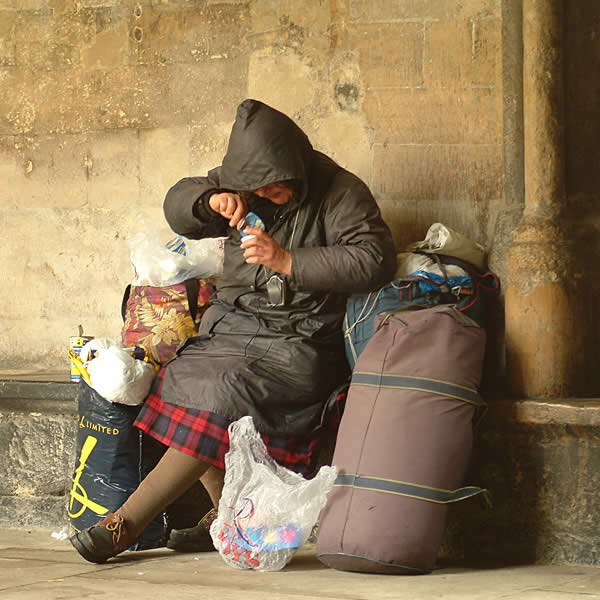
Criminalizing poverty

Barbara Ehrenreich -- author of 20 books, including the bestseller "Nickel and Dimed: On (Not) Getting By In America" -- has a piece in The New York Times today on the criminalization of poverty. She writes:
The pattern is to curtail financing for services that might help the poor while ramping up law enforcement: starve school and public transportation budgets, then make truancy illegal. Shut down public housing, then make it a crime to be homeless. Be sure to harass street vendors when there are few other opportunities for employment. The experience of the poor, and especially poor minorities, comes to resemble that of a rat in a cage scrambling to avoid erratically administered electric shocks.
Despite much public rhetoric to the contrary, class is a large and often determining factor in many aspects of American life. Not only are the poor politically powerless, but they are vilified as being lazy, shiftless and stupid. Though frequently the subject of anecdotes that conclude they are scamming the system, most people on the bottom of the economic ladder are desperate to free themselves from their circumstances. When, as a child, I was sent to the corner store with food stamps I felt humiliated by the experience, keeping the paper coupons hidden in my pocket and only approaching the counter when I thought the fewest people would see me.

There's a famous quotation from French Nobel Prize winner Anatole France:
The law, in its majestic equality, forbids rich and poor alike to sleep under bridges, to beg in the streets, and to steal their bread.
The statement is, of course, ironic, but amazingly the Ehrenreich story points out that an American local public official, recently and without irony, said, “If you’re lying on a sidewalk, whether you’re homeless or a millionaire, you’re in violation of the ordinance.”

Monday, May 4, 2009

Walk on

More than 40,000 people took part in this year's Walk for Hunger, and I was one of them. The weather was close to optimal for much of the morning and early afternoon; last year's walk started in the rain. This year's event raised about $4 million for food pantries across the state.

Though I completed the 20-mile walk twice in the early 1990s, I fell short last year and this year -- the gut is a bit bigger and the muscles get sore a bit quicker. Those of us over 40 know how that goes. This time I hopped -- OK, limped -- onto a bus at around Mile 14. Wait 'til next year.

Monday, February 23, 2009

Lending a hand

Once a week, students from Boston University's schools of medicine, dentistry, public health and social work come to East Boston, along with a doctor, to provide medical services to some of the neighborhood's homeless and indigent. There's an article about the program, which has been in place for a dozen years, posted today on BU's web site.

Thursday, October 16, 2008

Hub of the Hub

Did you know that one of the world's leading political activists works out of his home here in East Boston? Or that a foreign country has its local consulate in this neighborhood? I recently started taking note of some of the regional, national and even international organizations located in Eastie and here is what I found:

*The Albert Einstein Institution, led by Dr. Gene Sharp, advises political movements around the world from his office in Eastie. The mailing address for the organization is AEI, P.O. Box 455, East Boston, MA, 02128.

*The El Salvadoran Consulate for New England is located at 143 Border Street.

*Project Bread, the group that organizes the annual Walk for Hunger, has its headquarters at 145 Border Street.

*Hip hop record label Amalgam Digital operates out of 2 Neptune Road.

*The New England Gallery of Latin American Art opened last year at 184 Cottage Street.

*The Militant Labor Forum Hall hosts speakers and films on workers' issues and human rights on the second floor at 13 Bennington Street.

Those of us who live here, of course, have always known that Eastie is the center of the world.

Sunday, July 13, 2008

A nation's shame

A New York Times editorial today is titled “The Shame of Postville, Iowa,” but it's about an issue that has become the shame of our nation. The federal government has stepped up raids of undocumented immigrants and charged them unfairly with crimes that lead to jail time as opposed to deportation. The accused almost always come to America to work so they can feed their families and now we are putting them behind bars, an outcome that does no good for anyone.

The Times editorial makes reference to an essay by a translator who worked on a case involving the arrest of 390 workers in May at a Postville, Iowa, meat processing plant owned by Agriprocessors, Inc. The workers were charged with identity theft, but as the editorial points out, “there is a profound difference between stealing people’s identities to rob them of money and property, and using false papers to merely get a job.”

Further, most of the workers just filled out the papers they were presented with when they showed up to work, so many had no idea what they were doing, and -- in a twist that I hadn’t considered before, but which is something that puts the entire immigration saga in context -- many of those arrested not only couldn’t speak English, but they were illiterate in Spanish. The essay points out that most of the workers were from Guatemala, but were part of local indigenous tribes. In other words, these are Native Americans, whose ancestors were conquered by the Spanish and who have been pushed to the margins in those societies, and when they come to the only place where they can find work to feed their children they are thrown in jail by another country founded on the trampled lands of native peoples.

Unsure of what was happening around them, most of the immigrants accepted the “deal” that was worked out on their behalf -- five months in prison and then deportation -- because pleading innocent would have likely led to more jail time and they need to get back home as soon as possible. Meanwhile, their children remain unfed, our tax dollars pay to house and feed the prisoners, and the flow of people crossing the border looking for work does not slow in the least. The background for all of this is that American economic and foreign policy has often led to widening poverty for our neighbors to the south. We are culpable for some of the reasons that people migrate here for work, we benefit from their willingness to work at dirty, tough jobs for low wages, and then we arrest, jail and deport them.

The interpreter, Dr. Erik Camayd-Freixas of Florida International University, said that nearly everyone involved in the proceedings -- the clerks, the guards, the judges -- felt that this was an awful miscarriage of justice and an inhumane undertaking, but everyone’s hands were tied by federal laws and the policies of the Bush Administration. Of course, Agriprocessors -- a giant corporation that has recently been guilty of violating child labor, environmental and animal cruelty laws -- will get off with a fine and none of the company’s management will be held otherwise accountable for breaking laws on the employment of undocumented workers.

One of those workers, a Guatemalan peasant, said that he reached the US after walking “for a month and ten days until I crossed the river.” The essay goes on to say that the man “crossed alone, met other immigrants, and hitched a truck ride to Dallas, then Postville, where he heard there was sure work. He slept in an apartment hallway with other immigrants until employed. He had scarcely been working a couple of months when he was arrested.” Imagine walking 40 days, Most Americans, me included, don’t walk 40 seconds if we don’t have to.

Our nation’s vilification of immigrants is shameful, all the more so because we are a land of immigrants. How quickly we have forgotten our roots -- and lost our way.

Tuesday, June 17, 2008

Very classy

The New York Times web site has a piece on the 75th anniversary of the federal minimum wage, which was initially opposed by business and now has fallen well behind inflation. More expansively, The Nation magazine has given over an entire issue to economic inequality -- what has been referred to lately as a second Gilded Age.

Though Americans often refrain from the subject as part of the public discourse, I have for a long time believed that class -- rather than gender, religion, ethnicity or even race -- is the great issue of our country and our world. "Blah, blah, blah...you're a communist," is bound to be the response from those more interested in superficialities and labels rather than ideas and discussion, and I can't change that.

The world's resources are finite and the development and consumption of those resources is a zero-sum enterprise. Here is one staggering statistic that The Nation points out: "The richest 1 percent of Americans currently hold wealth worth $16.8 trillion, nearly $2 trillion more than the bottom 90 percent." It is worth noting that the last time we had such inequality was just before the Great Depression.

Monday, March 31, 2008

Looking anew at social ills

A piece in Sunday's Globe called "The Sting of Poverty" draws an analogy between the sometimes illogical choices of poor people and the decision of a person attacked by several bees to not bother treating any one of the stings because there will still be pain from the others. According to a book called The Persistence of Poverty, by the philosopher Charles Karelis, the issue can be looked at like this:
One doesn't have enough money to pay rent or car insurance or credit card bills or day care or sometimes even food. Even if one works hard enough to pay off half of those costs, some fairly imposing ones still remain, which creates a large disincentive to bestir oneself to work at all.
The analogy in the article that I like better is this: If I have a number of dents on my car and I don't have the money to get them all fixed, I am less likely to fix any one individual dent with the money that I do have. It makes sense to me and, in fact, I do have several dents in my car and have not had them fixed for that very reason. As Globe staff writer Drake Bennett points out,
Compared with the middle class or the wealthy, the poor are disproportionately likely to drop out of school, to have children while in their teens, to abuse drugs, to commit crimes, to not save when extra money comes their way, to not work.
Such behavior does seem irrational, the story says, but Karelis believes that the way most have viewed poverty is preventing us from fully understanding how it affects people.

A piece in The New York Times called "Race and the Social Contract" draws on various studies to conclude that an obstacle toward our country spending on public resources and social programs is America's diversity. People seem to be more willing to part with cash if they believe it's going to others of the same race, religion and/or ethnic background. The story goes on to say that,
Americans are not less generous than Europeans. When private charities are included, they probably spend more money for social purposes than Europeans do. But philanthropy allows them to target spending on those they personally believe are deserving, instead of allowing the government to choose.
I'm sure that some who consider themselves right-of-center will look at these two articles and dismiss them as excuses or whining or academic thumb-twiddling. Those of us on the left of the political spectrum who claim to have all the answers are incorrect, but both groups should be willing to examine the ills of our society with open eyes and to think in terms we might not have considered before.

Thursday, January 17, 2008

A moral recession

This week nearly one million Americans are homeless. It's not because anything in particular happened recently, but rather there are about a million homeless people in this country every week and 3.5 million over the course of a year.

Also this week the news media is filled with talk of recession, economic slowdown, the credit crunch, financial companies with quarterly losses, falling stock markets and rising oil prices. In response, members of Congress, the presidential candidates and the Bush Administration are tripping over each other to offer up stimulus packages to "get the economy moving again." Some of the suggestions: cutting corporate taxes, sending out $250 rebates to people and making permanent the Bush tax cuts from a few years ago.

Why is it that as soon as corporate profits or economic growth slow down there is action, but when poor citizens are in need almost no one in government lifts a finger? Where is the emergency plan to help them? Political leaders are talking about spending $50 billion, $100 billion, even $150 billion to avoid a recession or to end one if it has already begun. That money would go either to corporations (say the Republicans) or to taxpayers (say the Democrats). But what of the guy who is sleeping on a park bench tonight? And what of the woman who is collecting cans right now?

Where is the goddamn outrage on their behalf?