In mid-December I received a citation from a Revere police officer for going 42 mph in a 30 mph zone while approaching the Beachmont School. About one minute earlier, as I took the curve that leads into the straightaway that passes the marsh I thought to myself, "Slow down. There are often speed traps here." And seconds after slowing down, the thought drifted from my head until I saw the cop standing in the middle of the road waving me over. He grumbled at me, walked away and came back with a ticket.
Of course, it's not the heat that gets you, it's the humidity. In this case, the $120 are less troublesome than the insurance surcharge. (Is it still on my record for six year?) While my experience has been that hearings for speeding tickets result in a lower fine, the surcharge still sticks like a bur, and therefore taking a day off from work to save $60 or so doesn't seem worth it.
Today I went online to pay the infraction, and after going through all the motions I got an email that said the ticket information I entered was not on file and therefore I should call or go to the Registry. Now this is the stuff that makes one annoyed. I called and then waited 28 minutes on hold until someone handled my ticket. The Registry has made great strides in recent years, but there's no reason why the automated system can't tell me how long the average wait is. I would have called back another time if I knew I was going to spend half an hour listening to passionless music interrupted by a voice every minute thanking me for patience that I didn't have.
The officer, apparently, hasn't turned in the ticket yet. Maybe it should become void if he doesn't enter the information in a certain amount of time. Anyway, I know the moral: Don't speed. Yeah, but was a sunny day, the road was empty and it's a nice, open straightaway. I never felt like I was going too fast. I certainly wasn't driving dangerously. I do slow down on that stretch now, which I guess is the point, right?
Showing posts with label law. Show all posts
Showing posts with label law. Show all posts
Thursday, January 13, 2011


Wednesday, October 27, 2010
Jury duty
 For the third time in my life I was on a jury, this trial lasting for parts of two days, and for the second time I was the jury foreman. This was a fairly simple case of domestic assault and our verdict was "not guilty." It seemed to be a family squabble that should never have reached the courthouse, but the other jurors and I deliberated thoughtfully and patiently to arrive at our decision.
I know that people generally try to avoid jury duty, but I've always enjoyed it. I like seeing the justice system from the inside, and I've been reassured by the seriousness and intelligence of those who've sat on juries with me -- and this time was no different. I've been called to serve four times, but only once did I not get on a case. On that occasion I knew the young victim, who was from East Boston, and had met the accused stepfather, so I had to remove myself from the jury pool.
I arrived at the courthouse in Roxbury (pictured above) yesterday at 8:30 a.m. and was pointed to a small room where 14 others sat quietly, some reading, others looking blankly forward. The room was quite warm, and one guy was sweating profusely. The court officer made a call to maintenance, but the heat was not on. He opened all the windows for some relief, and it was unseasonably nice outside.
One young woman who sat across a narrow aisle from me appeared to have walked off of the video shoot of Olivia Newton-John's 1981 hit "Let's Get Physical." She must have been 18 or so, and she wore black spandex, a white T-shirt, sneakers with neon pink socks, and a headband with her hair up. Was this a ploy to appear so unserious that she'd never be chosen for a jury, or did she really believe it was alright to decide the fate of another person looking like that?
There was a young man with a big beard, slouchy jeans and a T-shirt, tattoos on his arms and a ring through his nose. The prosecutor seemed to have him removed from the jury. I couldn't hear the bench discussion too well from across the room, but it appeared that he'd had some brush with the law fairly recently. Either that, or the fear was that the guy was just generally anti-authority and wouldn't believe the cop who was scheduled to testify.
The judge in the case was Kenneth Fiandaca, and right away the name rang a bell as familiar in East Boston. It turns out that he grew up here and was three years ahead of me at Savio High School, graduating in 1978, according to this story in the Winthrop Transcript. Fiandaca did a fine job presiding at the brief trial, and he stopped by the jury room just before we left to thank us and answer questions. If I knew we were both sons of Eastie I would have mentioned it.
So my civic duty is done for a few years. I don't mind playing my part to ensure the rule of law in our system. Those of us, especially, who like to complain, disagree, actively dissent and argue against policies of our government have, I think, an obligation to participate in the levers of democracy, and voting and serving on a jury are two small ways to do so.
Wednesday, June 16, 2010
Traffic folly
I was pulled over by a Revere police officer yesterday afternoon and reprimanded for going through a red light as I turned from Broadway left onto Central Ave. At first I tried to spit out a few words to make my case, but it was immediately clear that the cop didn't want to hear it and since he was warning me instead of giving me a moving violation I nodded and said, "Yes sir."
I was surprised to see the cruiser's lights in my rear-view mirror because I honestly didn't believe I had committed any infraction. I was heading south on Broadway and moved into the left lane in front of the firehouse. The light was green when I rolled into the intersection and waited for oncoming traffic to stop so I could turn. By the time I took the left the light had, in fact, turned red, but I couldn't sit in the intersection at that point, right?
The officer said to me, "You cannot enter the intersection if you can't make it out before the light turns red," and I understand what he means, but there is one hitch at this particular intersection that caused me to turn after the red. As I waited to turn I assumed that when my light turned yellow the cars heading north on Broadway would slow and stop so that I could move before the red light. What I didn't realize is that their light remains green longer, which means those cars kept moving past me even as my light was red.
I couldn't explain myself to the cop, but at least I told someone, and as the saying goes, "Many a man would rather you heard his story than grant his request."
I was surprised to see the cruiser's lights in my rear-view mirror because I honestly didn't believe I had committed any infraction. I was heading south on Broadway and moved into the left lane in front of the firehouse. The light was green when I rolled into the intersection and waited for oncoming traffic to stop so I could turn. By the time I took the left the light had, in fact, turned red, but I couldn't sit in the intersection at that point, right?
The officer said to me, "You cannot enter the intersection if you can't make it out before the light turns red," and I understand what he means, but there is one hitch at this particular intersection that caused me to turn after the red. As I waited to turn I assumed that when my light turned yellow the cars heading north on Broadway would slow and stop so that I could move before the red light. What I didn't realize is that their light remains green longer, which means those cars kept moving past me even as my light was red.
I couldn't explain myself to the cop, but at least I told someone, and as the saying goes, "Many a man would rather you heard his story than grant his request."
Monday, October 5, 2009
Thinking inside the box
 The Globe has a story today about the state cracking down on people who skip out on jury duty. Massachusetts apparently follows through on issuing summonses for people who don't show and then warrants for those who ignore a summons. The state seems to have a relatively low rate or juror delinquency: 6.4%.
As opposed to most of the people I've ever spoken with, I like jury duty. I've been called three times and served twice. The first was a handgun possession case; the second, possession of cocaine with intent to distribute. It may surprise some to know that I voted "guilty" in both of those cases (and both defendants were found guilty).
The third time I was called I just missed getting on a jury because I knew both the victim and the defendant. They were from East Boston, and one can connect the dots if I reveal that the case involved a girl I knew from the Boys & Girls Club, where I worked for many years, and her stepfather.
I find jury duty interesting, and I've also felt reassured to see how serious everyone who served with me approached the task at hand. I hope to be called again soon.
Tuesday, August 18, 2009
Flipping off justice
 One of our Supreme Court justices apparently believes that being innocent shouldn't necessarily save someone from being executed for a crime.
In a decision released yesterday the high court ruled that evidence in a murder case should be reexamined because new and potentially exculpatory evidence has surfaced -- including seven witnesses who have recanted their testimony.
Know-it-all bonehead Justice Antonin Scalia, and his idiot soulmate Justice Clarence Thomas, dissented from the majority. Scalia wrote:
This court has never held that the Constitution forbids the execution of a convicted defendant who had a full and fair trial but is later able to convince a habeas court that he is "actually" innocent.The conservative super-duo seems to think that facts are irrelevant, that people's lives are expendable and that sticking to their interpretation of the law trumps everything else. This is exactly what President Obama meant when he said he wanted to appoint someone with real-life empathy on the Supreme Court.
Friday, June 26, 2009
Unreasonable school behavior smacked down
Thankfully the Supreme Court showed some common sense in the decision released yesterday ruling that a 2003 strip search of a middle-school student violated her Fourth Amendment rights. When I saw reports on this case being argued a few months ago, I thought it was outrageous and that only an idiot would think that the school officials acted reasonably and legally. Well, the Court's ruling was an 8-1 decision -- which validates my thinking because Clarence Thomas, the lone dissenting voter, is an idiot.
Six years ago Savana Redding was an eighth-grader in Arizona when a classmate was found to have some prescription-strength ibuprofen. The classmate told school administrators that Redding had some of the pills and the girl was searched. When a look through her backpack and outer clothing turned up nothing, Redding -- an honor student with no disciplinary record -- was told to take off her clothes and to move aside her underwear as two female school officials looked on. No contraband was found.
Redding was understandably upset by the encounter and never returned to the school. Her mother, with the help of the ACLU, brought suit against the school district and the offending school officials. The district court agreed with the school district, but the appeals court reversed the decision and the Supremes upheld that outcome.
The Fourth Amendment of the US Constitution says, in part, that, "The right of the people...against unreasonable searches and seizures...shall not be violated..." In this case, I think, the school officials acted unreasonably in a couple of ways. First, what they were looking for did not meet the standard of "imminent danger." If the allegation was that Redding had a gun in her pants or a vial of anthrax, then the safety of everyone in the school would be immediately at risk. One or two ibuprofen wasn't going to bring the building down. The school's reasonable suspicion may have given them legitimate cause to search Redding's backpack and to make her empty her pockets, but not to have the teenager take her clothes off.
Secondly, the accuser was another middle-school student -- one who was in trouble and looking to shift blame or bring someone else down. If a teacher had observed Redding passing out ibuprofen to classmates then it would be reasonable to expect the school to push this to another level, but even then I think you'd want to call in the parents -- Redding's mother was not informed of what was going on -- or to follow up in some other way.
Of course, Redding might, at one point, have possessed the pills in question. I'm not vouching for her innocence. However, given the two lines of argument above, it seems clear to me that school officials exercised their authority in an unreasonable manner and subjected the girl to a humiliating experience -- one that violated her Constitutional rights. Justice John Paul Stevens -- who I admire more and more -- called the actions of the school officials "clearly outrageous conduct." Stevens went on to write that, "it does not take a constitutional scholar to know that a strip search of a 13-year-old child is a significant invasion of constitutional rights."
Six years ago Savana Redding was an eighth-grader in Arizona when a classmate was found to have some prescription-strength ibuprofen. The classmate told school administrators that Redding had some of the pills and the girl was searched. When a look through her backpack and outer clothing turned up nothing, Redding -- an honor student with no disciplinary record -- was told to take off her clothes and to move aside her underwear as two female school officials looked on. No contraband was found.
Redding was understandably upset by the encounter and never returned to the school. Her mother, with the help of the ACLU, brought suit against the school district and the offending school officials. The district court agreed with the school district, but the appeals court reversed the decision and the Supremes upheld that outcome.
The Fourth Amendment of the US Constitution says, in part, that, "The right of the people...against unreasonable searches and seizures...shall not be violated..." In this case, I think, the school officials acted unreasonably in a couple of ways. First, what they were looking for did not meet the standard of "imminent danger." If the allegation was that Redding had a gun in her pants or a vial of anthrax, then the safety of everyone in the school would be immediately at risk. One or two ibuprofen wasn't going to bring the building down. The school's reasonable suspicion may have given them legitimate cause to search Redding's backpack and to make her empty her pockets, but not to have the teenager take her clothes off.
Secondly, the accuser was another middle-school student -- one who was in trouble and looking to shift blame or bring someone else down. If a teacher had observed Redding passing out ibuprofen to classmates then it would be reasonable to expect the school to push this to another level, but even then I think you'd want to call in the parents -- Redding's mother was not informed of what was going on -- or to follow up in some other way.
Of course, Redding might, at one point, have possessed the pills in question. I'm not vouching for her innocence. However, given the two lines of argument above, it seems clear to me that school officials exercised their authority in an unreasonable manner and subjected the girl to a humiliating experience -- one that violated her Constitutional rights. Justice John Paul Stevens -- who I admire more and more -- called the actions of the school officials "clearly outrageous conduct." Stevens went on to write that, "it does not take a constitutional scholar to know that a strip search of a 13-year-old child is a significant invasion of constitutional rights."
Wednesday, June 24, 2009
A lost war
New York Times columnist Nicholas Kristof makes an argument that we need to drastically change the nation's policies with regards to illegal narcotics. "This year marks the 40th anniversary of President Richard Nixon’s start of the war on drugs," he writes in his most recent piece, "and it now appears that drugs have won."
One former big-city police chief says:
One former big-city police chief says:
“We’ve spent a trillion dollars prosecuting the war on drugs. What do we have to show for it? Drugs are more readily available, at lower prices and higher levels of potency. It’s a dismal failure.”Kristof adds that the War on Drugs has left the US with five times more people imprisoned than the world average, while at the same time enriching criminals and terrorists. He raises some good points in the column and everyone who makes policy in this country, or who cares about it, should read it and start thinking about new approaches.
Sunday, April 19, 2009
Following through on our obligations
 The phrase "Equal justice under law" is carved into the front of the Supreme Court building in Washington, and it sums up an ideal that -- though we often fall short -- most Americans would, I think, agree that we should always strive for. President Obama's decision to release the CIA torture memos was the right thing to do. It might have created some waves, but sometimes the right thing is the most difficult option and sometimes it takes a confident leader to take that step. Obama's actions signal that the principle of justice cannot be permanently pushed aside in the United States.
On the second part of the president's decision, I am open to discussion, but as I see it now, not pursuing legal action against CIA officers and others who may have tortured, within the guidelines set forth in the released memos, those in US custody seems like an acceptable course of action. However, I absolutely believe that those at the top -- those who wrote the memos and those who instructed them to do so -- should be prosecuted. We cannot allow the Constitution and the Geneva Conventions to be ignored. If these documents, and the ideas behind them, are to mean anything they must be respected by all people at all times, no matter the political fallout (which, admittedly, would be nasty).
I agree with Paul Krugman, who writes that "there is now no way to view the people who ruled us these past 8 years as anything but monsters," and with a counter-terrorism expert writing in the Daily News. Alberto Goncalves, John Yoo, David Addington, Douglas Feith and Jay Bybee cooked up arguments that supported their immoral ideology even while trampling the Constitution, and they did so under orders from Donald Rumsfeld, Condoleeza Rice, Dick Cheney and George W. Bush. The whole lot of them should be put on trial.
John Adams said that we live in "a nation of laws, not men." When men, and women, at the highest levels of government ignore those laws, it is not a choice, but an obligation to follow through and bring them to justice.
Update (4/24): New York Times columnist Paul Krugman, in his column today, dissects the pros and cons inherent in an investigation of the Bush Administration's torture policies -- and the march to war in Iraq -- and concludes that this needs to be done because it is "the only way we can regain our moral compass."
Monday, March 9, 2009
Statements should be discontinued
Barack Obama's memo that government officials should confer with the Department of Justice before abiding by any of George W. Bush's signing statements is an adequate first step, but the president should really announce that his administration will not adhere to any of the statements and that the he will not be issuing any such statements.
Instead, Obama said he'd use them sparingly and wisely, but the Constitution allows only one course of action for a chief executive who disagrees with a law passed by Congress -- the veto. While there is limited precedent for signing statements to clarify the application of a newly passed law, there is none at all for reinterpreting or ignoring statutes passed by the legislative branch. The president cannot decide when a law is unconstitutional; that is the work of the courts.
Update: Upon reading Obama's memo I am more satisfied with his policy toward signing statements. The president also made another good move today by overturning the Bush policy on embryonic stem cell research, one of several steps he's taking to end the previous administration's war on science.
Instead, Obama said he'd use them sparingly and wisely, but the Constitution allows only one course of action for a chief executive who disagrees with a law passed by Congress -- the veto. While there is limited precedent for signing statements to clarify the application of a newly passed law, there is none at all for reinterpreting or ignoring statutes passed by the legislative branch. The president cannot decide when a law is unconstitutional; that is the work of the courts.
Update: Upon reading Obama's memo I am more satisfied with his policy toward signing statements. The president also made another good move today by overturning the Bush policy on embryonic stem cell research, one of several steps he's taking to end the previous administration's war on science.
Sunday, February 22, 2009
Not-so-private property
When work was being done to fix up a house on Chelsea Street two years ago, the crew on the job used the alley way on the right side to set up their ladders and to pass from the street to the back yard. The problem was that the alley is the property of my aunt, who lives next door to the building that was being worked on, and no one asked her for permission. Eventually the wooden gate was broken and one of the screens on my aunt's house was torn by a ladder.
Several people, myself included, spoke to the guys doing the work, but communication was difficult as they only spoke Spanish. An Internet search yielded the out-of-town owner of the house, but my messages were not returned. Eventually we made some headway and the gate was replaced. Still, the alley was used as a throughway until I put a lock on it with a "No Tresspassing" sign. Two years later the garbage from the house next door is still occasionally piled in front of the gate in anticipation of pick-up day.
How does one deal with situations where one party is unclear of property boundaries -- or just insists on ignoring them? Today I spoke with friends of mine who are dealing with a similar situation. They own a coffee shop on Meridian Street and their neighbors -- a music store -- has been dumping trash in the coffee shop's backyard for a while. Now the music store had a compressor built in the alley that is property of the coffee shop.
The owner of the music store has been unresponsive, according to my friends, and calls to the Boston Police have not been helpful either. The responding officers have told them to call the city's electrical inspectors. The city has said to call the police. Is there no recourse besides legal action -- which is a slow and expensive process. Any thoughts?
Several people, myself included, spoke to the guys doing the work, but communication was difficult as they only spoke Spanish. An Internet search yielded the out-of-town owner of the house, but my messages were not returned. Eventually we made some headway and the gate was replaced. Still, the alley was used as a throughway until I put a lock on it with a "No Tresspassing" sign. Two years later the garbage from the house next door is still occasionally piled in front of the gate in anticipation of pick-up day.
How does one deal with situations where one party is unclear of property boundaries -- or just insists on ignoring them? Today I spoke with friends of mine who are dealing with a similar situation. They own a coffee shop on Meridian Street and their neighbors -- a music store -- has been dumping trash in the coffee shop's backyard for a while. Now the music store had a compressor built in the alley that is property of the coffee shop.
The owner of the music store has been unresponsive, according to my friends, and calls to the Boston Police have not been helpful either. The responding officers have told them to call the city's electrical inspectors. The city has said to call the police. Is there no recourse besides legal action -- which is a slow and expensive process. Any thoughts?
Thursday, January 1, 2009
Of human bondage
While we tend to think of slavery as an evil eliminated by the Civil War, some recent newspaper stories remind us that around the world -- and even here in America -- people are still kept in bondage and treated like property.
According to an Associated Press article from earlier this week, there are an estimated 10,000 "forced laborers" in the US, many of them children purchased to do domestic work. That number is, sadly, just a tiny fraction of what goes on elsewhere in the world. Anti-Slavery International, which traces its roots back to 1787, estimates that there are at least 12 million people, half of them children, enslaved, and that the practice is going on in virtually every country.
In yesterday's New York Times, columnist Nicholas Kristof wrote about young girls used as sex slaves in Southeast Asia, an undertaking that is profitable because of the large number of men from the West who travel to those countries to pay for them. The girls are tortured in below-ground chambers if they don't smile, appear eager and get customers. There have also been recent stories about forcibly-held domestic servants in Saudi Arabia and child slaves in China.
We are sometimes tempted to ask, "Why should I care about this?" Of course, to think about all of the world's problems and about every human being who is suffering can be depressing and overwhelming, but as we begin a new year let us remember the words of the English poet John Donne:
According to an Associated Press article from earlier this week, there are an estimated 10,000 "forced laborers" in the US, many of them children purchased to do domestic work. That number is, sadly, just a tiny fraction of what goes on elsewhere in the world. Anti-Slavery International, which traces its roots back to 1787, estimates that there are at least 12 million people, half of them children, enslaved, and that the practice is going on in virtually every country.
In yesterday's New York Times, columnist Nicholas Kristof wrote about young girls used as sex slaves in Southeast Asia, an undertaking that is profitable because of the large number of men from the West who travel to those countries to pay for them. The girls are tortured in below-ground chambers if they don't smile, appear eager and get customers. There have also been recent stories about forcibly-held domestic servants in Saudi Arabia and child slaves in China.
We are sometimes tempted to ask, "Why should I care about this?" Of course, to think about all of the world's problems and about every human being who is suffering can be depressing and overwhelming, but as we begin a new year let us remember the words of the English poet John Donne:
No man is an island, entire of itself; every man is a piece of the continent, a part of the main. If a clod be washed away by the sea, Europe is the less, as well as if a promontory were, as well as if a manor of thy friend's or of thine own were: any man's death diminishes me, because I am involved in mankind, and therefore never send to know for whom the bell tolls; it tolls for thee.
Wednesday, December 31, 2008
Drink up
It's ridiculous that we would even be worrying about this in the 21st Century, but the state legislature passed a law today that protects breastfeeding mothers from being arrested for indecent exposure. The governor is expected to sign it. Theoretically, up to now, women could be forced to register as sex offenders for feeding their children (if arrested and found guilty).
American society is still prudish in many ways, with language or nudity controlled to various degrees on TV, radio and at the cinema. We should have long ago shaken off our silly mores.
Also, breast milk is what babies are supposed to be nourished on, though unfortunately the market economy has created products that even take the place of that.
American society is still prudish in many ways, with language or nudity controlled to various degrees on TV, radio and at the cinema. We should have long ago shaken off our silly mores.
Also, breast milk is what babies are supposed to be nourished on, though unfortunately the market economy has created products that even take the place of that.
Tuesday, August 19, 2008
First Amendment rights restored
The federal judge who gagged the MIT students for 10 days after a school project revealed flaws in the MBTA's fare system finally reached the correct decision and threw out the restraining order today.
US District Court Judge George O'Toole was wrong to have originally granted the T's request for such an order. The scope of reasons that a judge can censor citizens in America is, and should be, extremely narrow -- for example, troop movements during war time. A court order that prohibits publication or the release of information is known as "prior restraint," and it is decreed quite rarely. The usual route is that somebody can sue for damages after publication and, if their case is judged legitimate by a jury, can be awarded damages.
The fact that the T system has weaknesses is the agency's problem, not the students. They should move to fix it and not blame the messengers. On a positive note for the T, their lawyer in today's hearing is named Ieaun Mahoney, and I cannot think of another name or word that has four different vowels in a row. That is pretty cool.
US District Court Judge George O'Toole was wrong to have originally granted the T's request for such an order. The scope of reasons that a judge can censor citizens in America is, and should be, extremely narrow -- for example, troop movements during war time. A court order that prohibits publication or the release of information is known as "prior restraint," and it is decreed quite rarely. The usual route is that somebody can sue for damages after publication and, if their case is judged legitimate by a jury, can be awarded damages.
The fact that the T system has weaknesses is the agency's problem, not the students. They should move to fix it and not blame the messengers. On a positive note for the T, their lawyer in today's hearing is named Ieaun Mahoney, and I cannot think of another name or word that has four different vowels in a row. That is pretty cool.
Thursday, July 31, 2008
Alert fever?
 We've had two Amber Alerts in Massachusetts in the past few days, each in tandem with New York State, where the non-custodial dad went in one case and appeared to in another.
This morning we have a case that seems like it could have been the third in four days, when an estranged father grabbed his two-year-old daughter in Chicopee and headed for the Mass. Pike. However, would you believe there is squabbling among the two states' Amber systems?
Authorities asked police in New York to issue an Amber Alert for the toddler after learning that her father was headed for that state. Chicopee police said the girl is in danger because she requires medication.
Authorities in New York said the case did not meet their requirements for issuing an Amber Alert, particularly because an alert was not issued in Massachusetts.
State Police said an alert was not issued here because authorities acquired information showing that the father was headed out of state.
Beyond the double-take that this story produces is the article that was in the Sunday Globe on July 27, entitled: "Abducted!: The Amber Alert system is more effective as theater than as a way to protect children."
The piece, by Globe staffer Drake Bennett, looks at a study by the University of Nevada that concludes that Amber Alerts give people a false sense of being an effective tool, where in reality it almost never helps save children.
After looking at hundreds of cases in recent years the study confirmed that all but a handful of these are non-custodial parents and most of those were solved within a week even before the Amber system was created. In the nightmare case of a stranger kidnapping a child with intent to do harm, the alerts are almost never effective because the crime usually occurs within the first three hours.
Of course, any time we can do something that will save a child's life we should. However, our society has created this climate of fear because it's good for law-and-order politicians and because it's good for TV news profits. America's Most Wanted, Amber Alerts, tabloid newspapers, the Lifetime Network and local news stations feed into the mentality that the stranger down the street is coming for your kid.
In reality, of the hundreds of thousands of kids reported missing each year (according to the National Center for Missing and Exploited Children, with the vast majority being teen runaways), fewer than 100 (according to FBI numbers) are abducted by strangers, a total that has been falling in recent years, despite public fears. And one wonders how many of those are teenagers who went to meet someone they connected with online, rather than someone grabbing a child in a bedroom or forcing him into a van.
The same atmosphere of fear is what causes an elderly woman I know to dangerously store gasoline for her lawn mower in the cellar of her home. When told of the escaping fumes and the danger of explosion, she said that if it was stored in the back yard a stranger might come along and burn her house down. She was willing to accept the real danger for fear of the one created in her mind by crime shows.
The story goes on to say that other policies -- like "three strikes" sentencing and sex-offender registries -- are political in nature, create false calm, are costly and do little. I am not advocating eliminating the latter (while the former is clearly outrageous) or of discontinuing Amber Alerts. The study's author, Tim Griffin, says that his research is preliminary, and what I am saying is that we should continue to study, discuss and think about such public policies now and in the future.
What annoys me to no end is the idea that we cannot question, study and discuss this or any program or policy, as though it's become some type of sacred cow. The Globe immediately received a letter from Texas in response to the story that said, "It's beyond comprehension that someone who is looking at statistics and a spread sheet can conclude that there is no value in Amber Alerts..." How else would we determine that?
Wednesday, July 30, 2008
Turf battle amongst police
WBZ-TV has a special report on a story that I'd read somewhere once before -- that Boston Police have no jurisdiction in areas of the city that are owned by Massport. Instead, the State Police control those sections of Boston, which include Logan Airport and Piers Park in East Boston, 285 acres in South Boston and another 90 in Charlestown.
The story speculates that the regulations were instituted so that the State Police would benefit from lucrative detail work, but -- as South Boston state rep. Brian Wallace says in the story -- "This should be about public safety, not about dollars."
Apparently no one from either police agency or Massport would go on camera for the story, but reporter Joe Shortsleeve does say that the agencies are trying to work out a deal that returns police power in those areas to local law enforcement.
The story speculates that the regulations were instituted so that the State Police would benefit from lucrative detail work, but -- as South Boston state rep. Brian Wallace says in the story -- "This should be about public safety, not about dollars."
Apparently no one from either police agency or Massport would go on camera for the story, but reporter Joe Shortsleeve does say that the agencies are trying to work out a deal that returns police power in those areas to local law enforcement.
Wednesday, July 9, 2008
The tyrants and terrorists are winning
 Why doesn't the Bush Administration just blow up the National Archives? None of them pay any attention to the Constitution any way. It's despicable, infuriating and depressing. The terrorists have won.
This time the Democrats have gone along, giving Bush, Cheney and the Republicans what they wanted on warrantless wiretapping and immunity for telecommunications companies that assisted in spying on Americans.
Here is a good blog piece from Salon.com on what is happening and why it matters. The 4th Amendment has just been completely ignored by two of the branches of our government, and the conservative Supreme Court would likely agree.
How can we claim to export democracy when we live under tyranny?
Sunday, June 29, 2008
Missing the target
 I was hoping that the Supreme Court would come down on the other side of the gun control issue, but there wasn't a whole lot of surprise when this conservative court ruled that Washington, DC's ordinance -- which virtually prevented residents from owning guns -- violated the Second Amendment of the US Constitution.
The National Rifle Association and many Republicans cheered the ruling, but upon inspection the high court's majority opinion, written by Justice Antonin Scalia, has quite a bit for gun-control advocates to be happy about. Scalia, possibly the most conservative member of the court, wrote: "Nothing in our opinion should be taken to cast doubt on longstanding prohibitions on the possession of firearms by felons and the mentally ill, or laws forbidding the carrying of firearms in sensitive places such as schools and government buildings, or laws imposing conditions and qualifications on the commercial sale of arms.”
Newspaper accounts went on to say that,"The opinion also said that prohibitions on carrying concealed weapons would be upheld, and suggested somewhat less explicitly that the right to personal possession did not apply to 'dangerous and unusual weapons' that are not typically used for self-defense or recreation. Justice Scalia added that the court’s list of permissible restrictions was not exhaustive."
So, in this landmark ruling for the rights of gun owners, the Supreme Court's top defender of such rights was quite clear that local governments are well within their rights to place numerous restrictions on citizens when it comes to the right to bear arms. The NRA has, for years, been advocating for virtually no such limits, and the organization now plans to challenge all sorts of municipal ordinances and state laws in court, but it seems to me that only those regulations that are as tough as DC's -- and few are -- will be struck down. In other cases, I believe, lower courts will interpret Scalia's opinion as supporting tough prohibitions, and that is a good thing.
Thursday, May 8, 2008
The unfriendly skies
Several area residents are suing the FAA over increased noise levels from aircraft since Runway 14/32 went into operation at Logan Airport in 2006.
The suit, filed by residents from Chelsea, East Boston, Medford and Charlestown, contends that "the increased activity constitutes a change in runway use that warrants a public environmental review process that the FAA failed to initiate," according to the story in today's Globe.
Congressman Mike Capuano indicates that we won't get a more responsive FAA until we get a Democrat in the White House.
The suit, filed by residents from Chelsea, East Boston, Medford and Charlestown, contends that "the increased activity constitutes a change in runway use that warrants a public environmental review process that the FAA failed to initiate," according to the story in today's Globe.
Congressman Mike Capuano indicates that we won't get a more responsive FAA until we get a Democrat in the White House.
Tuesday, April 1, 2008
This guy has a law degree?
I'm no lawyer, but the just-released Justice Department memo from five years ago that gave the OK for President Bush to direct the military or intelligence agencies to torture suspected terrorists is ridiculous.
"Our previous opinions make clear that customary international law is not federal law and that the president is free to override it at his discretion," wrote John Yoo, then deputy assistant attorney general for the Office of Legal Counsel. He went on to write that, "even if the criminal prohibitions outlined above applied, and an interrogation method might violate those prohibitions, necessity or self-defense could provide justifications for any criminal liability."
Using this logic, all of the Nazi war criminals tried, convicted and executed at Nuremburg were not guilty because Hitler authorized their actions and his word was German law, which would have trumped the Geneva Conventions. Isn't the hypocrisy evident?
"Our previous opinions make clear that customary international law is not federal law and that the president is free to override it at his discretion," wrote John Yoo, then deputy assistant attorney general for the Office of Legal Counsel. He went on to write that, "even if the criminal prohibitions outlined above applied, and an interrogation method might violate those prohibitions, necessity or self-defense could provide justifications for any criminal liability."
Using this logic, all of the Nazi war criminals tried, convicted and executed at Nuremburg were not guilty because Hitler authorized their actions and his word was German law, which would have trumped the Geneva Conventions. Isn't the hypocrisy evident?
Wednesday, January 30, 2008
Signing away the Constitution
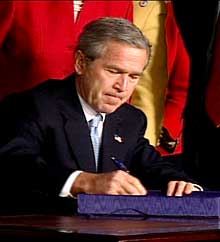 The Founding Fathers created three separate branches of government, each with its distinct role, to prevent power from being concentrated too tightly in one place by one person or small group of people. It was a wise move, and though the executive branch has always been the most visible and most driving force in our government, no president has moved as far in the direction of tyrant as George W. Bush.
The Globe reports today that Bush issued another "signing statement" this week. These are documents released after a president signs a bill -- thereby making it law -- that in the past have been used sparingly by presidents to indicate their interpretation of the new law. Bush has used such statements far more than previous occupants of the oval office -- more than 1,000 times -- and in them he often indicates certain parts of new laws that his administration will not follow.
This is clearly illegal. It completely ignores the structure of the United State Constitution, which presidents swear to "preserve, protect and defend" when they are inaugurated. The president's job is to enforce the laws. If he doesn't agree with a proposed law then his duty is to veto it. If he thinks it violates the Constitution, then the courts will make a decision. All three elements of power cannot and should not be concentrated in one branch and in one man (or two, considering Dick Cheney's influence).
The Globe's Charlie Savage won a Pulitzer Prize for his coverage of Bush's use of signing statements, which the American Bar Association has determined as "contrary to the rule of law." Republican Senator Arlen Specter has twice filed legislation that instructs all state and federal courts to ignore signing statements.
This latest signing statement, you should know, was filed after Bush signed the National Defense Authorization Act for 2008, which contains a provision forbidding the US from spending taxpayer dollars to build permanent military bases in Iraq. The president, after signing the bill into law, then issued a statement that says he does not have to abide by that section, as well as several others. It's clear from recent negotiations in Iraq that this administration is planning on such bases, and in another end-around the legal process, Bush has said that the eventual agreement with Iraq will be a "compact" and not a treaty, which means he can bypass the ratification process in the US Senate.
Goerge W. Bush is making a mockery of the rule of law. His violation of the Constitution and of his vow to uphold it are unethical and criminal.
Subscribe to:
Posts (Atom)