The tunnel named after the late Tip O'Neill is apparently leaking quite a bit these days, but the legacy of the former Massachusetts Congressman is more impressive to me than ever in the current political landscape. O'Neill served 10 years as Speaker of the House, much of it when Ronald Reagan ("the most ignorant man who had ever occupied the White House," according to O'Neill, who died before George W. Bush came on the national scene) was president. Reagan, and other Republicans elected in 1980, went to Washington to "make government smaller" -- GOP-speak for lowering taxes on the wealthy and dismantling the New Deal safety net. O'Neill, ridiculed publicly by arrogant conservatives as being old and overweight, used strength and charm to stand up against Reagan and his cohorts, virtually single-handedly absorbing the blows and holding the line.
Alas, O'Neill is gone and the Democrats seem to have no one like him in a leadership role. (Nancy Pelosi, House majority leader, is probably closest, but she doesn't run the House any more.) President Obama appears to get his clock cleaned by Republicans on every contentious issue. His natural inclination to compromise has been repeatedly taken advantage of by an opposition that is virtually unwilling to give any ground -- and therefore all "agreements" give the far right almost everything they want. It's discouraging.
The debt-ceiling agreement that leaders on both sides are touting today -- and which passed the House last night and will likely get Senate approval today -- is a complete capitulation to a group of elected officials who were willing to sacrifice the stability of the nation and the global economy to make sure that the rich in American don't have to pay a single penny more in taxes. Joe Nocera in The New York Times calls them "terrorists" who are "waging jihad on the American people." This group of Tea Partiers and their enablers in Congress -- only several dozen members -- give the impression that they will go to any length, including national crisis, to get what they want. It's like playing chicken against a crazy person: you have to get out of the way because he will take you both down.
This all reminds me of the story in the Old Testament where two women come to King Solomon, both claiming that they are the mother of a particular child, and the wise king declares that the child will be split in two. Of course, the strategy was that the child's actual mother wouldn't want to see any harm come to the boy, and so when one of the women cries out, "No! Let her have him!" the king knows she is the true mother. The Democrats keep flinching and crying out. They are not willing to let the country default in its fiscal obligations as of midnight tonight, and so they gave in. The Republicans, whose reasonable elements are shouted down by the far right, are willing to burn the entire Republic to the ground. As a result, the deal voted on today requires sacrifices from the poor, the elderly, the young, the sick and the hard working, while those at the top of the economic pyramid have to give up nothing.
Despite the political rhetoric, the deal will hurt the economy. In the meantime, our biggest national crisis -- millions of unemployed -- goes unaddressed. In times like this government needs to spend more, not less. The stimulus back in Obama's first year needed to be two or three times bigger, but he gave in to the right. Now the economy will suffer more, and the GOP will pin it on Democrats in 2012. It's hard to see an upside here.
Showing posts with label united states. Show all posts
Showing posts with label united states. Show all posts
Tuesday, August 2, 2011


Thursday, July 28, 2011
Getting serious
For weeks the word was that Wall Street was not panicking about Washington's inability to raise the debt ceiling because it was understood that, in the end, some kind of deal would be reached. After all, the thinking went, the leadership of both parties knows how potentially serious and far-reaching the consequences would be of default. In the past few days, however, markets around the world have started to drop and there is now a real feeling that "these guys could screw this thing up." We are, indeed, in interesting times.
One article that most still cling to is that the US will not default -- in other words, miss payments on the debt to creditors. Because of what would certainly be the cataclysmic results of the world's safest asset suddenly unable to pay its obligations, the widely held view is that even if no agreement is reached the Treasury would first pay the $90 billion due to bondholders. After that, the government would need to prioritize, as incoming tax dollars only cover 40% of outlays. More than half of government would not be funded: Social Security or homeland security or troop salaries or Medicare, etc. Some essential programs would be on hold.
This assumes that, absent a Congressional vote, President Obama doesn't invoke the 14th Amendment to the Constitution, which some Democrats are publicly pushing him to do. Obama, a Constitutional law professor, has said that his Administration's lawyers have reviewed the 14th Amendment -- part of which reads, "The validity of the public debt of the United States ... shall not be questioned." -- and concluded that it is not "a winning argument." Using such a tactic spuriously, some say, could lead to impeachment.
What has many analysts concerned is that even if an agreement is reached and the debt ceiling is raised this entire dramatic and drawn-out episode has already done its damage. Though the mounting total of US government debt -- currently $14.3 trillion -- has always been in plain sight, investing in that debt through US Treasury bonds was still considered the safest bet in the financial world. Now, the spotlight is on and some may start to second guess the wisdom of such an investment, for even if obligations are met this time the idea that there could come a time when this is not so is beginning to creep into worldwide financial markets. And the idea that the Tea Party segment of the political spectrum is actually playing chicken with America's financial affairs and that this most unstable and irresponsible movement may grow in power and is even looking to take the White House -- well, such a possibility could, right now, cause investors to panic and ratings agencies to lower the AAA rating of American debt.
Coupled with the current flat recovery from the Great Recession, it seems that we are forging new economic ground. The Tea Party and its lackeys in Congress think they know what they're doing, but we have seen how their conception of reality is not fact-based. We can only hope that saner heads step in and quickly fix this mess.
One article that most still cling to is that the US will not default -- in other words, miss payments on the debt to creditors. Because of what would certainly be the cataclysmic results of the world's safest asset suddenly unable to pay its obligations, the widely held view is that even if no agreement is reached the Treasury would first pay the $90 billion due to bondholders. After that, the government would need to prioritize, as incoming tax dollars only cover 40% of outlays. More than half of government would not be funded: Social Security or homeland security or troop salaries or Medicare, etc. Some essential programs would be on hold.
This assumes that, absent a Congressional vote, President Obama doesn't invoke the 14th Amendment to the Constitution, which some Democrats are publicly pushing him to do. Obama, a Constitutional law professor, has said that his Administration's lawyers have reviewed the 14th Amendment -- part of which reads, "The validity of the public debt of the United States ... shall not be questioned." -- and concluded that it is not "a winning argument." Using such a tactic spuriously, some say, could lead to impeachment.
What has many analysts concerned is that even if an agreement is reached and the debt ceiling is raised this entire dramatic and drawn-out episode has already done its damage. Though the mounting total of US government debt -- currently $14.3 trillion -- has always been in plain sight, investing in that debt through US Treasury bonds was still considered the safest bet in the financial world. Now, the spotlight is on and some may start to second guess the wisdom of such an investment, for even if obligations are met this time the idea that there could come a time when this is not so is beginning to creep into worldwide financial markets. And the idea that the Tea Party segment of the political spectrum is actually playing chicken with America's financial affairs and that this most unstable and irresponsible movement may grow in power and is even looking to take the White House -- well, such a possibility could, right now, cause investors to panic and ratings agencies to lower the AAA rating of American debt.
Coupled with the current flat recovery from the Great Recession, it seems that we are forging new economic ground. The Tea Party and its lackeys in Congress think they know what they're doing, but we have seen how their conception of reality is not fact-based. We can only hope that saner heads step in and quickly fix this mess.
Monday, July 4, 2011
In Congress, July 4, 1776

“We hold these truths to be self-evident, that all men are created equal, that they are endowed by their Creator with certain unalienable Rights, that among these are Life, Liberty and the pursuit of Happiness. That to secure these rights, Governments are instituted among Men, deriving their just powers from the consent of the governed…”
Tuesday, May 3, 2011
Choosing our own future
 Osama Bin Laden is dead. Good riddance. Don't believe Joe Scarborough or other moronic pundits who claim that President Obama went against his supporters on the left by taking out the head of Al-Qaeda. None of us are shedding a tear for Bin Laden. He got what he deserved.
Bin Laden was evil -- but he wasn't stupid. A realistic assessment of his actions suggest that he accomplished some of what he set out to do. The goal was to entice the US into a protracted ground war in Afghanistan in order to bankrupt America and to radicalize the Muslim world against the West. And the result? The US military is approaching a decade in Afghanistan, plus eight years in Iraq, and together those campaigns have cost two or three trillion dollars. Meanwhile, there has been some radicalization of small groups of Muslims.
We're still here, of course, and we can ensure that Bin Laden's goals are not fully accomplished if we wrap things up in Iraq and Afghanistan, and if we use our military a bit more sparingly in the future. This is not a call for demilitarization or isolationism, but only for wisdom and foresight. America cannot go on spending as much as all other countries combined on the military, and America cannot go on deploying its forces all over the world.
Let us regroup at home and lead by example so that the US once again occupies the moral high ground. If America had invaded Afghanistan after 9/11 with a smart plan and an exit strategy and if the country hadn't taken its eye off the ball by getting wrapped up in Iraq, then thousands of lives and trillions of dollars might have been saved. We might have had to wait for a small team of soldiers to take out Bin Laden 10 years after the fact, but that is what happened any way.
Tuesday, February 22, 2011
Supporting workers in the Midwest
 We like to say that America is a classless society, but that simply is not true. It's always been to the benefit of the wealthy in this country to dismiss the idea of class while rigging the system to keep them and their heirs on top. The current attempts of state governments in the Midwest to undo the progress that working people have made in the past 150 years in the US are the latest battle on this front, and it is a blatant and outrageous attack.
 Wisconsin's Republican governor, Scott Walker, is using his state's budget shortfall to take away the right of collective bargaining from most public-sector unions -- a right that Americans fought, and died, to establish. This is completely unacceptable. What is a union if not a group of workers who have the ability to bargain as a unit?
Wisconsin and Ohio -- the second state to declare war on unions -- have real fiscal issues, and so do most states, but these have been caused by a decrease in revenue due to the deep recession that the country was plunged into by Wall Street and by insufficient tax rates on millionaires. In both instances, the wealthy have benefited greatly and now those gains are going to be solidified on the backs of teachers, firefighters, police officers, garbage men and other state and municipal workers -- middle-class Americans who, as George Bailey says in It's A Wonderful Life, "do most of the working and paying and living and dying" in this country.
These are not desperate maneuvers in a time of fiscal emergency, but it is rather a strategy by the wealthy to increase the gold in their overflowing coffers: cut taxes for the rich; cut programs for the needy because there is suddenly less money to pay for them; and vilify public-sector unions.
The wealthy have fought labor unions as long as they have existed, using massive amounts of violence that is left out of the textbooks we use in our history classes. Many people were intimidated, fired, beaten and killed, but it was the courage of working men and women that won every battle against the more powerful forces that tried to keep them down. That struggle never ended; it only changed forms, so that companies like Wal-Mart are much more sophisticated in their anti-unions actions.
With the loss of most of America's manufacturing jobs and with the ever-present animosity of big business and the wealthy, private-sector unions are a much smaller player today. Of course, corruption is a part of that story, but so is a string of successes that includes not only a multitude of codified rights, but a national economy that outgrew all others even as union workers made decent wages, making the US economy the envy of others in the 20th century.
People in public-sector jobs deserve respect and a decent wage. They also deserve the right to bargain collectively with their employers. Taking away that right would be antithetical to everything America stands for. All working people should be aligned with the workers in Wisconsin and Ohio as they fight the latest battle in America's class war.
Photo courtesy of csmonitor.com.
Sunday, February 6, 2011
Evaluating Reagan
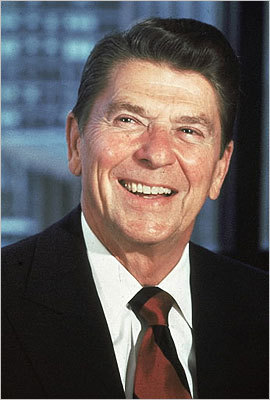
Across the country the 100th anniversary of Reagan's birth is being marked today. He has become larger than life and an icon of the conservative movement. Some even want to add him to Mount Rushmore. The facts, however, belie this tale of hero worship. While he was in office I remember thinking that Reagan was the worst president the nation had ever seen. Of course, I couldn't conceive of George W. Bush then, and in comparison Reagan seems only mildly bad, but from his backing of murderous militias in Latin America to his foolish "trickle-down" ideas in economics to his refusal to fight AIDS to Iran-Contra and more, Reagan was a disaster for America. Now we read in his son's memoir that the old man had likely begun to suffer from Alzheimer's while still in office. What was the difference from how he behaved before that?
Reagan's legacy may have done the most damage of all: a revived conservative movement. The country suffered through eight years of Bush Jr. and we are still trying to clean up that mess. Reagan's best acting job was as president, and today he has more people fooled than ever.
Sunday, January 30, 2011
The only solution to the debt
During his State of the Union address last week President Obama called for a five-year freeze of non-security discretionary spending in the federal budget. Meanwhile, Republicans in Congress proposed that spending be returned to 2008 levels. It's possible that one of those plans will be enacted, or something similar, but it's also possible that the two parties won't come to an agreement on the matter. What is certainly true is that either move would have, at best, a tiny effect on the country's incomprehensible $14 trillion national debt. In fact, despite the alarm bells being struck by Democrats and Republicans alike, no one appears anywhere near ready to take action that will actually begin to reduce the ocean of red ink the US finds itself in.
Every day on TV and in print elected officials bemoan the unfair burden that is being handed down to our children and our children's children, but the reality is that no one is ever going to make cuts and adjustments in the budget of the magnitude that would make meaningful reductions in the debt. No one. Ever. Not now, not soon, never. Neither party possesses the political courage to do what really has to be done: decrease defense spending and reform Social Security and Medicare. The non-security discretionary spending that the US government does, while the target for symbolic cuts, is not the problem. It is the areas that both sides are leery of confronting that are the problem.
So let's be honest, then. If we really want to get our financial house in order, if we really want to spare future generations from paying for our spending, then there is only one logical and effective thing to do: raise taxes. As I say, drastic decreases in spending are never going to happen, so the US government must increase tax revenues. It's got to happen at some point and, therefore, if we refuse to do it now we really are passing on the costs of today to our children.
Let me say this plainly: If we accept that major cuts in entitlement programs and defense spending are not going to happen (whether you are for or against them) -- and, based on everything we know about how Washington works THEY ARE NOT -- then those of us who do not advocate for tax increases are accepting that we will hand off a debt of some $15 trillion or $20 trillion to the next generation. I'm tired of hearing about the unfair burden we are passing on. Let's take the only course open to us and stop the melodramatic whining.
Every day on TV and in print elected officials bemoan the unfair burden that is being handed down to our children and our children's children, but the reality is that no one is ever going to make cuts and adjustments in the budget of the magnitude that would make meaningful reductions in the debt. No one. Ever. Not now, not soon, never. Neither party possesses the political courage to do what really has to be done: decrease defense spending and reform Social Security and Medicare. The non-security discretionary spending that the US government does, while the target for symbolic cuts, is not the problem. It is the areas that both sides are leery of confronting that are the problem.
So let's be honest, then. If we really want to get our financial house in order, if we really want to spare future generations from paying for our spending, then there is only one logical and effective thing to do: raise taxes. As I say, drastic decreases in spending are never going to happen, so the US government must increase tax revenues. It's got to happen at some point and, therefore, if we refuse to do it now we really are passing on the costs of today to our children.
Let me say this plainly: If we accept that major cuts in entitlement programs and defense spending are not going to happen (whether you are for or against them) -- and, based on everything we know about how Washington works THEY ARE NOT -- then those of us who do not advocate for tax increases are accepting that we will hand off a debt of some $15 trillion or $20 trillion to the next generation. I'm tired of hearing about the unfair burden we are passing on. Let's take the only course open to us and stop the melodramatic whining.
Monday, January 17, 2011
Taking Ike's warning seriously
Three days before leaving the White House in 1961, President Dwight D. Eisenhower delivered a farewell speech to the American public. That was 50 years ago today, and part of the one-time five-star general's remarks warned future generations of the dangers of the immense defense and weapons corporations that had been created after World War II:
Today, the United States spends almost as much on defense as every other country in the world combined, and there are somewhere around 1,000 US military bases OUTSIDE American soil. Defense contractors like Raytheon, Boeing, General Dynamics and others have raked in hundreds of billions of dollars since Eisenhower's speech -- and they play no small role in beating the drum when opportunities arise for the use of their weapons systems.
Aside of all other geopolitical concerns, just the cost of this military behemoth is going to end up leading to America's downfall if left unchecked. The US government needs to get it under control, and the people need to insist on it. As Ike said, the only remedy is "an alert and knowledgeable citizenry." Are we ready yet to heed his words?
This conjunction of an immense military establishment and a large arms industry is new in the American experience. The total influence -- economic, political, even spiritual -- is felt in every city, every State house, every office of the Federal government. We recognize the imperative need for this development. Yet we must not fail to comprehend its grave implications. Our toil, resources and livelihood are all involved; so is the very structure of our society.
In the councils of government, we must guard against the acquisition of unwarranted influence, whether sought or unsought, by the military industrial complex. The potential for the disastrous rise of misplaced power exists and will persist.
We must never let the weight of this combination endanger our liberties or democratic processes. We should take nothing for granted. Only an alert and knowledgeable citizenry can compel the proper meshing of the huge industrial and military machinery of defense with our peaceful methods and goals, so that security and liberty may prosper together.
Today, the United States spends almost as much on defense as every other country in the world combined, and there are somewhere around 1,000 US military bases OUTSIDE American soil. Defense contractors like Raytheon, Boeing, General Dynamics and others have raked in hundreds of billions of dollars since Eisenhower's speech -- and they play no small role in beating the drum when opportunities arise for the use of their weapons systems.
Aside of all other geopolitical concerns, just the cost of this military behemoth is going to end up leading to America's downfall if left unchecked. The US government needs to get it under control, and the people need to insist on it. As Ike said, the only remedy is "an alert and knowledgeable citizenry." Are we ready yet to heed his words?
Tuesday, December 21, 2010
Tension on Korean peninsula

The North has frequently taken aggressive action in the 57 years since the armistice brought an end to the war that killed 350,000 Korean soldiers and 2.5 million Korean civilians, as well as 36,000 Americans, at least 200,000 Chinese and several thousand from other countries. The leadership of the communist state is irrational and no one wants to see them get away with the recent attack on the South's Yeonpyeong Island or last spring's attack on a naval ship.
However, instigating a nuclear war is certainly in no one's interest, and so the US and South Korea need to think long and hard before they provoke the North. The entire world has a stake in what happens there.
Image courtesy socioecohistory.wordpress.com.
Sunday, December 19, 2010
Assessing Obama
On his widely read blog, The Daily Dish, Andrew Sullivan argues that Barack Obama is not a weak liberal, but rather a tactical and cautious president who reads the country's mood and compromises to get what he can. Then he lists what Obama has accomplished in his first two years:
It certainly is an impressive list, and though I was hoping for more bold legislation with a Democrat in the White House and large majorities in both houses of Congress, I do understand that political logistics must be taken into account when hashing out domestic policy.
As I've said before, it is in other areas that I have significant problems with Obama's leadership: the wars, the secrecy, the assault on privacy and civil rights, and Guantanamo Bay. In these areas the change in White House residents has given us little if any modification in policy. That is disturbing.
...universal health insurance, the rescue of Detroit, the avoidance of a Second Great Depression, big gains in private sector growth and productivity, three stimulus packages (if you count QE2), big public investments in transport and green infrastructure, the near-complete isolation of Iran, the very public exposure of Israeli intransigence and extremism, a reset with Russia (plus a new START), big drops in illegal immigration and major gains in enforcement, a South Korea free trade pact, the end of torture, and a debt commission that has put fiscal reform squarely back on the national agenda. Oh, and of yesterday, the signature civil rights achievement of ending the military's ban on openly gay service members.
It certainly is an impressive list, and though I was hoping for more bold legislation with a Democrat in the White House and large majorities in both houses of Congress, I do understand that political logistics must be taken into account when hashing out domestic policy.
As I've said before, it is in other areas that I have significant problems with Obama's leadership: the wars, the secrecy, the assault on privacy and civil rights, and Guantanamo Bay. In these areas the change in White House residents has given us little if any modification in policy. That is disturbing.
Saturday, December 18, 2010
Fun with maps
 | ||
| Illustration courtesy of The Daily Kos. |
The latest official census figures will be released Tuesday and those numbers will determine if the Bay State keeps 10 seats in the House of Representatives or slides down to nine. From 1913 to 1933 Massachusetts had 16 members in the House and since then we've lost one every one or two decades. Whenever such adjustments happen it usually leaves two sitting House members running against each other.
One web site surmises that this time the 1st and 2nd Congressional districts will be combined, pitting John Olver against Richard Neal, and it'd be likely that Olver, who will be 76 at the time of the 2012 election, would just retire. Whatever the revised map looks like, we can be sure it will be a contorted mess of districts, drawn to protect constituencies. The US should depoliticize redistricting by removing it from state legislatures (as a few states have done) and turning it over to independent boards that use software to draw cohesive districts.
Sunday, December 12, 2010
Bush league decision
It was 10 years ago that the Supreme Court rendered a decision that has and will continue to have lasting implications on the nation. By a 5-4 margin the justices brought to an end the recount of Florida's ballots in the presidential election between George W. Bush and Al Gore. The GOP ticket was awarded Florida's 25 electoral votes despite the questionable result and Bush -- who had 550,000 fewer votes nationally -- became the 43rd president.
It is a mystery to me why the Court would not allow the recount to continue, but the five conservative justices would seem to have interceded in the political process, and as a result the US had eight years of Bush/Cheney. It may take us eight decades to dig ourselves out from that foolish and tragic period.
It is a mystery to me why the Court would not allow the recount to continue, but the five conservative justices would seem to have interceded in the political process, and as a result the US had eight years of Bush/Cheney. It may take us eight decades to dig ourselves out from that foolish and tragic period.
Saturday, December 11, 2010
Ron Paul tells it like it is
Ron Paul deserves credit. No matter how much I disagree with many of the Texas Congressman's positions, mostly on domestic policy, there is much overlap in his libertarian ideology and the uber-liberal viewpoint that I come from -- and he is never afraid to stand up and say what he thinks.
Yesterday Rep. Paul was on the floor of the House offering a vastly different assessment of WikiLeaks than most other Republicans, who are calling for the web site's public face, Julian Assange, to be either prosecuted for espionage or taken out like a terrorist.
"Is this not an example of killing the messenger for bad news?" asked Paul. He also had nine questions that we should be asking ourselves:
Yesterday Rep. Paul was on the floor of the House offering a vastly different assessment of WikiLeaks than most other Republicans, who are calling for the web site's public face, Julian Assange, to be either prosecuted for espionage or taken out like a terrorist.
"Is this not an example of killing the messenger for bad news?" asked Paul. He also had nine questions that we should be asking ourselves:
Number 1: Do the America People deserve know the truth regarding the ongoing wars in Iraq, Afghanistan, Pakistan and Yemen?Number 2: Could a larger question be how can an army private access so much secret information?Number 3: Why is the hostility directed at Assange, the publisher, and not at our governments failure to protect classified information?Number 4: Are we getting our moneys worth of the 80 billion dollars per year spent on intelligence gathering?Number 5: Which has resulted in the greatest number of deaths: lying us into war or Wikileaks revelations or the release of the Pentagon Papers?Number 6: If Assange can be convicted of a crime for publishing information that he did not steal, what does this say about the future of the first amendment and the independence of the internet?Number 7: Could it be that the real reason for the near universal attacks on Wikileaks is more about secretly maintaining a seriously flawed foreign policy of empire than it is about national security?Number 8: Is there not a huge difference between releasing secret information to help the enemy in a time of declared war, which is treason, and the releasing of information to expose our government lies that promote secret wars, death and corruption?Number 9: Was it not once considered patriotic to stand up to our government when it is wrong?
Friday, December 10, 2010
Fouling the air
 Glad to see that the GOP has its priorities straight. Yesterday, Senate Republicans refused to allow a vote on a bill that ensures emergency personnel who responded to the 9/11 attacks get proper medical care. Their reasoning? Nothing gets done until the wealthy get their tax cuts.
This is even worse than not believing it's a worthy bill, as Republicans apparently feel that such items can be used as bargaining chips. Nothing is more important to the GOP than the rich getting richer.
Photo of 9/11 responder from care.com.
Sunday, December 5, 2010
The reluctant president
In the last week a trio of liberal newspaper columnists expressed disappointment in Barack Obama's presidency -- a feeling that the left has been tormented by for months. Paul Krugman and Frank Rich of The New York Times and The Washington Post's EJ Dionne call out the president for his seeming reluctance to take a stand and fight the Republicans -- who use bellicosity as a strategy, no matter the issue and the lack of connection to reality of their position.
Dionne:
This reminds me of a scene from the TV show The West Wing -- in fact, it's almost exactly where we find ourselves. Look at the episode's summary from Wikipedia:
Dionne:
And what will Obama do about all this? Ronald Reagan ... found a way to stand strong, to fight back and to win. We will soon know whether our current president has this in him.Krugman:
It’s hard to escape the impression that Republicans have taken Mr. Obama’s measure — that they’re calling his bluff in the belief that he can be counted on to fold. And it’s also hard to escape the impression that they’re right.Rich:
The cliché criticisms of Obama are (from the left) that he is a naïve centrist, not the audacious liberal that Democrats thought they were getting, and (from the right) that he is a socialist out to impose government on every corner of American life. But the real problem is that he’s so indistinct no one across the entire political spectrum knows who he is. A chief executive who repeatedly presents himself as a conciliator, forever searching for the “good side” of all adversaries and convening summits, in the end comes across as weightless, if not AWOL.They're right. Two years ago Democrats won in grand fashion, but they've struggled since then to control the agenda and to communicate with the public. Most of the responsibility for that falls on Obama's shoulders. There have been some gains, some important legislation -- health care and financial reform, for example -- but in each of those cases, and in others, the policies that became law were much weaker than we'd hoped. The Democrats emerged from those battles bruised and limping, checking their pockets with the strange feeling that their wallets had just been lifted.
This reminds me of a scene from the TV show The West Wing -- in fact, it's almost exactly where we find ourselves. Look at the episode's summary from Wikipedia:
The staff begin to realize that the Bartlet administration has been ineffective because it has been too timid to make bold decisions, focusing instead on the exigencies of politics.If only the Obama administration were to reach the conclusion that the fictional administration reaches:
Finally, Leo confronts President Bartlet with his own timidity, challenging him to be himself and to take the staff "off the leash." -- in other words, he seeks to "Let Bartlet be Bartlet." The President and his staff resolve to act boldly and "raise the level of public debate" in America.Please ... let life imitate art.
Friday, December 3, 2010
Truth as treason

In the four years of its existence, WikiLeaks has risen from nowhere to be a prominent shaper of news and information. Such is the way that technology affects us these days: Facebook, YouTube, Twitter and now WikiLeaks begin as an idea or a few lines of code and soon the way we see and understand the world is changed permanently.
Julian Assange, the force behind the site, is a wanted man these days. In the wake of WikiLeaks latest revelation -- 250,000 cables of US State Department reports -- a number of governments are investigating the Australian nomad, while Swedish authorities want to talk to him about sexual assault charges he has called phony. It's hard to see how this guy survives unless he takes cover underground for a very long time.
Texas Rep. Ron Paul tweeted this today: "Re: Wikileaks - In a free society, we are supposed to know the truth. In a society where truth becomes treason, we are in big trouble." While Paul -- a hardcore libertarian -- and I would disagree on many issues, on this one we share similar views. The US government has too many secrets. I am for a default position of openness and transparency in all branches and at all levels of government. WikiLeaks may have embarrassed the US and some of its allies this week, but exposing some of the workings of the State Department is, overall, a good thing.
When US missiles hit targets in Yemen one year ago, for example, it is the right of Americans AND Yemenis to know where those weapons came from, especially when many of those killed in these attacks were civilians -- including 14 women and 21 children. WikiLeaks is not the institution that illegally invaded Iraq and that has been occupying Afghanistan for nine years. That would be the US government.
News that Amazon.com dropped WikiLeaks from its servers yesterday and that today a New Hampshire company killed the domain WikiLeaks.org (find the site here, at WikiLeaks.ch) after Connecticut Sen. Joe Lieberman made some threatening comments is quite disturbing. This is not the way we treat information in the United States -- with the government actively seeking to prevent Americans from reading the truth. We're moving -- if we haven't been there since the passage of the PATRIOT Act -- toward 1984 territory. In that prophetic novel, one of the dystopian government's slogans would seem to be one that the US is now embracing: "Ignorance is strength."
Sunday, November 28, 2010
Korea, China and the 21st Century
US Navy ships are in the Yellow Sea today for exercises with the South Korean Navy. I hope this has been thought out. What will happen if North Korea fires on American vessels? Will the US retaliate? And after that? We certainly cannot be girding up for another war, this one against a country that does indeed have nuclear weapons -- most of which are pointed at the South Korean capital of Seoul and its 10 million residents.
North Korea's leader Kim Jong-il is unpredictable -- possibly even crazy. In addition, that country's military leaders may make decisions on their own, and it's hard to say if that is better or worse. It's also relevant to take note that the South Korean military was already engaged in exercises that pressed right up against the border of the two Koreas, which the North has said provoked their shelling. As one web site points out, this fact has been buried by the American media.
However, the key to this entire situation -- and we are hearing this more and more often these days -- is China. North Korea's only ally, the Chinese government could be quite helpful right now, but it's been hesitant to chasten Pyongyang in the past -- at least publicly. If China were to embrace its growing importance on the world stage by stepping up to play key roles in geopolitical disputes, economic crises and environmental concerns, that would seem to make life easier for everyone, but Beijing continues to work at its own pace.
I saw an interesting statistic last week: In 2009 China used twice as much steel as the US, the European Union and Japan COMBINED. Beijing's economic growth is surging at a level the world has never before seen. China recently became the world's second-largest economy, passing Japan, and China is the world's largest emitter of greenhouse gases. If the 1900s were the American Century, this is quickly becoming the Chinese Century.
North Korea's leader Kim Jong-il is unpredictable -- possibly even crazy. In addition, that country's military leaders may make decisions on their own, and it's hard to say if that is better or worse. It's also relevant to take note that the South Korean military was already engaged in exercises that pressed right up against the border of the two Koreas, which the North has said provoked their shelling. As one web site points out, this fact has been buried by the American media.
However, the key to this entire situation -- and we are hearing this more and more often these days -- is China. North Korea's only ally, the Chinese government could be quite helpful right now, but it's been hesitant to chasten Pyongyang in the past -- at least publicly. If China were to embrace its growing importance on the world stage by stepping up to play key roles in geopolitical disputes, economic crises and environmental concerns, that would seem to make life easier for everyone, but Beijing continues to work at its own pace.
I saw an interesting statistic last week: In 2009 China used twice as much steel as the US, the European Union and Japan COMBINED. Beijing's economic growth is surging at a level the world has never before seen. China recently became the world's second-largest economy, passing Japan, and China is the world's largest emitter of greenhouse gases. If the 1900s were the American Century, this is quickly becoming the Chinese Century.
Friday, November 19, 2010
Revealing "the devils" behind the financial crisis
A fascinating interview with the authors of a new book about the recent financial crisis sheds some light on who is the blame for the economic turmoil that the US and the rest of the world are still struggling to overcome (see Ireland's bank takeover plan). Bethany McLean, who co-wrote The Smartest Guys in the Room about the Enron debacle, teamed up with New York Times business columnist Joe Nocero to write All the Devils are Here: The Hidden History of the Financial Crisis.
McLean and Nocero were on the PBS NewsHour last night to talk about the roots of the crisis, and they said that -- to no one's surprise -- both Democrats and Republicans were culpable for the lack of regulation and foresight that led to the housing crash. They also said a number of other interesting things, including that the ratings agencies (Moody's and Standard & Poor's, among others) were at the top of their list of culprits most responsible for the crisis.
McLean also said that she "started this book with a bias toward personal responsibility," but found out the extent to which:
Maybe the most telling, and most disturbing points, the writers make are at the end of the interview, when McLean says that Wall Street and corporate America saw that cash-out refinancing was a way for them to reap billions:
McLean and Nocero were on the PBS NewsHour last night to talk about the roots of the crisis, and they said that -- to no one's surprise -- both Democrats and Republicans were culpable for the lack of regulation and foresight that led to the housing crash. They also said a number of other interesting things, including that the ratings agencies (Moody's and Standard & Poor's, among others) were at the top of their list of culprits most responsible for the crisis.
McLean also said that she "started this book with a bias toward personal responsibility," but found out the extent to which:
...these loans were sold; they weren't bought. And one of the most telling moments were these internal documents from Washington Mutual, one of the big subprime lenders, around 2003 talking about how to get consumers who really wanted safe 30-year fixed-rate mortgages to take out these dangerous option [adjustable rate mortgages] instead ... how to sell those to people, and how to confront a consumer who said, "But it doesn't feel right to me. I want to pay back my mortgage every month." ... How do you get these people to take out a risky mortgage instead? You told them that home prices could only go up. And the reason Washington Mutual wanted to sell these option ARMs, instead of the 30-year fixed rate mortgages, is that Washington Mutual could turn around and sell these to Wall Street for a lot more money than it could sell the old 30-year fixed-rate loans.Nocero adds, "I was stunned, in the reporting of this book, how much subprime was about predatory lending." He notes, also, that most of these transactions weren't for new homes, but for "cash-out refinancing" -- people remortgaging their homes in order to use the money the could get. "And that," said McLean, "enabled consumer spending through the 1990s and through the early part of -- of this decade."
Maybe the most telling, and most disturbing points, the writers make are at the end of the interview, when McLean says that Wall Street and corporate America saw that cash-out refinancing was a way for them to reap billions:
...in order to keep the U.S. economy going, you had to keep consumer spending strong. In order to keep consumer spending strong, you had to have consumers whose income otherwise wasn't keeping up have a ready source of cash. That was cash-out refinancing, by using their homes as piggy banks, and no one wanted to stop that party.The party may be over for American homeowners and consumers, but big business and the financial sector are still laughing all the way to the money trough.
Tuesday, November 2, 2010
Election Day 2010
***Boston.com has a nice feature where you can type in your address and see information on every race and question that will appear on your ballot. It's on the right side of their election coverage page here.
***The Globe's endorsement of Deval Patrick. The Herald's endorsement of Charlie Baker.
***Most signs indicate that Republicans will take control of the House, while it appears Democrats will keep control of the Senate. The New York Times has cool interactive graphics in its national political coverage section.
***The only House race that is tightly contested is the 10th District, where William Delahunt is retiring. Democrat William Keating leads Republican Jeff Perry by a small margin in the latest polls. It would be a disgrace if Perry, who watched and did nothing as two teenage girls were improperly strip-searched by a police officer under his command when he was on the Wareham force AND THEN lied about it to investigators, were to win the seat.
***It would also be a travesty if Tea Party nut job Sharron Angle were to beat Majority Leader Harry Reid in the battle for his Nevada Senate seat.
***The Globe's endorsement of Deval Patrick. The Herald's endorsement of Charlie Baker.
***Most signs indicate that Republicans will take control of the House, while it appears Democrats will keep control of the Senate. The New York Times has cool interactive graphics in its national political coverage section.
***The only House race that is tightly contested is the 10th District, where William Delahunt is retiring. Democrat William Keating leads Republican Jeff Perry by a small margin in the latest polls. It would be a disgrace if Perry, who watched and did nothing as two teenage girls were improperly strip-searched by a police officer under his command when he was on the Wareham force AND THEN lied about it to investigators, were to win the seat.
***It would also be a travesty if Tea Party nut job Sharron Angle were to beat Majority Leader Harry Reid in the battle for his Nevada Senate seat.
Saturday, October 30, 2010
Midterm madness
The midterm elections are just a few days away and the overwhelming plot thread is that the electorate is angry -- most notably, about the state of the American economy. Well, we should be angry -- we should be furious, in fact -- but voting for Republicans to express that anger would seem to be an antithetical response to the situation. I believe that, just two years ago, we swept Democrats into office mostly because of the GOP's mishandling of the economy. It appears that Americans are ready to cast their lot with Republicans again. How soon we forget!
Several points to keep in mind:
1. TARP -- the bank bailout -- was a Bush Administration program. Yes, it was passed by the Democratic Congress, but only after Treasury Secretary Hank Paulson actually got down on one knee to beg House Speaker Nancy Pelosi for her support, telling the Democratic leadership that the entire economy would collapse if the bill wasn't passed.
2. Despite GOP rhetoric, every analysis I've seen of Obama's stimulus bill indicates that it did save a significant amount of jobs and helped the economy begin its recovery. Now, we all agree that this recovery is moving too slowly and that an unemployment rate of 9.6 percent is unacceptable. However, many economists at the time said that the stimulus needed to be larger than the $787 billion, but considering the political mood, that was the best that Obama could get from Congress.
3. More than one-third of the stimulus ($288 billion) took the form of tax cuts. Again, the misinformation that Republicans are running on is that taxes have been increased under Obama.
4. While a recent poll showed that a small majority of Americans were not in favor of the health care reform bill that Obama and the Democrats passed this year, the survey noted that when asked about the major provisions individually people overwhelmingly supported the reforms! As usual, the right has done a better job framing the issues to their advantage -- with little concern for the truth.
5. Though it isn't as tough as many would have liked, the Democratic Congress did pass a bill that toughened regulation on Wall Street and created the Bureau of Consumer Financial Protection, which will in theory advocate and regulate with the citizenry's interests paramount.
Make no mistake: The recession that the US is still pulling itself out from is the result of Republican policies -- tax cuts for the wealthy, a financial sector operating like the Wild West, regulatory agencies controlled by Bush-appointed former lobbyists, expensive and poorly planned military forays, and, more broadly, an abiding belief in unfettered capitalism as the answer to every question.
Democratics have their weaknesses, and I am never at a loss to point them out, but it was Republicans who put us in the hole. Do we really want to hand them shovels again?
Several points to keep in mind:
1. TARP -- the bank bailout -- was a Bush Administration program. Yes, it was passed by the Democratic Congress, but only after Treasury Secretary Hank Paulson actually got down on one knee to beg House Speaker Nancy Pelosi for her support, telling the Democratic leadership that the entire economy would collapse if the bill wasn't passed.
2. Despite GOP rhetoric, every analysis I've seen of Obama's stimulus bill indicates that it did save a significant amount of jobs and helped the economy begin its recovery. Now, we all agree that this recovery is moving too slowly and that an unemployment rate of 9.6 percent is unacceptable. However, many economists at the time said that the stimulus needed to be larger than the $787 billion, but considering the political mood, that was the best that Obama could get from Congress.
3. More than one-third of the stimulus ($288 billion) took the form of tax cuts. Again, the misinformation that Republicans are running on is that taxes have been increased under Obama.
4. While a recent poll showed that a small majority of Americans were not in favor of the health care reform bill that Obama and the Democrats passed this year, the survey noted that when asked about the major provisions individually people overwhelmingly supported the reforms! As usual, the right has done a better job framing the issues to their advantage -- with little concern for the truth.
5. Though it isn't as tough as many would have liked, the Democratic Congress did pass a bill that toughened regulation on Wall Street and created the Bureau of Consumer Financial Protection, which will in theory advocate and regulate with the citizenry's interests paramount.
Make no mistake: The recession that the US is still pulling itself out from is the result of Republican policies -- tax cuts for the wealthy, a financial sector operating like the Wild West, regulatory agencies controlled by Bush-appointed former lobbyists, expensive and poorly planned military forays, and, more broadly, an abiding belief in unfettered capitalism as the answer to every question.
Democratics have their weaknesses, and I am never at a loss to point them out, but it was Republicans who put us in the hole. Do we really want to hand them shovels again?
Subscribe to:
Posts (Atom)