Showing posts with label capitalism. Show all posts
Showing posts with label capitalism. Show all posts
Friday, November 26, 2010
The stuff that nightmares are made of
Materialism and consumption are factors in America's economic downturn, our dependence on foreign oil, global climate change and other environmental issues -- and yet, millions of people rushed out this morning, or last night, to go out and buy more stuff. I join with those who marked Buy Nothing Day today, and in that spirit I suggest that everyone watch this video: The Story of Stuff.


Friday, November 19, 2010
Revealing "the devils" behind the financial crisis
A fascinating interview with the authors of a new book about the recent financial crisis sheds some light on who is the blame for the economic turmoil that the US and the rest of the world are still struggling to overcome (see Ireland's bank takeover plan). Bethany McLean, who co-wrote The Smartest Guys in the Room about the Enron debacle, teamed up with New York Times business columnist Joe Nocero to write All the Devils are Here: The Hidden History of the Financial Crisis.
McLean and Nocero were on the PBS NewsHour last night to talk about the roots of the crisis, and they said that -- to no one's surprise -- both Democrats and Republicans were culpable for the lack of regulation and foresight that led to the housing crash. They also said a number of other interesting things, including that the ratings agencies (Moody's and Standard & Poor's, among others) were at the top of their list of culprits most responsible for the crisis.
McLean also said that she "started this book with a bias toward personal responsibility," but found out the extent to which:
Maybe the most telling, and most disturbing points, the writers make are at the end of the interview, when McLean says that Wall Street and corporate America saw that cash-out refinancing was a way for them to reap billions:
McLean and Nocero were on the PBS NewsHour last night to talk about the roots of the crisis, and they said that -- to no one's surprise -- both Democrats and Republicans were culpable for the lack of regulation and foresight that led to the housing crash. They also said a number of other interesting things, including that the ratings agencies (Moody's and Standard & Poor's, among others) were at the top of their list of culprits most responsible for the crisis.
McLean also said that she "started this book with a bias toward personal responsibility," but found out the extent to which:
...these loans were sold; they weren't bought. And one of the most telling moments were these internal documents from Washington Mutual, one of the big subprime lenders, around 2003 talking about how to get consumers who really wanted safe 30-year fixed-rate mortgages to take out these dangerous option [adjustable rate mortgages] instead ... how to sell those to people, and how to confront a consumer who said, "But it doesn't feel right to me. I want to pay back my mortgage every month." ... How do you get these people to take out a risky mortgage instead? You told them that home prices could only go up. And the reason Washington Mutual wanted to sell these option ARMs, instead of the 30-year fixed rate mortgages, is that Washington Mutual could turn around and sell these to Wall Street for a lot more money than it could sell the old 30-year fixed-rate loans.Nocero adds, "I was stunned, in the reporting of this book, how much subprime was about predatory lending." He notes, also, that most of these transactions weren't for new homes, but for "cash-out refinancing" -- people remortgaging their homes in order to use the money the could get. "And that," said McLean, "enabled consumer spending through the 1990s and through the early part of -- of this decade."
Maybe the most telling, and most disturbing points, the writers make are at the end of the interview, when McLean says that Wall Street and corporate America saw that cash-out refinancing was a way for them to reap billions:
...in order to keep the U.S. economy going, you had to keep consumer spending strong. In order to keep consumer spending strong, you had to have consumers whose income otherwise wasn't keeping up have a ready source of cash. That was cash-out refinancing, by using their homes as piggy banks, and no one wanted to stop that party.The party may be over for American homeowners and consumers, but big business and the financial sector are still laughing all the way to the money trough.
Wednesday, July 14, 2010
American companies starve people for profit
For most of the 20th century, DeBeers -- a company founded in South Africa by Europeans milking the benefits of colonialism -- controlled almost all of the world's diamond market and used it to great advantage. Diamonds aren't actually that rare, but by hording and locking up vast quantities, DeBeers realized that it was easy to keep the price artificially high. Once they were able to create the idea that diamonds are a symbol of love and that a man must present one to his future bride, billions of dollars began to pour in. "A diamond is forever," was a phrase cooked up by a marketing firm hired by DeBeers, and it was voted the best advertising slogan of the last century.
Wheat, on first glance, doesn't seem to have much in common with diamonds. The staple grain is grown by farmers around the world, and bread, in various forms, is basic of sustenance for people everywhere. One Wall Street firm apparently saw some similarities between the two. In a stunning article in this month's Harper's magazine titled "The Food Bubble," Frederick Kaufman writes about investment bank Goldman Sachs entrance into the grain futures market and how that led, in 2008, to huge price increases, food riots in more than 30 countries and tens of millions of starving people.
The irony is that, according to the story, "The wheat harvest of 2008 turned out to be the most bountiful the world has ever seen..." The bubble eventually burst, but not before Goldman made millions of dollars on the misery of desperate people around the world, and the price of wheat has never come back down to pre-bubble levels.
Diamonds are a luxury item, but people cannot survive without food, yet Goldman and other banks and investment companies are now buying and selling commodities futures to make themselves richer with no regard for the consequences to real people. I've often thought it outrageous that some people own vast swaths of land and multiple houses while others are homeless or live in shacks, but the manipulation of food prices for profit is even more clearly evil and should be unacceptable to everyone. However, it's happening right now -- in the name of free-market capitalism.
Wheat, on first glance, doesn't seem to have much in common with diamonds. The staple grain is grown by farmers around the world, and bread, in various forms, is basic of sustenance for people everywhere. One Wall Street firm apparently saw some similarities between the two. In a stunning article in this month's Harper's magazine titled "The Food Bubble," Frederick Kaufman writes about investment bank Goldman Sachs entrance into the grain futures market and how that led, in 2008, to huge price increases, food riots in more than 30 countries and tens of millions of starving people.
The irony is that, according to the story, "The wheat harvest of 2008 turned out to be the most bountiful the world has ever seen..." The bubble eventually burst, but not before Goldman made millions of dollars on the misery of desperate people around the world, and the price of wheat has never come back down to pre-bubble levels.
Diamonds are a luxury item, but people cannot survive without food, yet Goldman and other banks and investment companies are now buying and selling commodities futures to make themselves richer with no regard for the consequences to real people. I've often thought it outrageous that some people own vast swaths of land and multiple houses while others are homeless or live in shacks, but the manipulation of food prices for profit is even more clearly evil and should be unacceptable to everyone. However, it's happening right now -- in the name of free-market capitalism.
Monday, July 12, 2010
Snake oil
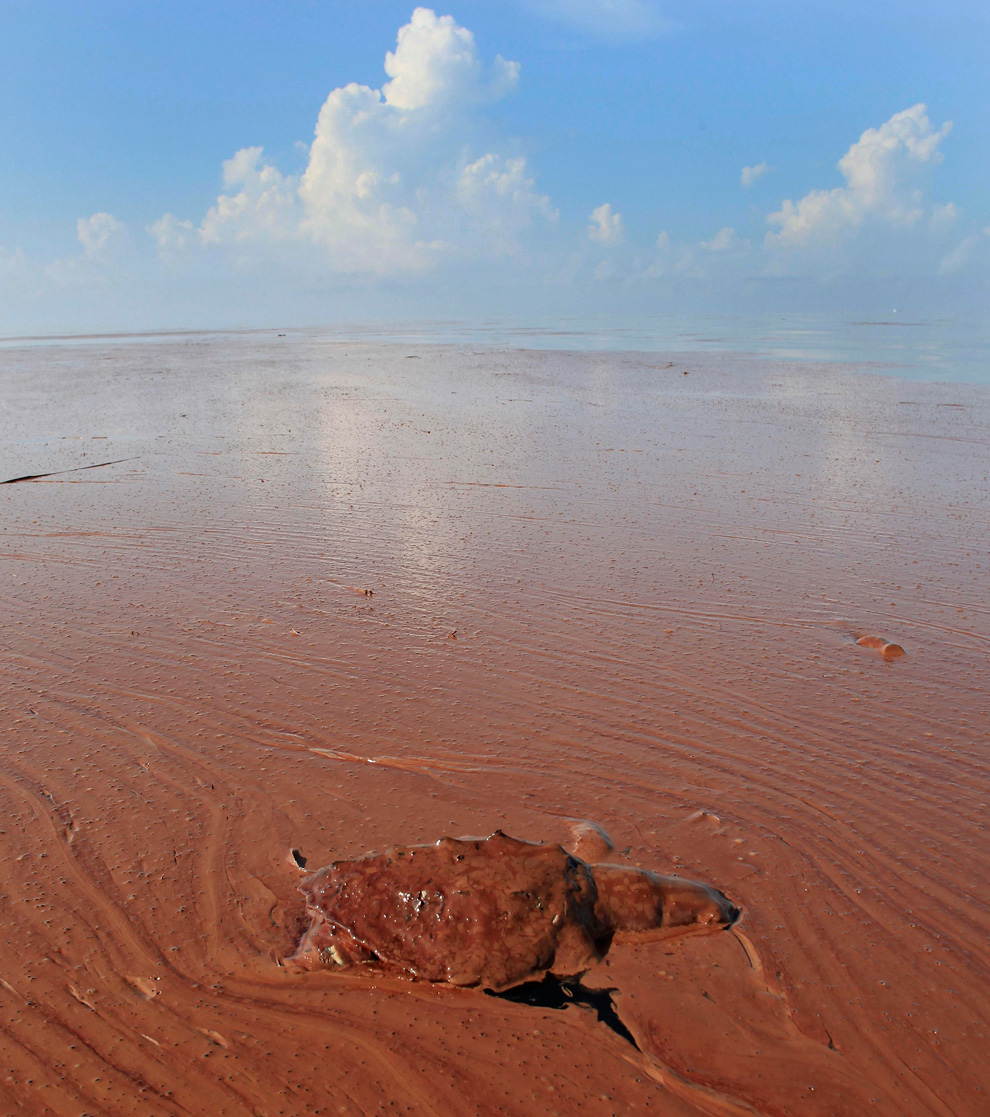 A cap has apparently been lowered on the oil leak in the Gulf of Mexico, and BP says that there are tests that need to be done to determine its effectiveness.
Meanwhile, one of the aspects of this story that is most infuriating is the collaboration between the oil giant and the US government to restrict the media's access to areas on the land and sea affected by the spill. CNN's Anderson Cooper was justifiably angry about the policy announced on July 1 that could result in fines or prison time for anyone who comes within 65 feet of a boom or vessel working on the spill.
Despite the "safety and security" rationale, this is clearly an attempt to limit images and stories that would shed more bad light on BP. Putting a corporation's interest above the right of the American people to get information is unconscionable and clearly violates the First Amendment.
The image above is an Associated Press photo of a dead turtle in a pool of oil. I found it at a blog that has collected some images of the devastation caused by the leak -- images that are generally being kept from Americans.
Wednesday, June 16, 2010
The evil hand
Last night, in his address to the nation from the Oval Office, President Obama said, in his closing paragraph, that "we pray that a hand may guide us through the storm towards a brighter day." The irony here is clear and poignant: there is a hand at work in the Gulf oil spill and it is the "invisible hand" of free-market economics. Along with BP's sloppiness and the lack of government oversight, capitalism-as-usual is responsible for the current environmental catastrophe.
Rep. Henry Waxman, the California Democrat who heads the House Energy and Commerce Committee, lists a number of points where BP could have prevented the oil rig explosion and the spill that followed but instead, each time, the multinational oil conglomerate decided on a course that was cheaper and/or faster. Guess what? That is what companies do. Similar decisions are being made all around the world right now and some of those are hurting people directly, others are hurting the planet. The only thing relevant is the bottom line.
Financial institutions almost destroyed the world economy; health-care providers are bankrupting the nation; oil companies and others have poisoned our air, water, land and food. And our response to all this? We sit here and do nothing about it. Americans seem to be numb to all that is going on around us. Capitalism chugs along, with the same results: the rich get richer, etc.
Tonight on The Daily Show, host Jon Stewart showed video of the last eight presidents, including Obama, saying that the US needs to free itself from dependence on oil, but our appetite has only increased. There is only one way to force people to use less energy: tax it more. Every elected official knows this is the only answer, but no one has the courage to do it. Oil and other fossil fuels have many "hidden costs" and one of those that is now less hidden is the environmental damage and the cost of cleaning that up. The gas tax should be raised significantly to pay for these costs.
It won't be, however, because we have become a nation of spoiled materialists. So the spill keeps spilling, people keep whining but take no action, and the invisible hand keeps sacrificing everything in the name of profit.
Rep. Henry Waxman, the California Democrat who heads the House Energy and Commerce Committee, lists a number of points where BP could have prevented the oil rig explosion and the spill that followed but instead, each time, the multinational oil conglomerate decided on a course that was cheaper and/or faster. Guess what? That is what companies do. Similar decisions are being made all around the world right now and some of those are hurting people directly, others are hurting the planet. The only thing relevant is the bottom line.
Financial institutions almost destroyed the world economy; health-care providers are bankrupting the nation; oil companies and others have poisoned our air, water, land and food. And our response to all this? We sit here and do nothing about it. Americans seem to be numb to all that is going on around us. Capitalism chugs along, with the same results: the rich get richer, etc.
Tonight on The Daily Show, host Jon Stewart showed video of the last eight presidents, including Obama, saying that the US needs to free itself from dependence on oil, but our appetite has only increased. There is only one way to force people to use less energy: tax it more. Every elected official knows this is the only answer, but no one has the courage to do it. Oil and other fossil fuels have many "hidden costs" and one of those that is now less hidden is the environmental damage and the cost of cleaning that up. The gas tax should be raised significantly to pay for these costs.
It won't be, however, because we have become a nation of spoiled materialists. So the spill keeps spilling, people keep whining but take no action, and the invisible hand keeps sacrificing everything in the name of profit.
Sunday, June 6, 2010
This land is NOT your land
 Despite Woody Guthrie's wishful thinking, this land -- "from California to the New York island" -- is not mine and it's not yours. It belongs to giant multi-national corporations, who've used America's vast natural resources to make a tiny percentage of the population obscenely wealthy.
Everyone is justifiably outraged by the current spill in the Gulf of Mexico, and the Obama Administration's frequently muddled response is deserving of criticism as well. Today's New York Times has a story that makes clear that "a hodgepodge of oversight agencies granted exceptions to rules, allowed risks to accumulate and made a disaster more likely on the rig." Most of these regulatory failures at the Deepwater Horizon rig -- owned by Transocean and leased by BP -- took place while Obama has been president, but these missteps are part of a much bigger issue: the overall weakening of government regulation over the past three decades.
While we should all be holding BP's feet to the fire -- insisting that they "make this right" as the company CEO says somberly in a new TV ad that's received widespread criticism -- this whole episode is just one example of the devastation that corporations have wrought upon the planet. Industry has been allowed to remove resources, destroy ecosystems and dump pollutants as governments colluded via campaign contributions and revolving-door jobs -- if not, in some cases, outright bribery. Air, water and land are all filled with the toxic byproducts of unbridled capitalism.
In some places -- the old Soviet Union or today's China, for example -- the average person can only stand by and watch, but in the United States we, the people, are culpable. Americans exercise their will at the ballot box locally, regionally and nationally, and we have a (theoretically) free press and now, the Internet, to provide vast quantities of information. Yet, we sit by and watch as corporations continue to level mountains, denude forests, poison waterways, darken the skies and render lifeless the oceans -- all for profit.
With apologies to Woody: This land is their land, from the redwood forest to the Gulf Stream waters. This land is here to make them rich.
Wednesday, May 26, 2010
The big leak
There are, I think, significant differences between Hurricane Katrina's devastation and British Petroleum's catastrophic oil leak into the Gulf of Mexico, but right now those differences are less important than the similarities -- and the key similarity is that many Americans perceive the federal government's reaction to the more recent disaster to be slow and incompetent.
Who can blame them? This is a nightmare and it'll have terrible long-term consequences for the Gulf, the coastal states in that region and the countless animals that will suffer and die because of the spill. BP is attempting to use another maneuver today, but it'll be a while before we know if it works. In the meantime, estimates on the amount of oil released into the Gulf are in the tens of millions of gallons.
Democratic strategist and Louisiana native James Carville slammed the Obama Administration today for its lack of fervor and imagination in response to the spill, and he is right to be angry. The government's reaction has been hesitant and uninspiring. Having said all that, I think it's clear that no one really knows what to do. BP comes up with a different idea every couple of days, but nothing has worked. They were obviously unprepared for something like this.
And there is the crux of this cataclysm. What happened after Katrina was the result of the incompetence and lack of leadership in the Bush Administration. What's happened today in the Gulf is, really, the consequences of 30 years of deregulation, begun under Ronald Reagan and pushed forward by the Republicans when they controlled Congress. Corporations act with only the bottom line in mind and it is the job of government to keep them honest.
The regulatory system has clearly failed here -- as it did in the recent coal-mining disaster and as it did in the run-up to the financial crisis. Some of those failures occurred on Obama's watch, and therefore he and his adminsitrati0n are responsible. The time to overhaul the Mine Safety and Health Administration and the Minerals Management Service was before the coal-mine explosion and the oil-rig explosion. Yes, there would likely have been a GOP push-back against such reforms without these disasters on the front page, but we elect people to make those hard choices and to do what is best. At this juncture, we've clearly been let down.
Who can blame them? This is a nightmare and it'll have terrible long-term consequences for the Gulf, the coastal states in that region and the countless animals that will suffer and die because of the spill. BP is attempting to use another maneuver today, but it'll be a while before we know if it works. In the meantime, estimates on the amount of oil released into the Gulf are in the tens of millions of gallons.
Democratic strategist and Louisiana native James Carville slammed the Obama Administration today for its lack of fervor and imagination in response to the spill, and he is right to be angry. The government's reaction has been hesitant and uninspiring. Having said all that, I think it's clear that no one really knows what to do. BP comes up with a different idea every couple of days, but nothing has worked. They were obviously unprepared for something like this.
And there is the crux of this cataclysm. What happened after Katrina was the result of the incompetence and lack of leadership in the Bush Administration. What's happened today in the Gulf is, really, the consequences of 30 years of deregulation, begun under Ronald Reagan and pushed forward by the Republicans when they controlled Congress. Corporations act with only the bottom line in mind and it is the job of government to keep them honest.
The regulatory system has clearly failed here -- as it did in the recent coal-mining disaster and as it did in the run-up to the financial crisis. Some of those failures occurred on Obama's watch, and therefore he and his adminsitrati0n are responsible. The time to overhaul the Mine Safety and Health Administration and the Minerals Management Service was before the coal-mine explosion and the oil-rig explosion. Yes, there would likely have been a GOP push-back against such reforms without these disasters on the front page, but we elect people to make those hard choices and to do what is best. At this juncture, we've clearly been let down.
Tuesday, December 15, 2009
Take it down
 Tell them to take down the giant American flag that hangs in front of the New York Stock Exchange. Bankers and other corporate executives have shown in the last couple of years that they care nothing about the United States and its people. Their only motivation is the bottom line.
The president met with CEOs of some of the nation's biggest financial institutions yesterday and they all played nice; in the meantime, they are lobbying Congress to weaken proposed reforms that would increase regulation of the industry to prevent meltdowns of the entire economy, such as the recent "Great Recession," which required massive amounts of tax dollars to avoid a total collapse and an actual depression.
Obama asked the "fatcats" to lend more to small businesses and the bankers made some half-hearted rumblings. They only get spurred into action when there is a pot of gold awaiting them at the other end. Then the bankers are willing to take wild risks that jeopardize the entire economy. When the flimsiness of their complex financial machinations was revealed all of us had to chip in to buoy the banks up. The system is, as many described it, socialism for big banks and big corporations.
Do us a favor guys. Take the Stars and Stripes down and put up something that really represents who you are wand what you do. Maybe the pirates' skull and crossbones?
Thursday, December 3, 2009
The tragedy at Bhopal
Another anniversary today: this one shameful. It was 25 years ago today that a Union Carbide factory in Bhopal, India, released a cloud of toxic gas that killed immediately about 4,000 people and another 10,000 to 20,000 people over time.
There's an op-ed piece in today's New York Times about the tragedy: how Dow Chemical -- which bought Union Carbide in 2001 -- disclaims any responsibility from the event; and how the CEO of UC at the time has never been extradited from the US despite the international arrest warrant in his name.
Of course, the poor and powerless of the world don't stand a chance when it comes to multi-national corporations and their relentless pillaging of the world's resources. The water, the air, the soil, the food, the social fabric of society -- whatever sits in the way of profit doesn't stand a chance.
There's an op-ed piece in today's New York Times about the tragedy: how Dow Chemical -- which bought Union Carbide in 2001 -- disclaims any responsibility from the event; and how the CEO of UC at the time has never been extradited from the US despite the international arrest warrant in his name.
Of course, the poor and powerless of the world don't stand a chance when it comes to multi-national corporations and their relentless pillaging of the world's resources. The water, the air, the soil, the food, the social fabric of society -- whatever sits in the way of profit doesn't stand a chance.
Friday, November 28, 2008
I'm buying nothing today
While some have been out since before sunrise to scoop up bargains and begin their holiday shopping, I am going to adhere to a small but growing movement that has taken Black Friday and turned it into something smarter and less stressful: Buy Nothing Day.
In the Western World, especially in the Unites States, we consume and throw away an obscene amount of stuff. The Internet video called "The Story of Stuff" does a nice job demonstrating how unsustainable our current path is. Buy Nothing Day attempts to ween us from our corporate-marketing driven impulse to collect more stuff -- of at least the day symbolically highlights the issue at a time when Americans are hitting the malls and commercial sites online.
One of the problems that is currently facing our financial system is that many people in this country are in debt. With our SUVs, plasma TVs, iPods, cell phones and all kinds of other gadgets, we are eating up the planet's resources, poisoning our environment and burying ourselves in debt. On top of that, some people went out and bought houses that they couldn't afford.
As I said, today is symbolic -- so don't shoot me if you see me out getting an espresso (I will not, however, be at any mall, big-box retailer, chain store, etc., for now or the foreseeable future) -- but it's what we do day-to-day and throughout the year that matters. I personally have a number of things I do to live a less throwaway life, but I will let today serve as motivation to do even more.
Update: On Long Island a Wal-Mart employee was trampled to death by the savage crowd that entered the store at 5 a.m. Meanwhile, in Southern California, two men killed each other when a gun battle broke out in a Toys R Us. Looks like the holiday spirit is upon us.
I saw a woman who had been waiting outside a store since Thursday afternoon the Newshour last night, and she said that her family was angry with her for missing Thanksgiving dinner, but she felt that shopping for bargains was more important. Consumerism has robbed many of us of our humanity.
In the Western World, especially in the Unites States, we consume and throw away an obscene amount of stuff. The Internet video called "The Story of Stuff" does a nice job demonstrating how unsustainable our current path is. Buy Nothing Day attempts to ween us from our corporate-marketing driven impulse to collect more stuff -- of at least the day symbolically highlights the issue at a time when Americans are hitting the malls and commercial sites online.
One of the problems that is currently facing our financial system is that many people in this country are in debt. With our SUVs, plasma TVs, iPods, cell phones and all kinds of other gadgets, we are eating up the planet's resources, poisoning our environment and burying ourselves in debt. On top of that, some people went out and bought houses that they couldn't afford.
As I said, today is symbolic -- so don't shoot me if you see me out getting an espresso (I will not, however, be at any mall, big-box retailer, chain store, etc., for now or the foreseeable future) -- but it's what we do day-to-day and throughout the year that matters. I personally have a number of things I do to live a less throwaway life, but I will let today serve as motivation to do even more.
Update: On Long Island a Wal-Mart employee was trampled to death by the savage crowd that entered the store at 5 a.m. Meanwhile, in Southern California, two men killed each other when a gun battle broke out in a Toys R Us. Looks like the holiday spirit is upon us.
I saw a woman who had been waiting outside a store since Thursday afternoon the Newshour last night, and she said that her family was angry with her for missing Thanksgiving dinner, but she felt that shopping for bargains was more important. Consumerism has robbed many of us of our humanity.
Tuesday, May 20, 2008
Ain't that America
 The Boston Globe today has a pair of stories that highlight the different worlds that many in the United States live in.
First, there is a piece on the falling life expectancy of women in eastern Maine. While Americans extended their average lifespan in the past few decades to around 80, there was a significant decrease in 3% of counties nationwide. Only one of those -- Washington County, Maine -- is in the northeast. Here is one woman's story:
Dolly Jordan matter-of-factly described a lifetime of poverty -- swiping her former husband's pocket change to buy food for her five children; making macaroni-and-ketchup suppers when tomato sauce cost too much. These days, the 61-year-old is obese, with high blood pressure and diabetes. Badly hurt when her car was hit by a drunk driver 16 years ago, she said, she is dependent on a wheelchair and in chronic pain.Jordan sees her doctor less often than she should, because it's hard for her to get out, she said, and she doesn't exercise because she can barely stand. With $97 in monthly food stamps, she stocks up on hot dogs, hamburger, and chicken, hunting through the freezers for the cheapest packages.
Meanwhile, another article in the Globe tells us that Red Sox owner John Henry is going to tear down a mansion that he just bought for $16 million, even after the previous owner renovated the structure in the 1990s. The problem with the existing building?
The larger house, a red brick Colonial revival with ivy-covered walls, contains seven bedrooms, eight bathrooms, and two half-bathrooms. A separate wing houses the pool, a media room, a playroom, and staff quarters...Henry, who I'm sure owns other houses as well, seems like a nice enough guy, but it is depressing -- even vulgar -- that he gets to play with houses as though it's a game of Monopoly while so many others struggle to get through each day. Our system of capitalism is unjust to the point of criminality.
It made more sense to build a new house rather than to try to add one to the site of either of the existing houses, both of which sit on either side of a ridge. Henry wanted his house atop the hillside.
Thursday, May 15, 2008
Choosing profit over human rights
 Far be it for some to allow the distractions of genocide to get in the way of making money. Shareholders for several mutual funds managed by Boston-based Fidelity Investments voted down proposals that would have prohibited investment in companies linked to genocide or human rights violations.
Fidelity's rationale is that the company is "obligated to achieve the best returns for shareholders." Wait a second -- How about your obligations as human beings?
Friday, March 14, 2008
That sinking feeling
 A top economist says that the US could be headed for the worst recession since World War II, and a major Wall Street investment bank is borrowing money from a competitor just to stay afloat. The Dow was down 200 points at midday as a result. Are we on the brink of financial collapse?
Friday, February 1, 2008
There will be...profit
 Yesterday it cost me $28 to fill up the tank on my crappy little Hyundai at the Mobil station at the intersection of Meridian and Condor streets. Today I hear that Exxon Mobil announced that its profit for 2007 was just over $40 billion. That is profit, not sales (which were more than $400 billion).
And still, America's oil and energy companies -- including Exxon Mobil -- receive billions of dollars in tax breaks and subsidies from the US government. So they screw us at the pump and then they screw us again via the tax code.
Nice work -- if you have no soul.
Friday, December 28, 2007
Ignoring the realities of capitalism
 Late in the film Michael Clayton, when the title character, played by George Clooney, casts off his role of defending wealthy screw-ups and the giant corporations they work for and gives uNorth -- the mythical agrochemical multinational that's been knowingly poisoning groundwater for years -- what they deserve, the small crowd at the Capitol Theater in Arlington gave out a cheer. Like other films of this genre, the audience is on the side of the renegade lawyer/whistle blower/victim, and that is both the way the director and writer have set things up as well as the way it should be.
However, what occurred to me as I sat there the other night was this: Why doesn't the same emotion expressed in the dark of the cinema follow us out when the film is over so that we may call corporations to task for what they are doing in the real world and how they are affecting our actual lives?
Instead, we shrug and allow this to continue all around us. Maybe corporations are so skilled at diverting our attention and obfuscating the truth that we don't know exactly what is going on; or maybe we look at the problems and just feel like they are too overwhelming to deal with; or maybe, sadly, we are so used to our comfortable and convenient lives that we choose not to look behind the curtain or to avert our eyes even when the curtain is pulled back by someone else.
It is sad and disheartening. Chemical companies continue to pollute the air, the water and the soil; agribusiness corporations and fast-food chains sell us processed food products that wreak havoc on our health; the energy and mining industries rape and pollute the planet; pharmaceutical companies convince us we need to be constantly medicated; retail stores screw workers from the US and abroad by demanding cheaper products to fatten their profit margins; insurance companies go to great lengths to avoid paying benefits to those who deserve them; financial services corporations keep us all in debt with outlandish interest rates; and the beat goes on.
This is not a few rogue elements operating in the system; this IS the system. Capitalism ensures that all decisions made by corporations use the bottom line as the only criteria. As a result, any concerns about public health, the environment or justice take a back seat. Meanwhile, the majority of us sit here and watch, saving our outbursts for darkened movie theaters.
Subscribe to:
Posts (Atom)