Suffolk Downs is partnering with the world's largest gaming company to bring a $600 million casino to the East Boston/Revere racetrack. Suffolk lead owner Richard Fields announced today a "strategic alliance" with Caesars Entertainment, which "owns or manages casino resorts on four continents."
Of course, the state legislature has yet to legalize casinos in the Bay State, and right now a bill filed by East Boston state Sen. Anthony Petruccelli that would authorize three resort casinos is sitting idly, but speculation is that the legislature will take up the matter this summer.
Those opposed to bringing casinos to Massachusetts are looking for a comprehensive, independent study of the effects, positive and negative, that such a move will bring to our state. So far, no such study has been authorized, and some feel that this is an attempt to downplay or hide the actual consequences of expanded gaming.
Neighbors of Suffolk Downs will be hosting "A Forum on Expanded Gambling" at the Winthrop Middle School on Wednesday, May 4.
Showing posts with label gambling. Show all posts
Showing posts with label gambling. Show all posts
Thursday, April 14, 2011


Wednesday, March 16, 2011
Demanding the truth
There's a bill in the state legislature that calls for an independent and comprehensive cost/benefit analysis of expanded gambling in Massachusetts, and John Ribeiro is leading the charge locally for passage of the bill. S.150 was filed by Sen. Stephen Brewer, a Democrat from Barre, back in January. It's currently before the Joint Committee on Economic Development and Emerging Technologies, as is a bill that would authorize three casinos in the state.
It's inconceivable that a proposal with the impact of legalized casino gambling would go forward without the public -- and the elected officials who are voting on it -- knowing exactly what the pros and cons would be, but that is what the pro-gambling forces tried last year, and it's what they will try again. Of course, the gambling lobby and their supporters on Beacon Hill understand that a truly honest study will include much to be concerned about, and that don't want you and me to see that.
East Boston will be negatively impacted by a casino at Suffolk Downs. We demand a legitimate study in order to fully understand exactly what we're getting ourselves into.
It's inconceivable that a proposal with the impact of legalized casino gambling would go forward without the public -- and the elected officials who are voting on it -- knowing exactly what the pros and cons would be, but that is what the pro-gambling forces tried last year, and it's what they will try again. Of course, the gambling lobby and their supporters on Beacon Hill understand that a truly honest study will include much to be concerned about, and that don't want you and me to see that.
East Boston will be negatively impacted by a casino at Suffolk Downs. We demand a legitimate study in order to fully understand exactly what we're getting ourselves into.
Thursday, August 19, 2010
Tracks struggle
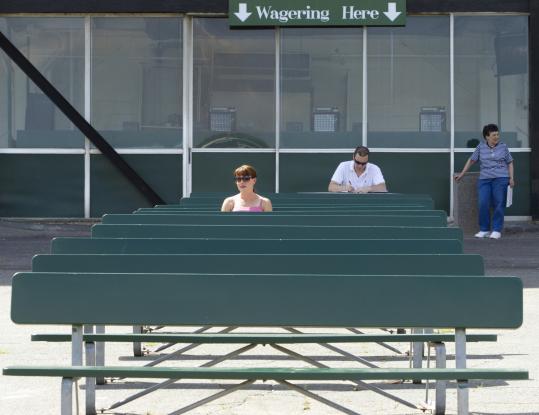 The Globe reports today that Wonderland has shut down. The Revere greyhound track was hanging on in the hope that expanded gambling would save it after a voter-approved initiative outlawing dog racing went into effective Jan. 1. A few days ago the newspaper reported that Suffolk Downs is making cutbacks. The state egislature is scheduled to return to formal session in January, and it's likely that a gambling bill will emerge again.
Photo from Boston.com
Friday, August 6, 2010
Just when you thought it was safe...
It appears that gambling may not be dead after all. Like Jason in the Friday the 13th movies, the Globe is reporting that the bill could be brought back to life because the legislature may need to return to formal session for other business. Hopefully, wiser heads will prevail. Stay tuned.
Tuesday, August 3, 2010
Not with a bang, but with a whimper?
Both sides are saying that any chance for a gambling bill to emerge from this legislative session is over. Gov. Patrick sent the bill back to the House and Senate with an amendment that strips out slot machines (and such an amended bill would, apparently, need a two-thirds majority, which I hadn't realized), and Speaker DeLeo is saying publicly that any such compromise is "doubtful." There is still time, but neither side looks like it's willing to budge.
While those of us against the idea are edging ever closer to victory, it seems like an unsatisfying win. Most of the state's elected officials were willing to dispense with even the simple step of commissioning an independent study of casino gambling and the benefits and negative consequences of bringing it to Massachusetts. Our own local officials were not interested in a real discussion of what slots or a casino at Suffolk Downs would mean to the people and business owners of East Boston.
Politicians are, too often, willing to go along with something because of the way it appears rather than because it is actually something good. The tax-free weekend (Aug 14-15) that the legislature recently passed is a case in point. It doesn't really help anyone. While consumers may save a few bucks here and there, those dollars are already spent in the state budget, so we're all going to have to fork them over sooner or later. As for businesses, studies show that almost all of the money spent on those weekends is for purchases that would have been made anyway. At best, it's a wash for businesses because they need to pay extra money to have more employees working during the busy weekend, but they are still paying for the regular shifts on other weekends when those customers aren't coming in.
Like the idea of bringing casinos and slot machines to this state, it's all glitter and no substance. Unfortunately, our legislators are like infants who get easily sidetracked by shiny things.
While those of us against the idea are edging ever closer to victory, it seems like an unsatisfying win. Most of the state's elected officials were willing to dispense with even the simple step of commissioning an independent study of casino gambling and the benefits and negative consequences of bringing it to Massachusetts. Our own local officials were not interested in a real discussion of what slots or a casino at Suffolk Downs would mean to the people and business owners of East Boston.
Politicians are, too often, willing to go along with something because of the way it appears rather than because it is actually something good. The tax-free weekend (Aug 14-15) that the legislature recently passed is a case in point. It doesn't really help anyone. While consumers may save a few bucks here and there, those dollars are already spent in the state budget, so we're all going to have to fork them over sooner or later. As for businesses, studies show that almost all of the money spent on those weekends is for purchases that would have been made anyway. At best, it's a wash for businesses because they need to pay extra money to have more employees working during the busy weekend, but they are still paying for the regular shifts on other weekends when those customers aren't coming in.
Like the idea of bringing casinos and slot machines to this state, it's all glitter and no substance. Unfortunately, our legislators are like infants who get easily sidetracked by shiny things.
Sunday, August 1, 2010
Squaring off over final bill
The Governor and the Speaker have squared off in a steel-cage match of sorts, with last night's legislative-session deadline of midnight passing and neither backing down. Both the House (120-37) and Senate (25-15) passed the final compromise bill -- which would allow for three casinos and two slot parlors in the state -- but Gov. Deval Patrick has said all along that he was leery of slots. He did grudgingly agree to accept one and only if there were a bidding process for the license.
What now? You have to believe that Patrick gamed this out with some plan for victory. He's been pushing expanded gambling -- and courting the blue-collar vote that goes with it -- for three years. He can't allow himself to be seen as the obstructionist when the goal is so close. So he sends back the bill with an amendment that strips one or both of the slot parlors from the proposal, tossing the proverbial ball back into the legislature's court.
House Speaker Bob DeLeo and Senate President Therese Murray have both said they would not bring their bodies back in session, but neither of them wants to be the obstacle to passage. They'll make sure it gets done and still be able to say, "Hey, I fought for slots, but it wasn't in the cards." All three leaders will then claim victory.
What now? You have to believe that Patrick gamed this out with some plan for victory. He's been pushing expanded gambling -- and courting the blue-collar vote that goes with it -- for three years. He can't allow himself to be seen as the obstructionist when the goal is so close. So he sends back the bill with an amendment that strips one or both of the slot parlors from the proposal, tossing the proverbial ball back into the legislature's court.
House Speaker Bob DeLeo and Senate President Therese Murray have both said they would not bring their bodies back in session, but neither of them wants to be the obstacle to passage. They'll make sure it gets done and still be able to say, "Hey, I fought for slots, but it wasn't in the cards." All three leaders will then claim victory.
Friday, July 30, 2010
Casino compromise reached, but governor not on board
Boston.com is reporting that House and Senate negotiators have reached an agreement that would bring three casinos and two slot parlors to Massachusetts, but moments later Gov. Deval Patrick released a statement that said, "I cannot support this bill in its current form."
The governor has said all along that he's not in favor of bringing slots to the state; however, he agreed last week to accept the machines in one location, provided there is a competitive bidding process for them. He has implied that he will veto a bill that isn't in line with those provisions.
The two-year legislative session ends tomorrow, and both House Speaker Bob DeLeo and Senate President Therese Murray say they have no plans to bring legislators back after that. Even if they did, it remains to be seen if both houses could override a gubernatorial veto.
The governor has said all along that he's not in favor of bringing slots to the state; however, he agreed last week to accept the machines in one location, provided there is a competitive bidding process for them. He has implied that he will veto a bill that isn't in line with those provisions.
The two-year legislative session ends tomorrow, and both House Speaker Bob DeLeo and Senate President Therese Murray say they have no plans to bring legislators back after that. Even if they did, it remains to be seen if both houses could override a gubernatorial veto.
Monday, July 26, 2010
Uncompromising
More negotiations, but no agreement on a casino bill. The three principals -- Gov. Patrick, House Speaker DeLeo, Senate Pres. Murray -- have made statements regarding their desire to reach a compromise, but each has also said that the legislative session may end Saturday without one.
Just throwing this out there: Could any (all?) of the three have their own reservations about bringing expanded gambling to the state and so will ensure that no law gets signed while appearing to certain constituent groups -- union voters, developer donors -- to be on their side?
Just throwing this out there: Could any (all?) of the three have their own reservations about bringing expanded gambling to the state and so will ensure that no law gets signed while appearing to certain constituent groups -- union voters, developer donors -- to be on their side?
Wednesday, July 21, 2010
Clock ticks on gambling bill
 It's been two weeks since members of a House/Senate conference committee first sat down to create a compromise bill that would expand gambling in Massachusetts, but -- with just 10 days remaining in the legislative session -- there is no indication that the two sides have been able to reach a consensus. As I understand it, failure to get a bill approved by both bodies on the governor's desk by July 31 means that the process would have to start from scratch when the legislature convenes again in the fall.
To give the process a bump forward, a dozen small-city mayors backed House Speaker Bob DeLeo's plan for for slots at tracks in a letter yesterday. Their motivation is some quick cash to close municipal budget shortfalls. However, mayors of the state's larger cities, including Boston's Tom Menino, are not on board with the request. The Globe story says that one sticking point for Menino is that he wants Boston cops in charge of law enforcement at any casino within city limits, while DeLeo's bill calls for the state police to have jurisdiction.
Meanwhile, The New York Times reports that New Jersey's governor is proposing that a state authority "take over the troubled gambling district." Yeah, that sounds like something we want to invite into our own backyard.
Image from Internet blog
Friday, July 16, 2010
Gambling round-up
***As expanded gambling comes closer to a reality in Massachusetts, those who stand to walk away with massive amounts of our money have turned up the lobbying heat on Beacon Hill. The Associated Press reports that $1.8 million was spent on lobbyists in the first half of this year, mostly by out-of-state companies. Suffolk Downs spent more than a half-million dollars. In 2009, $2 million was spent on gambling lobbyists. Some of that money went directly to elected officials' campaign funds: last year lobbyists contributed $8,000 to House Speaker Bob DeLeo, $7,800 to Senate President Therese Murray and $4,900 to Gov. Deval Patrick.
***Mayor Menino has decided that the developer who failed to go forward with a project at Downtown Crossing should not profit from any casino that might be built at Suffolk Downs. Vornado Realty Trust, a New York City company worth some $20 billion, owns 20% of the racetrack, but the developer has angered the mayor and that is a no-no in this city. (See Yoon, Sam) Menino is right on this issue, but he is inviting gambling interests into Boston and in the future he can expect to be partners with much more unsavory characters than this.
***Brian McGrory's column from earlier this week discusses the positions state leaders have staked out on casino legislation and his suggestion to solve the impasse.
***Dan Rea's radio program Nightside was scheduled to have guests for and against casino gambling last night. I wasn't able to listen, but I'd be interested in what people thought of it. Thanks to Neighbors of Suffolk Downs for keeping us updated on such things.
***Mayor Menino has decided that the developer who failed to go forward with a project at Downtown Crossing should not profit from any casino that might be built at Suffolk Downs. Vornado Realty Trust, a New York City company worth some $20 billion, owns 20% of the racetrack, but the developer has angered the mayor and that is a no-no in this city. (See Yoon, Sam) Menino is right on this issue, but he is inviting gambling interests into Boston and in the future he can expect to be partners with much more unsavory characters than this.
***Brian McGrory's column from earlier this week discusses the positions state leaders have staked out on casino legislation and his suggestion to solve the impasse.
***Dan Rea's radio program Nightside was scheduled to have guests for and against casino gambling last night. I wasn't able to listen, but I'd be interested in what people thought of it. Thanks to Neighbors of Suffolk Downs for keeping us updated on such things.
Tuesday, July 6, 2010
Coming soon to a racetrack near you
 Suffolk Downs today released a preview of its plans for a resort-style casino on the East Boston/Revere line. Note that elderly folks with oxygen tanks and children left in cars are missing from the attractive drawing.
Image from David M. Schwarz Architects via Boston.com.
Monday, July 5, 2010
'A false jackpot'
A few excerpts from an editorial in yesterday's New York Times on the "delusions" that some have about casino gambling:
Gamblers aren’t the only ones prone to jackpot delusions. Politicians all over see casinos as magic revenue chests that will help them avoid painful spending cuts, escape the trap of no-tax pledges and make budget gaps vanish.
...
Casinos are a magnet for tainted money and promote addiction, crime and other ills.
...
The state’s politicians should also stop chasing gamblers. At a time when casino revenue is slumping across the country, it doesn’t even make economic sense. They need to make hard decisions on taxes and spending, and focus on developing stable industries, improving education and working their way to growth. If they keep holding out for a false jackpot, everyone will lose.
Friday, July 2, 2010
Leaping without looking
As the state legislature comes together to hash out a final bill that would bring casinos to Massachusetts --the Senate passed its version last night -- here are a few myths that need to be discussed:
Myth #1: It's a jobs bill.
Just because a proposal creates jobs, it isn't primarily "a jobs bill." The Iraq War created jobs in the military, but the authorization for the use of force passed by Congress was not "a jobs bill." A bill to increase border security in the Southwest would create more Border Patrol agents, but it isn't "a jobs bill." Let's call things what they are instead of cloaking them in catchy and misleading slogans.
Of course, some jobs will be created -- some short-term construction jobs and some long-term jobs in the casino and its other businesses. Most of those will be low-paying jobs -- for example, black-jack dealers, which a magazine recently called one of the 20 worst jobs in America, with an average salary of $16,000. A family of two living on that salary would qualify for food stamps and other benefits. While the casino reaps profits, you and I will be paying the social costs.
Myth #2: Suffolk Downs is a sympathetic local business.
Suffolk Downs principal owner is Richard Fields, chairman of Coastal Development, which "finances and develops resort properties, entertainment venues, and casino gaming facilities," according to the company web site. He's not a local guy here to help the community; he is a multi-millionaire who sees a chance to make more millions, money that will go from the pockets of working people and into his bank account -- instead of local restaurants and stores.
How are Suffolk employees treated? Some of the people who currently make their living at the track are jockeys, groomers, trainers and stable hands. Unfortunately, it appears that Fields doesn't think they deserve medical care that's as good as the horses get, so the group Boston Health Care for the Homeless comes by the track two mornings a week to check out broken bones, bites, bruises and other hazards of the trade.
Myth #3: A casino will benefit city and state government.
In testimony last year before the Florida legislature, Earl Grinols, a professor at Baylor and a gaming expert, said that "costs to the government resulting from casino gambling is three dollars for every dollar generated by the activity."
Don't take his word for it. Look at comments from two people who've served as mayor of Ledyard, Conn., the town that hosts Foxwoods:
Mayor Wesley Johnson: "I've become very cynical about this operation ...There has been no economic development spin-off from the casino."
Mayor Susan Mendenhall: "You have no idea how much [the casino] has cost our town ... millions, and it is on the backs of taxpayers."
I'm not saying I have all the answers -- or any of them. I'm just saying that building a casino right here in East Boston could have sweeping consequences, and before the legislature passes a final bill and the governor signs it into law there should be a comprehensive, independent study of the issue.
For our elected officials to lurch forward without doing so is nothing less than dereliction of duty.
Myth #1: It's a jobs bill.
Just because a proposal creates jobs, it isn't primarily "a jobs bill." The Iraq War created jobs in the military, but the authorization for the use of force passed by Congress was not "a jobs bill." A bill to increase border security in the Southwest would create more Border Patrol agents, but it isn't "a jobs bill." Let's call things what they are instead of cloaking them in catchy and misleading slogans.
Of course, some jobs will be created -- some short-term construction jobs and some long-term jobs in the casino and its other businesses. Most of those will be low-paying jobs -- for example, black-jack dealers, which a magazine recently called one of the 20 worst jobs in America, with an average salary of $16,000. A family of two living on that salary would qualify for food stamps and other benefits. While the casino reaps profits, you and I will be paying the social costs.
Myth #2: Suffolk Downs is a sympathetic local business.
Suffolk Downs principal owner is Richard Fields, chairman of Coastal Development, which "finances and develops resort properties, entertainment venues, and casino gaming facilities," according to the company web site. He's not a local guy here to help the community; he is a multi-millionaire who sees a chance to make more millions, money that will go from the pockets of working people and into his bank account -- instead of local restaurants and stores.
How are Suffolk employees treated? Some of the people who currently make their living at the track are jockeys, groomers, trainers and stable hands. Unfortunately, it appears that Fields doesn't think they deserve medical care that's as good as the horses get, so the group Boston Health Care for the Homeless comes by the track two mornings a week to check out broken bones, bites, bruises and other hazards of the trade.
Myth #3: A casino will benefit city and state government.
In testimony last year before the Florida legislature, Earl Grinols, a professor at Baylor and a gaming expert, said that "costs to the government resulting from casino gambling is three dollars for every dollar generated by the activity."
Don't take his word for it. Look at comments from two people who've served as mayor of Ledyard, Conn., the town that hosts Foxwoods:
Mayor Wesley Johnson: "I've become very cynical about this operation ...There has been no economic development spin-off from the casino."
Mayor Susan Mendenhall: "You have no idea how much [the casino] has cost our town ... millions, and it is on the backs of taxpayers."
I'm not saying I have all the answers -- or any of them. I'm just saying that building a casino right here in East Boston could have sweeping consequences, and before the legislature passes a final bill and the governor signs it into law there should be a comprehensive, independent study of the issue.
For our elected officials to lurch forward without doing so is nothing less than dereliction of duty.
Wednesday, June 30, 2010
Forum feedback
Some thoughts on tonight's "Forum on Casino Gambling at Suffolk Downs":
1. The event began more than a half-hour late for no reason that was evident or announced to the crowd, which became restless and started chanting for things to begin. The forum finally began at 7:07 p.m. I left about 8:10 while the question session was going on.
2. The format was apparently decided on the fly, as the moderator would, at each juncture, look back and forth and around the room as if to say, "How should we do this?" I'm not sure why time wasn't used to figure out the ground rules while the speakers were standing and chit-chatting.
3. I don't know why Suffolk Downs COO Chip Tuttle was included among elected officials who were given time to speak. I didn't vote for him and neither did anyone else in the room. Plus, his weekly newsletter is distributed free to all of us.
4. Some elected officials, in a move that seemed rather arrogant, made clear that they were going to speak longer than the time allotted. Since some of them are part of the bill-crafting process and have the media at their disposal -- especially the East Boston Times, which is their mouthpiece -- it seems unfair that they would go past the time they were given when members of the public were limited to writing questions on pieces of paper.
5. The most misguided -- and frankly, offensive -- statement was that an independent and comprehensive study of the positives and negatives of casino gambling in Massachusetts is not needed. Huh? Since the research that the legislature is currently using was provided by studies funded by the casino industry AND since an independent study of casino gambling nationally, cited tonight by one of the speakers for the opposition, shows that there are $3 of public expenditure for every $1 expanded gambling brings to a state, it would seem shortsighted and negligent not to have one done -- unless proponents of casinos do not want the public to see the list of consequences that a study reveals.
1. The event began more than a half-hour late for no reason that was evident or announced to the crowd, which became restless and started chanting for things to begin. The forum finally began at 7:07 p.m. I left about 8:10 while the question session was going on.
2. The format was apparently decided on the fly, as the moderator would, at each juncture, look back and forth and around the room as if to say, "How should we do this?" I'm not sure why time wasn't used to figure out the ground rules while the speakers were standing and chit-chatting.
3. I don't know why Suffolk Downs COO Chip Tuttle was included among elected officials who were given time to speak. I didn't vote for him and neither did anyone else in the room. Plus, his weekly newsletter is distributed free to all of us.
4. Some elected officials, in a move that seemed rather arrogant, made clear that they were going to speak longer than the time allotted. Since some of them are part of the bill-crafting process and have the media at their disposal -- especially the East Boston Times, which is their mouthpiece -- it seems unfair that they would go past the time they were given when members of the public were limited to writing questions on pieces of paper.
5. The most misguided -- and frankly, offensive -- statement was that an independent and comprehensive study of the positives and negatives of casino gambling in Massachusetts is not needed. Huh? Since the research that the legislature is currently using was provided by studies funded by the casino industry AND since an independent study of casino gambling nationally, cited tonight by one of the speakers for the opposition, shows that there are $3 of public expenditure for every $1 expanded gambling brings to a state, it would seem shortsighted and negligent not to have one done -- unless proponents of casinos do not want the public to see the list of consequences that a study reveals.
Tuesday, June 29, 2010
Abandon your money -- and your kids
Globe columnist Kevin Cullen does a good job raising only some of the pertinent issues in the legislature's rush to permanently change the culture and quality of life in this state by introducing expanded gambling. The first part of his piece today describes the machinations involved in arranging a local referendum on a proposed casino, but take a look at the last half of his column:
In the same week Massachusetts state troopers buried one of their own, a father of four run down by an accused drunk driver while he was questioning another accused drunk driver, the Massachusetts Senate voted to let casinos serve free booze to their customers.
What do you call a state that endorses the concept of getting its citizens liquored up and taking their money in a game of chance that’s stacked against them?
“Nuts,’’ said Susan Tucker, a Democrat from Andover, and one of a minority of senators who thinks this is madness.
“We outlawed happy hours in this state because we had statistical evidence that they increased the number of fatalities and serious injuries,’’ she said. “And now we’re saying it’s OK for casinos to have an open bar? We’re overturning our public safety laws for a predatory industry.’’
Welcome to Mississippi-on-the-Charles, where anything goes, as long as it convinces some corporation that it’ll be able to maximize its ability to fleece people. We are so desperate for jobs, so desperate for tax revenue, that we will sell our collective souls, and then redefine what constitutes those souls.
To be fair, the Senate is asking the casinos to step up to the plate on at least one thing: The bill would require casinos to check their parking lots regularly for abandoned children and animals.
“Maybe it’s me,’’ Susan Tucker said, “but if we believe there are going to be children and pets abandoned because of this industry, should we be facilitating them? I don’t remember ever requiring a biotech company to check its parking lots for abandoned children.’’
Meanwhile, a few elected officials and a representative from Suffolk Downs have been added to the program of Wednesday night's "Forum on Casino Gambling," which will be held at Don Orione starting at 6:30 p.m. This move, I think, is a terrible idea. The politicians' opinions are always broadcast through the media, and as for Suffolk COO Chip Tuttle -- well, we get to see the East Boston Times play footsie with him every week.
Tuesday, June 22, 2010
Casino forum site shifted
The site for next week's "forum on the benefits and disadvantages of building a resort-style casino at Suffolk Downs" has been changed to the Don Orione Hall at 150 Orient Ave. The event, scheduled for June 30 at 6:30 p.m. and sponsored by the East Boston Times, will feature a discussion between proponents and opponents of the issue. Details can be found at Neighbors of Suffolk Downs.
In the meantime, former AG Scott Harshbarger outlines a few questions that need to be asked -- and answered -- before the state lurches ahead with casino gambling.
In the meantime, former AG Scott Harshbarger outlines a few questions that need to be asked -- and answered -- before the state lurches ahead with casino gambling.
Saturday, June 19, 2010
Times continues Suffolk lovefest
The East Boston Times continues to shill for Suffolk Downs as the track moves forward on its quest to bring expanded gambling to the Eastie/Revere line. In a front-page story this week, Times' new favorite son Chip Tuttle, Suffolk's chief operating officer, is quoted extensively from his appearance at a recent public hearing -- and between his quotes the newspaper itself sounds like a Suffolk press release.
Though three people who support the gambling proposals are mentioned in the story by name -- Tuttle, State Sen. Anthony Petruccelli and Teamsters leader Sean O'Brien -- no one opposed to the idea is named or quoted directly. There are exactly two sentences in the story that express a contrary opinion and in both cases the people holding those opinions are referred to as "some." For example: "Expanded gaming or full scale resort-style casino’s in the Commonwealth are not going to be as epidemic as crack was in the 1980s as some suggested at the public hearing."
Yes, that is an undoctored sentence from the story (and the spelling and punctuation errors are the newspaper's, not mine.) The Times would have us believe that fear of a crack epidemic is the best argument that those against a rush to casinos have. It is, of course, a commonly used tactic: rebut the most far-fetched opposition argument you can so as to divert attention from smart, solid arguments.
Why won't the East Boston Times dedicate some space to a real discussion of an issue that is of huge importance to this neighborhood?
Though three people who support the gambling proposals are mentioned in the story by name -- Tuttle, State Sen. Anthony Petruccelli and Teamsters leader Sean O'Brien -- no one opposed to the idea is named or quoted directly. There are exactly two sentences in the story that express a contrary opinion and in both cases the people holding those opinions are referred to as "some." For example: "Expanded gaming or full scale resort-style casino’s in the Commonwealth are not going to be as epidemic as crack was in the 1980s as some suggested at the public hearing."
Yes, that is an undoctored sentence from the story (and the spelling and punctuation errors are the newspaper's, not mine.) The Times would have us believe that fear of a crack epidemic is the best argument that those against a rush to casinos have. It is, of course, a commonly used tactic: rebut the most far-fetched opposition argument you can so as to divert attention from smart, solid arguments.
Why won't the East Boston Times dedicate some space to a real discussion of an issue that is of huge importance to this neighborhood?
Wednesday, June 2, 2010
Senate casino plan unveiled
The leadership of the state Senate today announced their plan to legalize casino gambling in Massachusetts, and the proposal differs in one key way from the plan approved by the House: no slot parlors at the state's four racetracks.
Speaker Bob DeLeo has been the biggest proponent of bringing the flashing, ringing gambling machines to Suffolk Downs, Wonderland, Raynham and Plainridge, but Senate President Therese Murray and Gov. Deval Patrick have been vocal in their distaste for slots.
Unlike DeLeo's blatant disregard for the citizenry, the Senate will hold a public hearing on its proposal on Tuesday. Of course, one hearing announced six days prior is not a very open process, but big money has co-opted this issue and it appears to many a foregone conclusion.
The anti-casino battle is led by Kathleen Conley Norbut, the leader of United to Stop Slots in Massachusetts.
Speaker Bob DeLeo has been the biggest proponent of bringing the flashing, ringing gambling machines to Suffolk Downs, Wonderland, Raynham and Plainridge, but Senate President Therese Murray and Gov. Deval Patrick have been vocal in their distaste for slots.
Unlike DeLeo's blatant disregard for the citizenry, the Senate will hold a public hearing on its proposal on Tuesday. Of course, one hearing announced six days prior is not a very open process, but big money has co-opted this issue and it appears to many a foregone conclusion.
The anti-casino battle is led by Kathleen Conley Norbut, the leader of United to Stop Slots in Massachusetts.
Thursday, May 13, 2010
Follow the money
A friend who works at an East Boston non-profit recently told me that it has become more difficult to get MassPort to drop a contribution on the place, and the agency doesn't even return phone calls like they used to. He added that Suffolk Downs has become much more accessible and willing to make donations.
Of course, it all makes sense. MassPort doesn't need us much any more. They got almost everything they wanted in the past decade (additional runway, centerfield taxiway), so there's not as much motivation to smooth over ties with the neighborhood. There is still the consolidated rent-a-car facility, but it seems that there is less of an activist mindset in Eastie anyway. The Latino community here doesn't see Logan Airport as the encroaching beast that Italian-Americans of older generations did because the newer residents haven't been mowed over in a battle with MassPort yet.
Suffolk Downs, on the other hand, needs us. Multi-millionaire Richard Fields bought the track to build a casino there once the state's political establishment came around to approving expanded gambling, and now they're almost there. In order to quiet those in the neighborhood who might raise a ruckus, it helps to give cash to local non-profits. Community agencies can always use the help, and the total is just a tiny percentage of what Fields will make once the slots and table games start raking it in.
The East Boston Times is doing its part to support the racetrack. There have been nothing but pro-Suffolk Downs and pro-casino gambling stories in the local weekly, and this week the paper published a Suffolk Downs press release, also available on the track's web site, verbatim on the front of the sports section. Shouldn't readers be made aware that this material is written as marketing pablum?
Of course, it all makes sense. MassPort doesn't need us much any more. They got almost everything they wanted in the past decade (additional runway, centerfield taxiway), so there's not as much motivation to smooth over ties with the neighborhood. There is still the consolidated rent-a-car facility, but it seems that there is less of an activist mindset in Eastie anyway. The Latino community here doesn't see Logan Airport as the encroaching beast that Italian-Americans of older generations did because the newer residents haven't been mowed over in a battle with MassPort yet.
Suffolk Downs, on the other hand, needs us. Multi-millionaire Richard Fields bought the track to build a casino there once the state's political establishment came around to approving expanded gambling, and now they're almost there. In order to quiet those in the neighborhood who might raise a ruckus, it helps to give cash to local non-profits. Community agencies can always use the help, and the total is just a tiny percentage of what Fields will make once the slots and table games start raking it in.
The East Boston Times is doing its part to support the racetrack. There have been nothing but pro-Suffolk Downs and pro-casino gambling stories in the local weekly, and this week the paper published a Suffolk Downs press release, also available on the track's web site, verbatim on the front of the sports section. Shouldn't readers be made aware that this material is written as marketing pablum?
Thursday, April 15, 2010
The House always wins
The Massachusetts House of Representatives overwhelmingly approved a bill that would bring casino gambling to the state, including slot machines to racetracks. Speaker Bob DeLeo pushed hard on the legislation, ramming it through quickly without public hearings, and the vote was 120-37. It remains to be seen what the Senate version of the bill will look like, as Senate President Therese Murray has indicated she is not in favor of slot machines at the tracks, a position echoed by the governor.
Among those who voted for the proposal, which I think is a terrible idea for East Boston, is our state Rep. Carlo Basile. Here is an excerpt from my September 2007 interview with Basile published on this site:
Among those who voted for the proposal, which I think is a terrible idea for East Boston, is our state Rep. Carlo Basile. Here is an excerpt from my September 2007 interview with Basile published on this site:
Hubster: I’ll throw out a few issues, and you tell me in a few sentences what you think. Casino gambling?Basile had many good questions then, and maybe he's received satisfactory answers to them. It would be nice if those answers were shared with the rest of us.
Basile: I don’t know enough about it. Don’t know at what cost. What’s East Boston going to get in return? Can our infrastructure support it? We’re a blue-collar neighborhood. People get their checks once a month. We don’t want them running to the casino and giving it up all in one day. We’re going to pay for it anyway, so what are we getting in return? Are we going to hurt more people? I know it’s going to create jobs, but at what cost? At this point I can’t say that I’m for it and I can’t say that I’m against it. I just need to educate myself more about it.
Hubster: What if it wasn’t at Suffolk Downs, but in Massachusetts in general?
Basile: I believe in the whole general concept of casino gambling. Massachusetts residents are running to Connecticut and making Connecticut rich, but I just don’t know if Suffolk Downs is the place to put it. We already have a major airport. We have three tunnels. We’re dealing with a lot already in East Boston.
Subscribe to:
Posts (Atom)