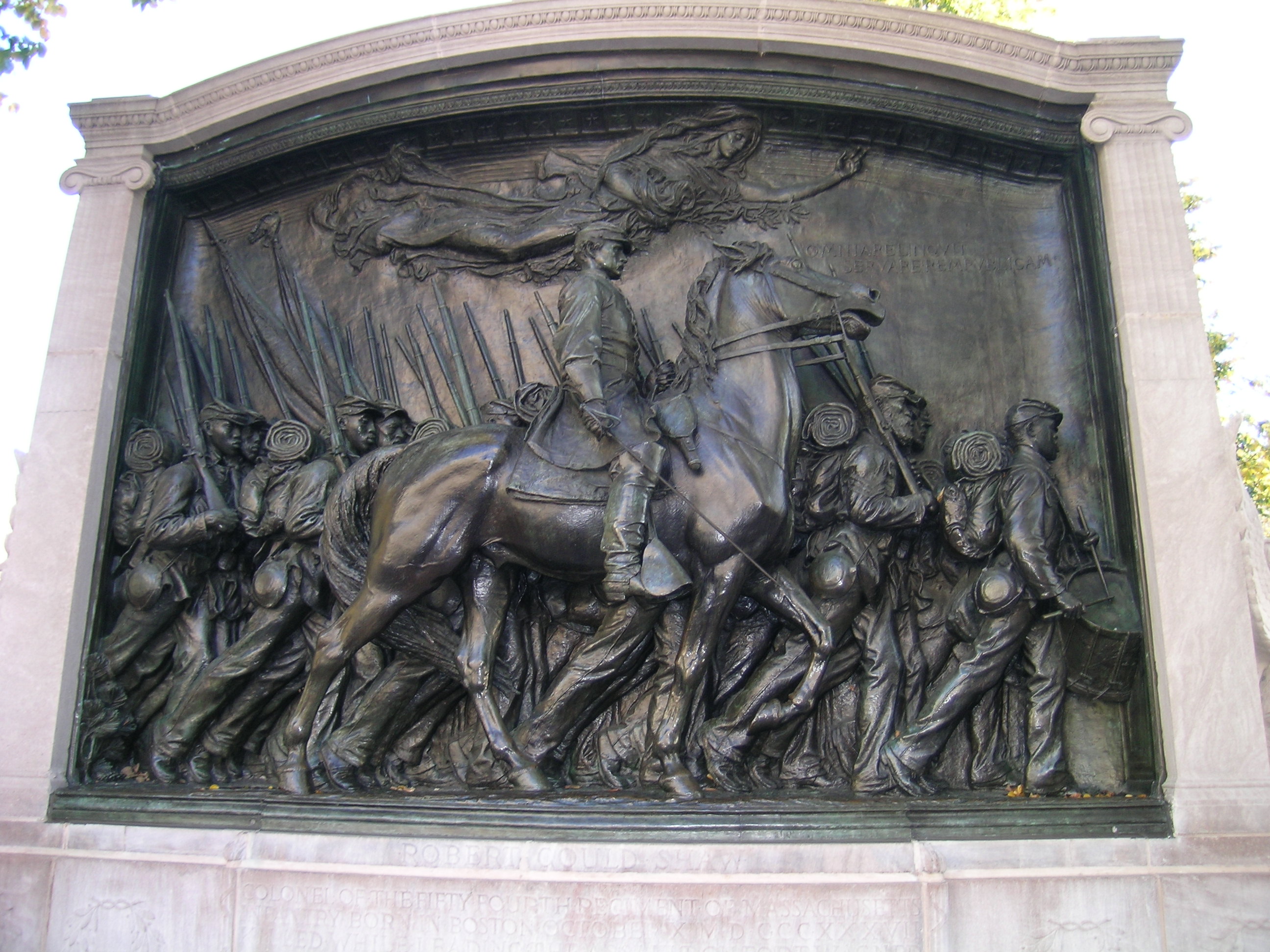
On Memorial Day in 1897, a work of art was unveiled to the public at the edge of the Boston Common, across from the State House. It was a bronze bas-relief by the American master Augustus Saint-Gaudens commemorating the 54th Massachusetts Volunteer Infantry Regiment and its leader, Colonel Robert Gould Shaw. The 54th was one of the first units composed of black soldiers to fight in the Civil War, and Shaw was from a Boston abolitionist family.
Considered by many to be the finest piece of public art in Boston, as well as one of Saint-Gaudens' masterpieces, the work depicts the 54th on May 28, 1863, marching down Beacon Street and off to war, with Shaw on horseback and an angel floating above. Shaw and 29 of his men died in South Carolina less than two months later, but throughout the war, the 54th fought with distinction. The regiment was portrayed in the Oscar-winning 1989 film Glory.
Showing posts with label war. Show all posts
Monday, May 30, 2011
Tuesday, May 3, 2011
Choosing our own future
Osama Bin Laden is dead. Good riddance. Don't believe Joe Scarborough or other moronic pundits who claim that President Obama went against his supporters on the left by taking out the head of Al-Qaeda. None of us are shedding a tear for Bin Laden. He got what he deserved.Bin Laden was evil -- but he wasn't stupid. A realistic assessment of his actions suggest that he accomplished some of what he set out to do. The goal was to entice the US into a protracted ground war in Afghanistan in order to bankrupt America and to radicalize the Muslim world against the West. And the result? The US military is approaching a decade in Afghanistan, plus eight years in Iraq, and together those campaigns have cost two or three trillion dollars. Meanwhile, there has been some radicalization of small groups of Muslims.
We're still here, of course, and we can ensure that Bin Laden's goals are not fully accomplished if we wrap things up in Iraq and Afghanistan, and if we use our military a bit more sparingly in the future. This is not a call for demilitarization or isolationism, but only for wisdom and foresight. America cannot go on spending as much as all other countries combined on the military, and America cannot go on deploying its forces all over the world.
Let us regroup at home and lead by example so that the US once again occupies the moral high ground. If America had invaded Afghanistan after 9/11 with a smart plan and an exit strategy and if the country hadn't taken its eye off the ball by getting wrapped up in Iraq, then thousands of lives and trillions of dollars might have been saved. We might have had to wait for a small team of soldiers to take out Bin Laden 10 years after the fact, but that is what happened any way.
Tuesday, December 21, 2010
Tension on Korean peninsula
South Korea, with encouragement from the US, carried out military drills with live fire right next to the border with North Korea, further stressing the relationship with its unpredictable communist neighbor. This morning the South is on standby in case of attack.
The North has frequently taken aggressive action in the 57 years since the armistice brought an end to the war that killed 350,000 Korean soldiers and 2.5 million Korean civilians, as well as 36,000 Americans, at least 200,000 Chinese and several thousand from other countries. The leadership of the communist state is irrational and no one wants to see them get away with the recent attack on the South's Yeonpyeong Island or last spring's attack on a naval ship.
However, instigating a nuclear war is certainly in no one's interest, and so the US and South Korea need to think long and hard before they provoke the North. The entire world has a stake in what happens there.
Image courtesy socioecohistory.wordpress.com.
The North has frequently taken aggressive action in the 57 years since the armistice brought an end to the war that killed 350,000 Korean soldiers and 2.5 million Korean civilians, as well as 36,000 Americans, at least 200,000 Chinese and several thousand from other countries. The leadership of the communist state is irrational and no one wants to see them get away with the recent attack on the South's Yeonpyeong Island or last spring's attack on a naval ship.
However, instigating a nuclear war is certainly in no one's interest, and so the US and South Korea need to think long and hard before they provoke the North. The entire world has a stake in what happens there.
Image courtesy socioecohistory.wordpress.com.
Friday, December 3, 2010
Truth as treason
I may not be a First Amendment absolutist, but I'm pretty close. I will allow that there are a few limited areas where national security trumps press freedom, but those should be quite narrow. Democracy depends on the citizenry having access to information, and few concerns should ever be allowed to top that principle.
In the four years of its existence, WikiLeaks has risen from nowhere to be a prominent shaper of news and information. Such is the way that technology affects us these days: Facebook, YouTube, Twitter and now WikiLeaks begin as an idea or a few lines of code and soon the way we see and understand the world is changed permanently.
Julian Assange, the force behind the site, is a wanted man these days. In the wake of WikiLeaks latest revelation -- 250,000 cables of US State Department reports -- a number of governments are investigating the Australian nomad, while Swedish authorities want to talk to him about sexual assault charges he has called phony. It's hard to see how this guy survives unless he takes cover underground for a very long time.
Texas Rep. Ron Paul tweeted this today: "Re: Wikileaks - In a free society, we are supposed to know the truth. In a society where truth becomes treason, we are in big trouble." While Paul -- a hardcore libertarian -- and I would disagree on many issues, on this one we share similar views. The US government has too many secrets. I am for a default position of openness and transparency in all branches and at all levels of government. WikiLeaks may have embarrassed the US and some of its allies this week, but exposing some of the workings of the State Department is, overall, a good thing.
When US missiles hit targets in Yemen one year ago, for example, it is the right of Americans AND Yemenis to know where those weapons came from, especially when many of those killed in these attacks were civilians -- including 14 women and 21 children. WikiLeaks is not the institution that illegally invaded Iraq and that has been occupying Afghanistan for nine years. That would be the US government.
News that Amazon.com dropped WikiLeaks from its servers yesterday and that today a New Hampshire company killed the domain WikiLeaks.org (find the site here, at WikiLeaks.ch) after Connecticut Sen. Joe Lieberman made some threatening comments is quite disturbing. This is not the way we treat information in the United States -- with the government actively seeking to prevent Americans from reading the truth. We're moving -- if we haven't been there since the passage of the PATRIOT Act -- toward 1984 territory. In that prophetic novel, one of the dystopian government's slogans would seem to be one that the US is now embracing: "Ignorance is strength."
In the four years of its existence, WikiLeaks has risen from nowhere to be a prominent shaper of news and information. Such is the way that technology affects us these days: Facebook, YouTube, Twitter and now WikiLeaks begin as an idea or a few lines of code and soon the way we see and understand the world is changed permanently.
Julian Assange, the force behind the site, is a wanted man these days. In the wake of WikiLeaks latest revelation -- 250,000 cables of US State Department reports -- a number of governments are investigating the Australian nomad, while Swedish authorities want to talk to him about sexual assault charges he has called phony. It's hard to see how this guy survives unless he takes cover underground for a very long time.
Texas Rep. Ron Paul tweeted this today: "Re: Wikileaks - In a free society, we are supposed to know the truth. In a society where truth becomes treason, we are in big trouble." While Paul -- a hardcore libertarian -- and I would disagree on many issues, on this one we share similar views. The US government has too many secrets. I am for a default position of openness and transparency in all branches and at all levels of government. WikiLeaks may have embarrassed the US and some of its allies this week, but exposing some of the workings of the State Department is, overall, a good thing.
When US missiles hit targets in Yemen one year ago, for example, it is the right of Americans AND Yemenis to know where those weapons came from, especially when many of those killed in these attacks were civilians -- including 14 women and 21 children. WikiLeaks is not the institution that illegally invaded Iraq and that has been occupying Afghanistan for nine years. That would be the US government.
News that Amazon.com dropped WikiLeaks from its servers yesterday and that today a New Hampshire company killed the domain WikiLeaks.org (find the site here, at WikiLeaks.ch) after Connecticut Sen. Joe Lieberman made some threatening comments is quite disturbing. This is not the way we treat information in the United States -- with the government actively seeking to prevent Americans from reading the truth. We're moving -- if we haven't been there since the passage of the PATRIOT Act -- toward 1984 territory. In that prophetic novel, one of the dystopian government's slogans would seem to be one that the US is now embracing: "Ignorance is strength."
Sunday, November 28, 2010
Korea, China and the 21st Century
US Navy ships are in the Yellow Sea today for exercises with the South Korean Navy. I hope this has been thought out. What will happen if North Korea fires on American vessels? Will the US retaliate? And after that? We certainly cannot be girding up for another war, this one against a country that does indeed have nuclear weapons -- most of which are pointed at the South Korean capital of Seoul and its 10 million residents.
North Korea's leader Kim Jong-il is unpredictable -- possibly even crazy. In addition, that country's military leaders may make decisions on their own, and it's hard to say if that is better or worse. It's also relevant to take note that the South Korean military was already engaged in exercises that pressed right up against the border of the two Koreas, which the North has said provoked their shelling. As one web site points out, this fact has been buried by the American media.
However, the key to this entire situation -- and we are hearing this more and more often these days -- is China. North Korea's only ally, the Chinese government could be quite helpful right now, but it's been hesitant to chasten Pyongyang in the past -- at least publicly. If China were to embrace its growing importance on the world stage by stepping up to play key roles in geopolitical disputes, economic crises and environmental concerns, that would seem to make life easier for everyone, but Beijing continues to work at its own pace.
I saw an interesting statistic last week: In 2009 China used twice as much steel as the US, the European Union and Japan COMBINED. Beijing's economic growth is surging at a level the world has never before seen. China recently became the world's second-largest economy, passing Japan, and China is the world's largest emitter of greenhouse gases. If the 1900s were the American Century, this is quickly becoming the Chinese Century.
North Korea's leader Kim Jong-il is unpredictable -- possibly even crazy. In addition, that country's military leaders may make decisions on their own, and it's hard to say if that is better or worse. It's also relevant to take note that the South Korean military was already engaged in exercises that pressed right up against the border of the two Koreas, which the North has said provoked their shelling. As one web site points out, this fact has been buried by the American media.
However, the key to this entire situation -- and we are hearing this more and more often these days -- is China. North Korea's only ally, the Chinese government could be quite helpful right now, but it's been hesitant to chasten Pyongyang in the past -- at least publicly. If China were to embrace its growing importance on the world stage by stepping up to play key roles in geopolitical disputes, economic crises and environmental concerns, that would seem to make life easier for everyone, but Beijing continues to work at its own pace.
I saw an interesting statistic last week: In 2009 China used twice as much steel as the US, the European Union and Japan COMBINED. Beijing's economic growth is surging at a level the world has never before seen. China recently became the world's second-largest economy, passing Japan, and China is the world's largest emitter of greenhouse gases. If the 1900s were the American Century, this is quickly becoming the Chinese Century.
Sunday, October 24, 2010
The truth on Iraq
The pile of documents from the Iraq war that was released by WikiLeaks seems to add evidence to the argument that the supposed success of the so-called Surge touted by the Bush Administration and Sen. John McCain is a myth. Other factors had already come together to slow the violence in Iraq even before the first extra troops arrived and the political reconciliation -- for which the Surge was intended to create breathing room -- has never happened.
Speaking of Iraq, a new book by Gen. Hugh Shelton, the former chairman of the Joints Chiefs of Staff, says that George W. Bush was dead set against invading that country when Defense Sec. Donald Rumsfeld came to him not long after 9/11. Bush, according to Shelton, wanted to deal only with Afghanistan, but Rumsfeld went ahead and had the Pentagon draw up plans to invade Iraq and kept beating the drum -- presumably with Dick Cheney at his side -- until Bush agreed.
As blogger Andrew Sullivan writes of Iraq:
Speaking of Iraq, a new book by Gen. Hugh Shelton, the former chairman of the Joints Chiefs of Staff, says that George W. Bush was dead set against invading that country when Defense Sec. Donald Rumsfeld came to him not long after 9/11. Bush, according to Shelton, wanted to deal only with Afghanistan, but Rumsfeld went ahead and had the Pentagon draw up plans to invade Iraq and kept beating the drum -- presumably with Dick Cheney at his side -- until Bush agreed.
As blogger Andrew Sullivan writes of Iraq:
This whole enterprise designed to rid the world of danger has increased danger in the world; an attempt to end a torture regime led to widespread torture by Iraqi government forces, and, of course, by the US itself; a bid to encourage democracy will in all likelihood lead to either chaos or a Shiite strongman; an endeavor seeking to weaken Iran has ended in empowering it.
Friday, August 13, 2010
More alike than you think
I am only part of the amateur left. I have been critical of Barack Obama, who I voted for in both the primary and the general, on a wide range of issues. Gibbs comments are off the mark for a couple of reasons. First, they call to mind the story, possibly apocryphal, about FDR, who told liberal reformers at one point, "I agree with you. I want to do it. Now make me do it." As a citizen, it's my duty, I believe, to say what I think; it's not my job to worry about how my criticism plays out politically.
More deeply, however, what Gibbs' little rant ignores is that those of us on the left understand the political realities and the national climate; we are not unaware of how these factors can limit a president's legislative agenda. I wanted the stimulus package to be more sweeping; I wanted health-care reform to be more bold; I wanted financial regulation to be tougher. Each of these bills was watered down in Congress. I wish the president had been more forceful and had pushed harder, but I understand the obstacles. I wanted to see immigration reform and an energy bill, but I understand that there was no appetite for either. With majorities in both houses and control of the White House, I hoped the Democrats would be more aggressive, but there were some victories.
Much more troubling than these issues, however, is this administration's failings on foreign policy, civil rights, government transparency and national security. Salon.com blogger Glenn Greenwald does a commendable job keeping up with these issues, and to be honest my level of disappointment with Obama in these areas is through the roof. The US military is still in Iraq and Afghanistan, people are still being held in American military prisons without being charged and tried, way too much information is still kept secret and Americans are still being spied on by their government. On these and other similar issues Obama is indeed "like George Bush." And implying that those of us who are willing to speak the truth are chemically impaired is an insult and a disgrace.
Thursday, July 8, 2010
Reality in Afghanistan
Five Afghan soldiers were killed Wednesday when a NATO air strike mistook them for the enemy, and so America's war in Afghanistan under a newly appointed general continues as it had under the previous few -- not a complete disaster, but certainly a distressing failure. GOP chairman Michael Steele's latest firestorm-inducing comments that the Afghan War is "not something the United States had actively prosecuted or wanted to engage in" was ludicrous, but the other part of his statement on the subject -- that it is "a war of Obama's choosing"-- is only partly off base. The president may not have chosen to invade Afghanistan, a decision made by George W. Bush in the wake of the 9/11 attacks, but after a methodical review last year Obama ordered an increase in troops, shaking off the advice of Vice President Joe Biden -- a man he'd in theory added to the ticket for his extensive foreign policy experience.
Obama should have known better. While it's true that politically he would have been excoriated if he'd rejected General McChrystal's request last year for more troops and instead initiated a withdrawal, it was the right thing to do and that should always take precedence over the politics. US forces have been in Afghanistan for nine years and now there is no easy way out. The Taliban are going to come back -- they are there now and they will be everywhere in Afghanistan as soon as the American troops leave. I certainly don't want them in power; I don't want them shutting all the girls' schools and enforcing their theocracy. However, the US cannot stay there forever.
What we needed to do back in 2001 was to set a clear goal, accomplish it and pull out. Our military, along with the Afghan enemies of the Taliban known as the Northern Alliance, took the capital of Kabul in just five weeks. We pushed the Taliban out of power and we retaliated for 9/11. At that point the US should have left victorious, but instead our government leaders decided that we could build a democratic nation from scratch. The vision of the world guiding our political leadership of the time was "American exceptionalism," which holds that we are somehow better than everyone else. Such thinking led us into two wars at the same time, one of which we initiated completely. As a result we have thousands of dead American soldiers, tens of thousands of dead Iraqis and Afghans, and a government even more in debt at the worst possible moment.
I recently saw a documentary of the Afghan War called "Restrepo," which follows a platoon of US soldiers who spend a year at a small forward base in the Korangal Valley in eastern Afghanistan. The guys spent most days getting shot at and then taking their anger out on the nearby villagers. In the end our soldiers pulled back from the valley without building the road they'd promised the locals. Sebastian Junger, who co-directed and shot the movie and wrote a book, "War," based on his time with the troops, writes in Vanity Fair magazine, "By many measures, Afghanistan is falling apart." Historian and writer William Dalrymple, just back from Afghanistan, says, "The war has lost all semblance of shape or form." One Afghan elder told Dalrymple, "The Americans know that this war is lost. It is only their politicians who pretend they can win it."
It's time to stop pretending.
Obama should have known better. While it's true that politically he would have been excoriated if he'd rejected General McChrystal's request last year for more troops and instead initiated a withdrawal, it was the right thing to do and that should always take precedence over the politics. US forces have been in Afghanistan for nine years and now there is no easy way out. The Taliban are going to come back -- they are there now and they will be everywhere in Afghanistan as soon as the American troops leave. I certainly don't want them in power; I don't want them shutting all the girls' schools and enforcing their theocracy. However, the US cannot stay there forever.
What we needed to do back in 2001 was to set a clear goal, accomplish it and pull out. Our military, along with the Afghan enemies of the Taliban known as the Northern Alliance, took the capital of Kabul in just five weeks. We pushed the Taliban out of power and we retaliated for 9/11. At that point the US should have left victorious, but instead our government leaders decided that we could build a democratic nation from scratch. The vision of the world guiding our political leadership of the time was "American exceptionalism," which holds that we are somehow better than everyone else. Such thinking led us into two wars at the same time, one of which we initiated completely. As a result we have thousands of dead American soldiers, tens of thousands of dead Iraqis and Afghans, and a government even more in debt at the worst possible moment.
I recently saw a documentary of the Afghan War called "Restrepo," which follows a platoon of US soldiers who spend a year at a small forward base in the Korangal Valley in eastern Afghanistan. The guys spent most days getting shot at and then taking their anger out on the nearby villagers. In the end our soldiers pulled back from the valley without building the road they'd promised the locals. Sebastian Junger, who co-directed and shot the movie and wrote a book, "War," based on his time with the troops, writes in Vanity Fair magazine, "By many measures, Afghanistan is falling apart." Historian and writer William Dalrymple, just back from Afghanistan, says, "The war has lost all semblance of shape or form." One Afghan elder told Dalrymple, "The Americans know that this war is lost. It is only their politicians who pretend they can win it."
It's time to stop pretending.
Monday, April 12, 2010
A look at the Immigration Station
Boston.com has a story, photos and a video about the East Boston Immigration Station, which saw tens of thousands pass through between 1920 and the mid-1940s. At that point the Marginal Street facility was used to intern people of German and Japanese descent after the United States entered World War II.
Today the structure is decrepit and it's owned by Massport, which is considering tearing it down, though some in the neighborhood are hoping to save and rehabilitate this slice of Eastie's history. One web site is behind the idea. As usual, I expect no attempt by the Evil Empire to consider what local residents think when making a decision that affects our neighborhood.
Monday, April 5, 2010
Video of US attack on civilians leaked
Am extremely disturbing video of an American military helicopter shooting up Iraqi civilians, including journalists and children, has been posted on the site WikiLeaks.org and its authenticity has been confirmed, according to The New York Times, by sources inside the American military.
Among the approximately eight people killed in the July 2007 attack were Namir Noor-Eldeen and Saeed Chmagh, both employees of Reuters, an international news agency based in London. Two children appear to have been wounded in the shooting as well.
Many of those targeted in the attack appear to be unarmed, including the journalists, who have what look like cameras slung over their shoulders. The audio of US military personnel is sickening, with one soldier hoping that a desperately wounded journalist picks up a weapon so the Apache helicopter can "engage" again. When a pilot is informed that children were wounded he is overheard saying, “Well, it’s their fault for bringing their kids into a battle.”
But there was no battle -- at least not in the square where the firing takes place. There were a number of men walking unhurriedly, and then when a van pulls up to collect the bodies of those killed in the initial attack the soldiers call excitedly for permission to shoot up the van, where two children were sitting in the front seat.
This video, which Reuters has been trying to get hold of and which was leaked to the WikiLeaks site, should be the subject of an investigation by Congress. It alone should make each of us question the use of American military power in Iraq as well as elsewhere.
Among the approximately eight people killed in the July 2007 attack were Namir Noor-Eldeen and Saeed Chmagh, both employees of Reuters, an international news agency based in London. Two children appear to have been wounded in the shooting as well.
Many of those targeted in the attack appear to be unarmed, including the journalists, who have what look like cameras slung over their shoulders. The audio of US military personnel is sickening, with one soldier hoping that a desperately wounded journalist picks up a weapon so the Apache helicopter can "engage" again. When a pilot is informed that children were wounded he is overheard saying, “Well, it’s their fault for bringing their kids into a battle.”
But there was no battle -- at least not in the square where the firing takes place. There were a number of men walking unhurriedly, and then when a van pulls up to collect the bodies of those killed in the initial attack the soldiers call excitedly for permission to shoot up the van, where two children were sitting in the front seat.
This video, which Reuters has been trying to get hold of and which was leaked to the WikiLeaks site, should be the subject of an investigation by Congress. It alone should make each of us question the use of American military power in Iraq as well as elsewhere.
Friday, January 29, 2010
Bringing history to life
Students at the Umana Middle School have helped develop a video game that is set during the Battle of Chelsea Creek, a little-known but key skirmish during the American Revolution that took place just off-shore of East Boston.
A Boston Globe story today talks about the game and other elements of Eastie's history that are on display at the Cultural Exchange Center at 80 Border Street.
Monday, January 11, 2010
Eastie wrap
***In an update on the city's dealings with the H1N1 virus, Boston.com reports on a Boston Public Health Commission analysis that shows that East Boston was hit with a higher than average rate of flu cases back in the spring, but a much lower rate during the second wave of cases in the fall.
***Globe columnist Kevin Cullen had a nice story last week on the re-dedication of the local ice rink to Lou Porrazzo, a local son who was killed in action in Vietnam on Sept. 27, 1967.
***A guy who robbed an Eastie convenience store yesterday is wanted by the Boston Police for a string of robberies. There's a photo of him here on the web site of the Dorchester Reporter.
***The story of Sal, the East Boston cat summoned to jury duty, is being widely reported. I even found a link to it at the bottom of a Wall Street Journal summary of "The Best of the Web" under the heading, "Everything is Seemingly Spinning Out of Control."
***Globe columnist Kevin Cullen had a nice story last week on the re-dedication of the local ice rink to Lou Porrazzo, a local son who was killed in action in Vietnam on Sept. 27, 1967.
***A guy who robbed an Eastie convenience store yesterday is wanted by the Boston Police for a string of robberies. There's a photo of him here on the web site of the Dorchester Reporter.
***The story of Sal, the East Boston cat summoned to jury duty, is being widely reported. I even found a link to it at the bottom of a Wall Street Journal summary of "The Best of the Web" under the heading, "Everything is Seemingly Spinning Out of Control."
Sunday, November 22, 2009
Obama needs to rise to challenge
I know that Barack Obama is working on numerous fronts to bring forth policies that I believe in, but the ride is slow, bumpy and not at all guaranteed to succeed -- and it seems that the president hasn't been fighting enough to make these important changes come to fruition. I cannot help but pine for a leader like Franklin Roosevelt.
Now, Obama does not have FDR's disposition and the economic mess he inherited, while serious, is not the Great Depression (and therefore, drastic action is harder to implement). More than that, however, times have changed since the 1930s and 1940s, and maybe there's no bigger example than the breadth and scrutiny of the media, evidenced by disproved lies, like Obama not being a citizen, getting significant play while an actual fact, that FDR was confined to a wheelchair, was hushed by the press of his day.
Those who have grumbled about Obama being socialist and the most radical occupant ever of the White House are ignoring that the current president is nowhere near as far to the left as Roosevelt, who quickly and forcefully empowered the government to help the "third of the nation" that was "ill-housed, ill-clad, ill-nourished," actions which had him labeled "a traitor to his class."

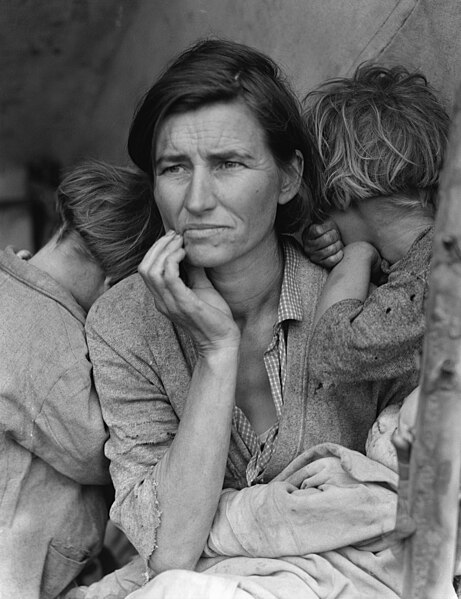
Today I watched a PBS documentary on the federal government program that sent photographers out to chronicle rural poor during the Depression, an undertaking that resulted in 160,000 images (the most famous of which, Dorothea Lange's "Migrant Mother" is to the right) that are housed in the Library of Congress and considered a national treasure. The project was conceived by a member of FDR's inner circle, and the president not only gave the go-ahead, but fought battles with Congress, which sought to defund the program because members felt the realistic and sad images reflected badly on the US.
Today, most historians consider FDR in the company of Lincoln and Washington as America's greatest presidents, and back in 2000 Time magazine chose Roosevelt as runner-up (to Albert Einstein) as the most important person of the 20th century. Despite the consequences of his paralytic illness, FDR stood up against fascism abroad and economic injustice at home. He fought the good fight like few presidents before or since. Now, in the midst again of war and economic uncertainty, I'd like to see President Obama stand tall and forcefully against the short-sighted, narrow-minded and self-serving opponents to his agenda of change.
Now, Obama does not have FDR's disposition and the economic mess he inherited, while serious, is not the Great Depression (and therefore, drastic action is harder to implement). More than that, however, times have changed since the 1930s and 1940s, and maybe there's no bigger example than the breadth and scrutiny of the media, evidenced by disproved lies, like Obama not being a citizen, getting significant play while an actual fact, that FDR was confined to a wheelchair, was hushed by the press of his day.
Those who have grumbled about Obama being socialist and the most radical occupant ever of the White House are ignoring that the current president is nowhere near as far to the left as Roosevelt, who quickly and forcefully empowered the government to help the "third of the nation" that was "ill-housed, ill-clad, ill-nourished," actions which had him labeled "a traitor to his class."
Today I watched a PBS documentary on the federal government program that sent photographers out to chronicle rural poor during the Depression, an undertaking that resulted in 160,000 images (the most famous of which, Dorothea Lange's "Migrant Mother" is to the right) that are housed in the Library of Congress and considered a national treasure. The project was conceived by a member of FDR's inner circle, and the president not only gave the go-ahead, but fought battles with Congress, which sought to defund the program because members felt the realistic and sad images reflected badly on the US.
Today, most historians consider FDR in the company of Lincoln and Washington as America's greatest presidents, and back in 2000 Time magazine chose Roosevelt as runner-up (to Albert Einstein) as the most important person of the 20th century. Despite the consequences of his paralytic illness, FDR stood up against fascism abroad and economic injustice at home. He fought the good fight like few presidents before or since. Now, in the midst again of war and economic uncertainty, I'd like to see President Obama stand tall and forcefully against the short-sighted, narrow-minded and self-serving opponents to his agenda of change.
Thursday, October 29, 2009
Decision time for Afghanistan
Twin bombshells regarding Afghanistan in the past couple of days: Foreign Service Officer Matthew Hoh's resignation; and The New York Times story that Afghan president's brother, who was widely reported to be in control of that country's drug trade, has been on the CIA payroll for years. Throw in the obvious widespread fraud during Afghanistan's presidential election, and we have a toxic mix just as President Obama is in the final stages of making a decision on future US policy in that South Asian nation.
I think that American forces need to be pulled out of Afghanistan. I understand the post-9/11 invasion, but I don't see what we are accomplishing now -- eight years later. For those on the fence, I suggest that you read Hoh's resignation letter, which makes clear the complexities of the situation and, further, says that America's presence is only making things worse. In fact, I think everyone should read the letter.
Saturday, October 10, 2009
Finding an exit strategy
I think Frank Rich nails it when he says in his latest New York Times column that the US needs to extract itself from Afghanistan. Rich points out that those who are most loudly advocating sending more troops to that country (namely, John McCain and his allies) were also the people who pushed the invasion of Iraq -- a diversion that forced Afghanistan onto the back-burner, which is why we are still there today.
"Afghanistan is not Iraq," Rich writes. "It is poorer, even larger and more populous, more fragmented and less historically susceptible to foreign intervention." And the oft-skipped over reality in Iraq is the much-touted "surge" only found some success because a) the sectarian killing had pretty much succeeded by then in purging the Sunni from Shia areas and vice-versa and b) the Sunni rose up in Anbar province because they'd had enough of the insurgents killing of Muslims.
President Obama needs to begin the withdrawal of American military personnel from Afghanistan. The US has been there long enough, the Afghan government is corrupt, our military needs a rest and our treasury cannot afford the price. The fallout will be severe from the the Right, but we are not going to win this conflict in the conventional sense. That already happened just weeks into the start of hostilities. I can see no goal that we can possibly achieve by staying. Let's declare victory and bring the troops home. The president needs to start securing the peace that his Nobel promises.
"Afghanistan is not Iraq," Rich writes. "It is poorer, even larger and more populous, more fragmented and less historically susceptible to foreign intervention." And the oft-skipped over reality in Iraq is the much-touted "surge" only found some success because a) the sectarian killing had pretty much succeeded by then in purging the Sunni from Shia areas and vice-versa and b) the Sunni rose up in Anbar province because they'd had enough of the insurgents killing of Muslims.
President Obama needs to begin the withdrawal of American military personnel from Afghanistan. The US has been there long enough, the Afghan government is corrupt, our military needs a rest and our treasury cannot afford the price. The fallout will be severe from the the Right, but we are not going to win this conflict in the conventional sense. That already happened just weeks into the start of hostilities. I can see no goal that we can possibly achieve by staying. Let's declare victory and bring the troops home. The president needs to start securing the peace that his Nobel promises.
Sunday, September 20, 2009
A small price to pay
New York Times columnist Thomas Friedman wants to see a higher gas tax and he is right. I'm not saying that I would enjoy forking over more money at the pump, but less dependence on oil is good for the environment, for our health and for our national security.Americans have long had the true costs of fuel subsidized and with global warming affecting us more, with our nation filled with overweight folks, and with the geopolitical machinations of the Middle East constantly pulling us in, we need to do what European nations have done for years: use higher gas taxes to raise money and discourage driving.
It may hurt a little, but sometimes we have to do what is best for the greater good. Our men and women in uniform and their families must not be the only ones who sacrifice for their countrymen. While I sit here comfortably and watch them on the news, I have no gripe if all I have to do is part with a few extra bucks.
Sunday, September 6, 2009
Time to go
Intelligent conservatives like former Sen. Chuck Hagel and Washington Post columnist George F. Will have publicly called at least for a reevaluation of America's goals in Afghanistan (the former) and in some cases for an end to the mission there (the latter). Liberals have been uncomfortable, if not adamantly opposed, with Obama's apparent willingness to extend the mission and to send in more troops.
It's understandable that, politically and intellectually, this is a tough nut to crack -- the hawkish right will call the president a coward and a quitter; the military will grumble that the mission isn't complete and that the US lives already lost cannot have been in vain; the insurgents will boast that America has shown a lack of fortitude as in Vietnam; future troubles in Afghanistan, as there are bound to be, will be laid at the feet of the Administration; and if there should be a large terror attack against the US, whether launched from Afghanistan or not, Obama will be tagged as an enabler -- but there are real lives at stake here, and whether American military personnel complain about the decision, their lives and sanity are in the president's hands and must be safeguarded whether they approve or not.
Further, all sides recognize the paramount importance of Pakistan in the whole terrorism house of cards. American foreign policy has to focus on how to best stabilize that country, which possesses nuclear weapons that cannot be allowed to fall into the wrong hands. (I would start by intensively brokering a relaxation of tensions between Pakistan and India, which is domestically Pakistan's biggest security concern. We have pull with India. Show some American good will while freeing up Pakistani resources to secure the northwestern tribal areas.)
But the reality here is that eight years into the US mission in Afghanistan, it looks more and more like the oft-repeated historical lesson about invading the central Asian nation (the British failed; the Soviets failed; no one can do it) is more true than not. I'm not saying that all the answers are clear here, but I am saying that diverting more blood and treasure to Afghanistan at this time now seems pointless, and it is time to get out.
It's understandable that, politically and intellectually, this is a tough nut to crack -- the hawkish right will call the president a coward and a quitter; the military will grumble that the mission isn't complete and that the US lives already lost cannot have been in vain; the insurgents will boast that America has shown a lack of fortitude as in Vietnam; future troubles in Afghanistan, as there are bound to be, will be laid at the feet of the Administration; and if there should be a large terror attack against the US, whether launched from Afghanistan or not, Obama will be tagged as an enabler -- but there are real lives at stake here, and whether American military personnel complain about the decision, their lives and sanity are in the president's hands and must be safeguarded whether they approve or not.
Further, all sides recognize the paramount importance of Pakistan in the whole terrorism house of cards. American foreign policy has to focus on how to best stabilize that country, which possesses nuclear weapons that cannot be allowed to fall into the wrong hands. (I would start by intensively brokering a relaxation of tensions between Pakistan and India, which is domestically Pakistan's biggest security concern. We have pull with India. Show some American good will while freeing up Pakistani resources to secure the northwestern tribal areas.)
But the reality here is that eight years into the US mission in Afghanistan, it looks more and more like the oft-repeated historical lesson about invading the central Asian nation (the British failed; the Soviets failed; no one can do it) is more true than not. I'm not saying that all the answers are clear here, but I am saying that diverting more blood and treasure to Afghanistan at this time now seems pointless, and it is time to get out.
Friday, September 4, 2009
Good grief
We often hear that the drug trade in Afghanistan is being used to finance the insurgency and that Muslim mosques and non-profits funnel money to terror groups. Brace yourselves for this: Our own tax dollars, spent on recovery programs in Afghanistan, may be paying for fighters and weapons that kill American soldiers and the locals who work with them.
This is extremely disturbing and further evidence of the futility of the so-called war on terror. In another way, however, it makes sense. It was American policies and money that created al-Qaeda and the Taliban. I've met the enemy and he is staring into my monitor.
Tuesday, August 4, 2009
A dark cloud
Some 240,000 people were killed directly, while many thousands more were made ill, dying later. The Empire of Japan surrendered unconditionally on Aug.15 because of the bombings and because the Soviet Union backed out of their treaty with Japan and was ready to invade from the north while the US prepared to do so from the south.
A recent poll by Quinnipiac University found that 61% of Americans believe that using the atomic bombs was the right thing to do, while 22% disagreed and 16% were undecided. It's no surprise that women, Democrats and young people were less likely to approve of the bombings than men, Republicans and older folks.
As an unabashed liberal, my first inclination is to believe that using such destructive weapons on civilian-filled cities is immoral. There is, however, a great deal to consider on this topic, and I don't disparage anyone who comes to a conclusion based on an examination of the evidence and reasoned thought -- whatever that conclusion may be. (Wikipedia has an entry on the issue that does a decent job briefly laying out the arguments on both sides.)
By the summer of 1945 it was clear that Japan could not win the war, yet Emperor Hirohito and his military commanders refused to surrender. The fighting in the Pacific went from island to island, with American forces closing in on the home islands and the Japanese employing desperate tactics, such as kamikaze pilots. After the US victory at Okinawa, plans were coming together for an invasion of Japan that was scheduled to begin on Nov. 1, 1945. Estimates were that the invasion, Operation Downfall, would bring unprecedented casualties on all sides -- possibly a million American soldiers, several million Japanese soldiers and millions more Japanese civilians.
In the end, President Truman decided that the US needed to drop the recently developed atomic bombs to hasten the end of hostilities and to save American lives, and today most in the US still see this as the right course of action. It seems, however, that some of the country's top military leaders -- General Dwight D. Eisenhower, General Douglas MacArthur, Admiral Chester Nimitz and others -- believed that the war had essentially already been won and that using the bombs was unnecessary. After meeting with Truman, Eisenhower later wrote:
During his recitation of the relevant facts, I had been conscious of a feeling of depression and so I voiced to him my grave misgivings, first on the basis of my belief that Japan was already defeated and that dropping the bomb was completely unnecessary, and secondly because I thought that our country should avoid shocking world opinion by the use of a weapon whose employment was, I thought, no longer mandatory as a measure to save American lives.I'm not saying it was an easy decision then or that it's an easy judgment today. I'm just saying that when top military people -- including a five-star general and future president -- clearly had misgivings about such drastic actions, those of us who don't agree that it was right and necessary aren't necessarily foolish or unserious or revisionists or lily-livered. Any way you slice it, the Japanese government and military of the period engaged in many abhorrent actions, and the steps taken to finally end the war were sorrowful days for all of humankind.
Thursday, July 23, 2009
When a news anchor told it like it was
Salon.com blogger Glenn Greenwald ripped into the popular media a few days ago in the wake of Walter Cronkite's passing. Much like the death of journalist David Halberstam, mainstream television and print reporters are using this occasion to slap themselves on the back in celebrating the achievements of one of their own. Greenwald notes that today's celebrity journalists are often little more than shills for the government and corporate America. They praise Cronkite while ignoring that, in 1968, the CBS news anchor told Americans on live TV that the government wasn't being honest with them and that the Vietnam War would end in nothing better than a draw.
Those eulogists had their chance to step forward with equivalent truth-telling but instead they spouted the party line on Iraq. Greenwald quotes one network reporter as saying it's not his job to point out to Americans when their government is lying. Cronkite himself wrote in 1999 that "there has been an abdication of responsibility within the profession..." And that's the way it is.
Subscribe to:
Posts (Atom)