Showing posts with label government. Show all posts

Wednesday, August 26, 2009

Ted Kennedy

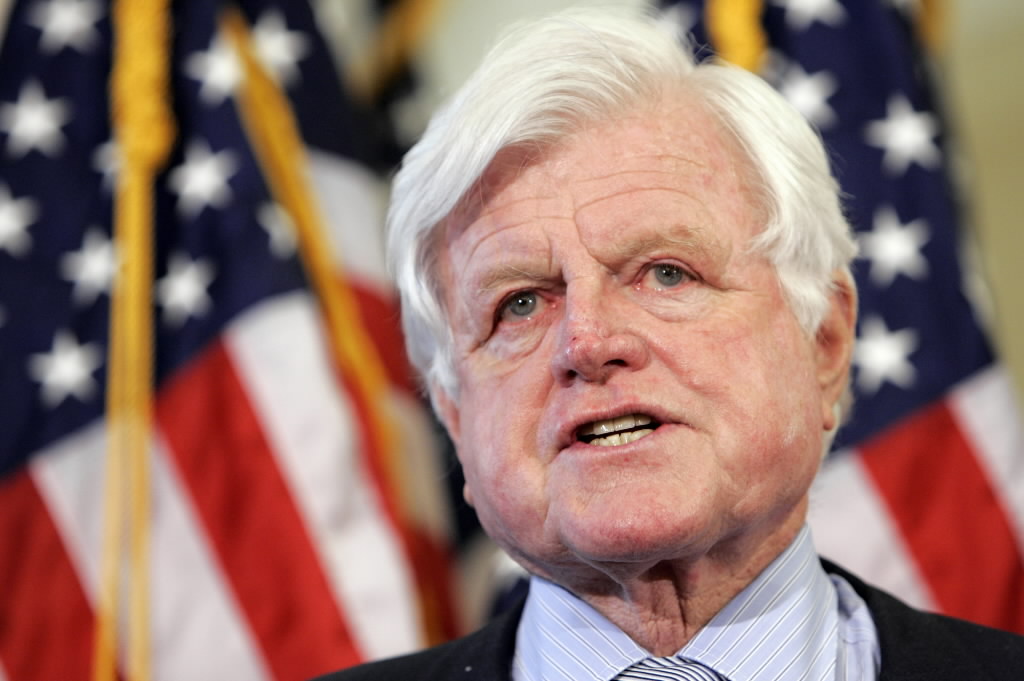
Until his passing overnight, Ted Kennedy had been a US Senator from Massachusetts as long as I've been alive. In fact, he was sworn in for the first of his nine terms on the day I was born -- Nov. 7, 1962. For progressives, fighting the good fight will be a little bit harder without him.

One of the striking things about Kennedy is the way his office handled constituent services. I'd heard many tales before, and today on NPR every caller told a story of how they'd met the senator or called his office or worked for a cause and were surprised and gratified that he personally called back or that he remembered someone's name or that he sent a personal thank-you note.

Of course, the events of July 18, 1969, in Edgartown, Massachusetts, cannot, and should not, be dismissed. Kennedy left his overturned car in the tidal channel that separates Chappaquiddick Island from the mainland of Martha's Vineyard after he drove the vehicle off the wooden bridge that connects the two. Inside was 28-year-old Mary Jo Kopechne, who had worked on Robert Kennedy's presidential campaign, and Kennedy later said he dove down "seven or eight times" to rescue her and then went back to the site of the party the two had left, returning with two other men, and the three of them again attempted to free Kopechne. Kennedy, however, did not notify authorities until the next day.

Questions about Chappaquiddick dogged Kennedy for years -- and rightfully so -- and it seems likely that his inability to explain clearly exactly what had happened, his apparent panic and irrational behavior in response to a stressful incident and his escape with a two-month suspended sentence -- attributed to his illustrious last name -- doomed any chance he ever had of being president.

However, what do we want of those who fail morally, especially in the spotlight of fame, except for them to commit to being better people and to do their best from here on? Kennedy did rise up and fought for issues that matter to average Americans, especially in the areas of poverty, education and health care. Like FDR, he leveled the playing field for those on the bottom rungs of the economic ladder despite the fact that he hailed from the uppermost class. Kennedy's resources left him beholden to no one but his principles.

Liberals are now without their torch carrier, and so the way forward for us is now a little darker and a little more difficult.

Sunday, January 25, 2009

The tech house

Barack Obama's presidency has -- at least for now -- excited large numbers of people and rekindled their interest in government.

The Obama Administration promises to be more open and more technologically savvy than any previous government. For example, at the revamped WhiteHouse.gov citizens can look at proclamations, statements and executive orders from the new president, and over on YouTube the White House has its own page, where today's weekly radio/video address can be viewed.

Thursday, January 22, 2009

Relearning the lessons

A number of serious people are arguing that the best -- and maybe only -- way out of the current financial crisis is the nationalization of some of our largest banks. Things are that desperate.

We've reached a point, they say, where Citibank, for example, is actually insolvent, but is still afloat with the belief that the US government will and must step in because it is too big an entity to fail. As a result, the stock price has not collapsed; however, this means that Citibank will have to be propped up at some point by the Treasury because the other option -- that it falls off the cliff -- would be catastrophic.

One point I feel strongly about is that no business should be "too big to fail." The size and span of corporations should be limited so that their power to negatively impact our economy is greatly diluted. Greed has put us at the mercy of the conglomerate.

My second thought is that this is another death knell in the complete faith in unfettered free markets, a movement that returned under the presidency of Ronald Reagan. By 1980, the lessons of the Great Depression and its causes had been lost -- or conveniently forgotten by those looking for quick riches -- and so some of the checks and balances instituted by the New Deal were abolished, and then things accelerated under George W. Bush. And here we are, learning the same lessons again.

Finally, at what point do I pull my money out of the bank and stuff it in the mattress?

Saturday, January 17, 2009

Listening and inspiring

On NPR today I heard a story that included interviews of officials from veterans' groups. One guy said that, in eight years, the Bush Administration had never reached out or contacted them about issues concerning veterans. He was then asked his opinion of the incoming president.

"People from Obama's transition have already contacted us," he said. "They wanted to know who we'd like to see in the top 35 positions in the Veterans Administration. We couldn't believe it."

Barack Obama has much to do and the issues and problems he and our country face are daunting, but the soon-to-be president is certainly inspiring many and even winning over some. He has, so far, lived up to his talk of a post-partisan administration. Of course, he hasn't spent a single second as chief executive yet; let's hope he continues to be the person that those of us who voted for him believe him to be.

Saturday, January 3, 2009

Pledge to nowhere

Globe columnist Ellen Goodman discusses the failure of abstinence-only education that was advocated and funded by the Bush Administration for the past eight years. After spending $1.5 billion on such programs around the country, research shows what most non-ideologues already knew: abstinence-only does not work.

The latest study, from Johns Hopkins, of teens who took virginity pledges -- which is one way the government measured their policy as working -- "found absolutely no difference in their sexual behavior, or the age at which they began having sex, or the number of their partners." The only difference? Those who pledged abstinence were less likely to use birth control.

So what did we get for our money? More pregnant teens. That is what happens when, as Goodman says, we pay for "an ideology in search of a methodology." The good news is that the war on science, truth and reality that has been waged for eight years will end in 17 days. The bad news may be that the damage done is so great that it will take years to recover.

Friday, December 19, 2008

Obama so far

One month from tomorrow, at high noon, Barack Obama will repeat the 35-word oath of office, which is prescribed specifically in the Constitution, on the steps of the US Capitol. He will likely tack on the postscript of "So help me God," as has been the practice of all recent presidents. In the weeks since Election Day, the president-elect has overseen an extremely orderly transition, taking the podium almost daily to name top appointments and to take questions from the media. It is all somewhat reassuring. Meanwhile, the nation's economic condition slides into even deeper distress and the current chief executive's only newsworthy action in the past six months was to duck from a flying piece of footwear flung furiously in his direction.

Obama's picks have disappointed some on the left, and I do long for a dream team of progressives taking over the controls of our government's mammoth bureaucracies. I am, however, inclined at this stage to sit back and give wide berth to the incoming president. He is, as most have acknowledged, a pretty bright guy, and he does operate -- as evidenced by the campaign and the transition -- in a smartly-conceived and well-executed manner. He gets to select who surrounds him, and by all accounts he's selected an exceptionally qualified and able group. If they aren't liberal enough on face, then I expect that they will be carrying out the policies of this president, and therefore will generally do the right thing.

But, of course, it has been clear all along that Obama does have many centrist, bridge-building tendencies. Those of us on the left will, I suspect, find ourselves in disagreement with the new administration from time to time. There will be attempts to find common ground rather than ramming through Democratic party ideas just because our party's nominee won the top spot. It's a bit frustrating because the Republicans, especially under George W. Bush, have done (and are still doing in last-minute executive orders) exactly that. Again and again, they talk bipartisanship and then lunge to the right. I take Obama at his word when he says he wants to change that culture.

The most extreme example may be the revelation that Rick Warren will be delivering the invocation at the inauguration. The minister of America's most well-known megachurch (Saddleback in Orange County, Calif.) and the author of the bestselling book"The Purpose-Driven Life," Warren is the new face of evangelical Christianity. Less outwardly prim and proper, he has been a key part of a movement that has focused on some good things in recent years, like working against poverty and hunger in Africa or embracing environmentalism. Still, in many ways, the new boss is the same as the old boss: homosexuality is seen as sinful; atheists are evil; etc.

Warren is a maddening choice for many who voted Democratic in November, and still it may be a brilliant selection in other ways. Obama has made the usual claim of being president of all Americans, not just those who voted for him; maybe this is one way to demonstrate that. He is also showing quite clearly that he will not hesitate to anger his base when he wants to. He is repaying Warren for inviting him to the Saddleback Forum, the pre-election interviews that Warren did with Obama and John McCain at the church in August (where McCain gave brief talking-point answers that he knew the crowd would applaud and Obama gave longer, more intelligent, nuanced responses that sometimes flew in the face of what the audience wanted to hear).

Finally, there is the "Team of Rivals" strategy, as discussed in the Doris Kearns Goodwin book as it relates to Abraham Lincoln. In other settings, with slight tweaks, it might be understood as the "Keep your friends close and your enemies closer" strategy. Obama wants to accomplish important things, and after the first 100 days -- maybe more, maybe less -- the novelty, the honeymoon and the perception of a mandate will all wear off and the broad support of the public will be necessary to overcome the usual gridlock, partisanship and the lack of a filibuster-proof Senate.

A year down the road the 44th president might turn to the two Republicans in his cabinet (Robert Gates and Ray LaHood) or to the senator whose committee chairmanship he saved (Joe Lieberman) or to his former Democratic opponent turned cabinet member (Hillary Clinton) or, even, to the leader of one of the largest evangelical congregations in the country. Each of them, to varying degrees, will feel some obligation to jump on board with the president.

Is Obama thinking that far ahead? Is he really that smart? I think he is.

Friday, September 19, 2008

Grover Norquist should be drowned in a bathtub

Republican ideology calls for shrinking government and loosening regulation. George W. Bush came into office and followed through on some of that. Nearly eight years later, what are the results?

*When Hurricane Katrina struck, federal agencies tasked with responding to such events were unprepared and badly managed.

*When toxic food and dangerous toys flooded American stores from overseas, there few inspectors to stop these products from entering the country.

*When financial services giants stuffed their pockets while exposing the nation's economy to great risk, there were no regulators to rein them in.

Ronald Reagan, now the second-worst president of all-time, famously said, "Government is not the solution to our problem; government is the problem." I say that a Republican-run government is not the solution to our problem; Republican-run government is the problem.

Friday, July 11, 2008

Keep your seat

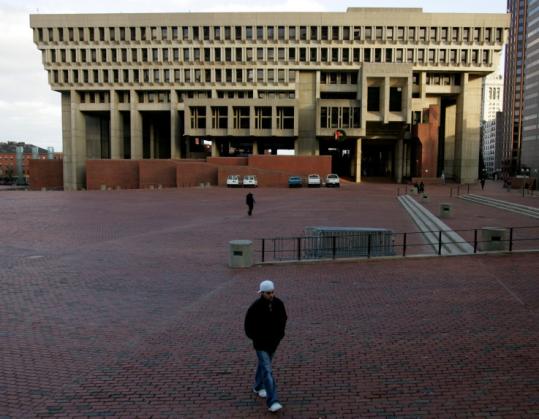
Mayor Menino continues to advocate building a new city hall on the South Boston waterfront, with $2 million in this year's budget to study the new location. The best case against moving the seat of government from where it is now -- whether in the current building or in another -- is the location, today's Globe points out.

Though there are some architects who gush about City Hall as a brutalist-style landmark, very few people -- including city workers and elected officials -- care for the structure's look or ergonomics. However, there can be little argument that it is located in one of the most convenient places possible for most Boston residents, with easy access from all four subway lines.

Building a new structure, while providing sweet new digs for the mayor and leaving a monument that would certainly have his name on it, would cost us a big chunk of money and make it harder for people who need to visit City Hall for routine business. Moving it is a bad idea.

Sunday, May 11, 2008

Star struck

Some of your tax dollars, you may have heard, have been spent on a secret domestic propaganda program with the goal of convincing you that the tax dollars you are spending in Iraq -- and the blood that our soldiers are sacrificing -- is a good idea.

A columnist for Salon.com writes about the Pentagon documents that outline the program that has retired generals who appear on TV and radio spouting the Bush Administration's official line, or in the words of military memos, "carry our water...because we are their bread and butter." Some of that "bread and butter" is in the form of military contracts awarded to giant corporations, many of which have those same generals on their boards of directors. Oh, and guess whose tax dollars are paying those corporations?

Monday, April 21, 2008

Tyranny on the loose

In all the recent media coverage of Barack Obama's bowling, Hillary Clinton's downing a shot and a beer, and John McCain's plea-for-attention proposal to suspend the gas tax for the summer, you may have missed an astonishing bit of news: the Bush Administration appears to have covertly suspended part of the Constitution.

In a footnote to the recently released memo by former Justice Department lawyer John Yoo, reference is made to a secret document that mentions the Fourth Amendment -- you know, the one that protects us against "unreasonable searches and seizures" by the government. This bedrock precept of our democracy has "no application to domestic military operations," wrote Yoo.

As an opinion from a high-ranking DOJ lawyer, this document would theoretically guide the actions of government agents, in this case allowing the military to walk onto the private property of citizens and take possession of their property and their person. Of course, much more likely is the collecting of our phone calls and emails, which some people might say is OK, but many feel clearly violates the Constitution. Bush and his cohorts must have felt that it did so, and therefore, they overruled it.

In an administration that has trampled the sacred text of our society at every turn, this is one of the most egregious violations yet.

Sunday, April 6, 2008

City response not up to snuff

Today's Boston Sunday Globe takes a look at the way complaints are handled when people call City Hall's Office of Neighborhood Services. It seems that Boston is behind other cities in tracking and responding to such calls, and the excuses -- being that we're talking about a few hundred calls a day and not three million -- seem pretty lame.

An informal Globe survey showed that about half of the people who had called the city got a reasonable response to their request, while half didn't. Most calls are basic health, safety and quality of life issues: broken streetlights or stoplights, potholes, debris on public or private property, abandoned cars, graffiti, animal control, snow removal, etc.

The fact that one of the issues seems to be that our city government is having difficulty tracking the calls, tabulating the statistics and following up to find out if anything was done about the calls -- in a major city like Boston in the year 2008 -- is almost absurd. How hard can it be to set up a computer program/network that does that? Seriously, it's been almost 40 years since we landed on the moon!

I might have called the number listed in the article -- 617.635.4500 -- but I know I've called Neighborhood Services a few times -- 617.635.3485 -- and my experience has been that it takes several calls to get any some action. I call the complaint number and speak with the person that answers, but I also call whatever departments I think might be of help, and then I call each a few times. It may be that the Neighborhood Services staff relays requests quickly, but that the logjam is at the various departments. I'm not sure.

Once, recently, after a barrage of calls, the city responded that afternoon to a trash problem outside my mother's house. On the other hand, my cousin once called to have a tree on Havre Street trimmed and it took more than a year to get it done. One instance where I got a bit perturbed with Neighborhood Services was when the city employee responded to my complaint by giving me the phone number of the department to call. I said, "Excuse me?" and he repeated himself. Then I said, "If I wanted the number to that department I could have looked it up online in about ten seconds. What is the purpose of Neighborhood Services if all you do is give me another number to call? I expect you to get this information to the relevant departments." He backpedaled at that point.

Update: The mayor quickly appoints someone to make the system work more efficiently.

Wednesday, February 13, 2008

Can you hear me now?

Why is the Democratically-controlled US Senate siding with the Bush Administration on current legislation that would offer immunity to telecommunications companies that assisted the government in spying illegally on Americans?

The warrantless wiretapping program clearly violates the Fourth Amendment's prohibition against "unreasonable searches and seizures," and lawsuits against industry giants like AT&T and Verizon should be allowed to make their way through the courts, which are the proper forum for a judgment on whether the government should be eavesdropping on our phone calls and emails.

Among the presidential candidates, John McCain voted in favor of the bill, while Barack Obama voted against it. Hillary Clinton was on the campaign trail. The House version of this legislation does not contain immunity, and the president has threatened to veto any telecommunications legislation without it.

Wednesday, January 30, 2008

Signing away the Constitution

The Founding Fathers created three separate branches of government, each with its distinct role, to prevent power from being concentrated too tightly in one place by one person or small group of people. It was a wise move, and though the executive branch has always been the most visible and most driving force in our government, no president has moved as far in the direction of tyrant as George W. Bush.

The Globe reports today that Bush issued another "signing statement" this week. These are documents released after a president signs a bill -- thereby making it law -- that in the past have been used sparingly by presidents to indicate their interpretation of the new law. Bush has used such statements far more than previous occupants of the oval office -- more than 1,000 times -- and in them he often indicates certain parts of new laws that his administration will not follow.

This is clearly illegal. It completely ignores the structure of the United State Constitution, which presidents swear to "preserve, protect and defend" when they are inaugurated. The president's job is to enforce the laws. If he doesn't agree with a proposed law then his duty is to veto it. If he thinks it violates the Constitution, then the courts will make a decision. All three elements of power cannot and should not be concentrated in one branch and in one man (or two, considering Dick Cheney's influence).

The Globe's Charlie Savage won a Pulitzer Prize for his coverage of Bush's use of signing statements, which the American Bar Association has determined as "contrary to the rule of law." Republican Senator Arlen Specter has twice filed legislation that instructs all state and federal courts to ignore signing statements.

This latest signing statement, you should know, was filed after Bush signed the National Defense Authorization Act for 2008, which contains a provision forbidding the US from spending taxpayer dollars to build permanent military bases in Iraq. The president, after signing the bill into law, then issued a statement that says he does not have to abide by that section, as well as several others. It's clear from recent negotiations in Iraq that this administration is planning on such bases, and in another end-around the legal process, Bush has said that the eventual agreement with Iraq will be a "compact" and not a treaty, which means he can bypass the ratification process in the US Senate.

Goerge W. Bush is making a mockery of the rule of law. His violation of the Constitution and of his vow to uphold it are unethical and criminal.

Wednesday, January 23, 2008

Liars


We don't need a study to tell us that the Bush Administration lied repeatedly in the run-up to the invasion of Iraq, but having the statements of top government officials reviewed and quantified is a good idea.

The Center for Public Integrity and the Fund for Independence in Journalism did just such an analysis and found 935 false statements about Iraq that were made between 9/11 and the start of the Iraq War by President Bush, Vice President Cheney, Secretary of State Colin Powell, Secretary of Defense Donald Rumsfeld, National Security Advisor Condoleezza Rice, Deputy Defense Secretary Paul Wolfowitz and press secretaries Ari Fleischer and Scott McClellan.

The study, released this week, said that the false statements "were part of an orchestrated campaign that effectively galvanized public opinion and, in the process, led the nation to war under decidedly false pretenses."

There's another term for "false statements" -- lies. George W. Bush and his cohorts boldly lied directly to the American public and as a result 3,931 members of our military have been killed, 307 have been killed among other coalition forces, somewhere between 50,000 and 250,000 Iraqis have died, and the overall cost of the invasion and occupation is estimated to total $2 trillion.

Now does anyone think we should not have slowed down in the late autumn of 2000 and counted those Florida votes a little more carefully?

Sunday, January 20, 2008

Bushed

Today marks the start of George W. Bush's last year as the nation's chief executive. As 2008 is a leap year, we have 366 days remaining in what is certainly the worst presidency of my lifetime and will likely be regarded as being among the worst in American history.

Bush's comments that future historians will be a better judge of his tenure are a fairy tale, like most of what he says he believes. His administration, characterized by decisions made by a small group of twisted ideologues, has done vast damage to the country and the world in ways that will take decades to repair -- if repairs are indeed possible.

It is enormously disturbing that Bush and his people were able to filch the 2000 election from the arms of democracy; then, in 2004, it was equally upsetting to see that any Americans would actually vote to reelect someone who was clearly so incompetent and disingenuous.

Look around: the US military is mired in Iraq; the economy is tanking; we've gone backwards on the environment, healthcare, consumer safety, etc.; and America has virtually no credibility throughout the world. Are you better off than you were eight years ago? Is the world a safer place?

There's no argument that Iraq has become less violent since the surge of US troops arrived there last spring, but it doesn't take a genius to agree that more soldiers on the ground make it easier to control the insurgency. The success of the surge only emphasizes how badly Bush and former Defense Secretary Donald Rumsfeld screwed up when they dismissed estimates, some by career military men, that more troops would be needed in post-war Iraq.

But the fact that Baghdad is a little quieter these days distracts from the point of the surge, which was to provide stability so that Iraq's politicians could come together to solve the large and numerous issues that keep their government from working. So far there has been little progress there, with the country's legislature even taking off last summer because of "the heat," even while American soldiers were out in that same heat in full gear -- and even while some of those soldiers were being killed and wounded.

Speaking of vacations, here is a point that has not been discussed enough, yet is a microcosm of Bush's time in office. Back in the summer of 2001, after about half a year in office, the president left Washington for a month to vacation at his Texas ranch. From Aug. 3 to Sept. 3 he was out of the nation's capital, even as Mohamed Atta was receiving money wired from al-Qaeda, rounding up the other hijackers and purchasing a utility knife at Wal-Mart. On Aug. 6 -- the day that the he was given an intelligence briefing titled "Bin Laden Determined to Strike in US" -- Bush was so concerned about the implications of that memo that he played golf that morning.

We can't be positive that the 9/11 plot would have been stopped if the president were less disengaged and more vigilant, but I don't think it is a stretch to imagine that if Al Gore had been in office on that day -- even if he was working on the problem of terrorism all his waking hours -- the Republican Congress would have not only blamed him, but would have immediately initiated impeachment hearings.

George W. Bush should never have been elected, even once, to the White House -- and wouldn't have if it weren't for large sums of money, dirty tricks and a conservative Supreme Court. He should never have received his party's nomination in 2000. At this point we can only hope to survive one more year with him in charge, and we can only hope that our fellow citizens have seen enough of what happens when we fail to scrutinize closely our choices in the ballot box.

Saturday, January 12, 2008

Ba'athing beauties

On May 16, 2003, Paul Bremer -- the head of the Coalition Provisional Authority, the US entity that ruled Iraq between the fall of Saddam Hussein and the empowering of the Iraqi interim government -- issued an order banning members of the Saddam's Ba'ath party from serving in the various government ministries, as well as holding posts such as leaders of state-run companies or university professors and department heads.

The result -- de-Ba'athification -- has been a disaster, with one American official in Iraq noting, according to The New Yorker, “We were left dealing with what seemed like the fifth string … Nobody who was left knew anything." Bremer's decision -- followed a week later by another disastrous move: disbanding the Iraqi army -- was done without discussion with or approval by experienced members of the US military and diplomatic core, many of whom could see the foolishness of such policies.

Today, nearly five years later, the Iraqi parliament voted to restore party members, excepting those who committed violent crimes, to government jobs. The law was passed at the behest of the United States, which realized along the way that it had screwed up royally. As the film No End in Sight so clearly pointed out, President Bush and his political leadership made blunder after blunder, refusing to listen to people in the state and defense departments who knew what they were talking about.

While we cannot be positive that things would have gone smoother in Iraq if hundreds of thousands of soldiers and Ba'ath party members weren't thrown out of work and left fuming -- and, in the case of the former, armed -- this latest action by Iraq's government indicates that this might have been the case. Several thousand American soldiers and many thousands of Iraqi citizens have died in the time between the original Bush Administration decision and the current attempt to reverse it. Weren't each of those people owed a competent and well-informed leadership, both in Washington and in Baghdad?

Monday, April 23, 2007

Dirty GOP hands

One lasting lesson that I'd like conservatives to take from the past eight years of Republican rule is that they cannot believe GOP promises to "clean up the corruption in Washington." Their guys are just as vulnerable to being corrupted by money and power -- if not more so -- as Democrats are.

Right now at least 15 people appointed to office by George W. Bush are being investigated for, or have already been found guilty of, impropriety. Christian conservatives should especially take note: You were hoodwinked into supporting these guys, but they are not the people you assumed they were.

Friday, April 20, 2007

Off with their heads! (Or at least let's fire them)

The Vermont state senate today became the first legislative body to publicly call for the impeachment of both the president and vice president. On a 16-9 vote that body approved a non-binding resolution that urged Vermont's Congressman to introduce an impeachment resolution against George W. Bush and Dick Cheney.

It's about time. Does this incompetent duo have to inflict any more damage before they get booted out of office? Bill Clinton was impeached on exponentially less important charges than lying to get the country involved in a war and running every federal department with politics and ideology as the only criteria.

Throw the bums out!