The tunnel named after the late Tip O'Neill is apparently leaking quite a bit these days, but the legacy of the former Massachusetts Congressman is more impressive to me than ever in the current political landscape. O'Neill served 10 years as Speaker of the House, much of it when Ronald Reagan ("the most ignorant man who had ever occupied the White House," according to O'Neill, who died before George W. Bush came on the national scene) was president. Reagan, and other Republicans elected in 1980, went to Washington to "make government smaller" -- GOP-speak for lowering taxes on the wealthy and dismantling the New Deal safety net. O'Neill, ridiculed publicly by arrogant conservatives as being old and overweight, used strength and charm to stand up against Reagan and his cohorts, virtually single-handedly absorbing the blows and holding the line.
Alas, O'Neill is gone and the Democrats seem to have no one like him in a leadership role. (Nancy Pelosi, House majority leader, is probably closest, but she doesn't run the House any more.) President Obama appears to get his clock cleaned by Republicans on every contentious issue. His natural inclination to compromise has been repeatedly taken advantage of by an opposition that is virtually unwilling to give any ground -- and therefore all "agreements" give the far right almost everything they want. It's discouraging.
The debt-ceiling agreement that leaders on both sides are touting today -- and which passed the House last night and will likely get Senate approval today -- is a complete capitulation to a group of elected officials who were willing to sacrifice the stability of the nation and the global economy to make sure that the rich in American don't have to pay a single penny more in taxes. Joe Nocera in The New York Times calls them "terrorists" who are "waging jihad on the American people." This group of Tea Partiers and their enablers in Congress -- only several dozen members -- give the impression that they will go to any length, including national crisis, to get what they want. It's like playing chicken against a crazy person: you have to get out of the way because he will take you both down.
This all reminds me of the story in the Old Testament where two women come to King Solomon, both claiming that they are the mother of a particular child, and the wise king declares that the child will be split in two. Of course, the strategy was that the child's actual mother wouldn't want to see any harm come to the boy, and so when one of the women cries out, "No! Let her have him!" the king knows she is the true mother. The Democrats keep flinching and crying out. They are not willing to let the country default in its fiscal obligations as of midnight tonight, and so they gave in. The Republicans, whose reasonable elements are shouted down by the far right, are willing to burn the entire Republic to the ground. As a result, the deal voted on today requires sacrifices from the poor, the elderly, the young, the sick and the hard working, while those at the top of the economic pyramid have to give up nothing.
Despite the political rhetoric, the deal will hurt the economy. In the meantime, our biggest national crisis -- millions of unemployed -- goes unaddressed. In times like this government needs to spend more, not less. The stimulus back in Obama's first year needed to be two or three times bigger, but he gave in to the right. Now the economy will suffer more, and the GOP will pin it on Democrats in 2012. It's hard to see an upside here.
Showing posts with label economy. Show all posts
Showing posts with label economy. Show all posts
Tuesday, August 2, 2011


Thursday, July 28, 2011
Getting serious
For weeks the word was that Wall Street was not panicking about Washington's inability to raise the debt ceiling because it was understood that, in the end, some kind of deal would be reached. After all, the thinking went, the leadership of both parties knows how potentially serious and far-reaching the consequences would be of default. In the past few days, however, markets around the world have started to drop and there is now a real feeling that "these guys could screw this thing up." We are, indeed, in interesting times.
One article that most still cling to is that the US will not default -- in other words, miss payments on the debt to creditors. Because of what would certainly be the cataclysmic results of the world's safest asset suddenly unable to pay its obligations, the widely held view is that even if no agreement is reached the Treasury would first pay the $90 billion due to bondholders. After that, the government would need to prioritize, as incoming tax dollars only cover 40% of outlays. More than half of government would not be funded: Social Security or homeland security or troop salaries or Medicare, etc. Some essential programs would be on hold.
This assumes that, absent a Congressional vote, President Obama doesn't invoke the 14th Amendment to the Constitution, which some Democrats are publicly pushing him to do. Obama, a Constitutional law professor, has said that his Administration's lawyers have reviewed the 14th Amendment -- part of which reads, "The validity of the public debt of the United States ... shall not be questioned." -- and concluded that it is not "a winning argument." Using such a tactic spuriously, some say, could lead to impeachment.
What has many analysts concerned is that even if an agreement is reached and the debt ceiling is raised this entire dramatic and drawn-out episode has already done its damage. Though the mounting total of US government debt -- currently $14.3 trillion -- has always been in plain sight, investing in that debt through US Treasury bonds was still considered the safest bet in the financial world. Now, the spotlight is on and some may start to second guess the wisdom of such an investment, for even if obligations are met this time the idea that there could come a time when this is not so is beginning to creep into worldwide financial markets. And the idea that the Tea Party segment of the political spectrum is actually playing chicken with America's financial affairs and that this most unstable and irresponsible movement may grow in power and is even looking to take the White House -- well, such a possibility could, right now, cause investors to panic and ratings agencies to lower the AAA rating of American debt.
Coupled with the current flat recovery from the Great Recession, it seems that we are forging new economic ground. The Tea Party and its lackeys in Congress think they know what they're doing, but we have seen how their conception of reality is not fact-based. We can only hope that saner heads step in and quickly fix this mess.
One article that most still cling to is that the US will not default -- in other words, miss payments on the debt to creditors. Because of what would certainly be the cataclysmic results of the world's safest asset suddenly unable to pay its obligations, the widely held view is that even if no agreement is reached the Treasury would first pay the $90 billion due to bondholders. After that, the government would need to prioritize, as incoming tax dollars only cover 40% of outlays. More than half of government would not be funded: Social Security or homeland security or troop salaries or Medicare, etc. Some essential programs would be on hold.
This assumes that, absent a Congressional vote, President Obama doesn't invoke the 14th Amendment to the Constitution, which some Democrats are publicly pushing him to do. Obama, a Constitutional law professor, has said that his Administration's lawyers have reviewed the 14th Amendment -- part of which reads, "The validity of the public debt of the United States ... shall not be questioned." -- and concluded that it is not "a winning argument." Using such a tactic spuriously, some say, could lead to impeachment.
What has many analysts concerned is that even if an agreement is reached and the debt ceiling is raised this entire dramatic and drawn-out episode has already done its damage. Though the mounting total of US government debt -- currently $14.3 trillion -- has always been in plain sight, investing in that debt through US Treasury bonds was still considered the safest bet in the financial world. Now, the spotlight is on and some may start to second guess the wisdom of such an investment, for even if obligations are met this time the idea that there could come a time when this is not so is beginning to creep into worldwide financial markets. And the idea that the Tea Party segment of the political spectrum is actually playing chicken with America's financial affairs and that this most unstable and irresponsible movement may grow in power and is even looking to take the White House -- well, such a possibility could, right now, cause investors to panic and ratings agencies to lower the AAA rating of American debt.
Coupled with the current flat recovery from the Great Recession, it seems that we are forging new economic ground. The Tea Party and its lackeys in Congress think they know what they're doing, but we have seen how their conception of reality is not fact-based. We can only hope that saner heads step in and quickly fix this mess.
Monday, January 17, 2011
Taking Ike's warning seriously
Three days before leaving the White House in 1961, President Dwight D. Eisenhower delivered a farewell speech to the American public. That was 50 years ago today, and part of the one-time five-star general's remarks warned future generations of the dangers of the immense defense and weapons corporations that had been created after World War II:
Today, the United States spends almost as much on defense as every other country in the world combined, and there are somewhere around 1,000 US military bases OUTSIDE American soil. Defense contractors like Raytheon, Boeing, General Dynamics and others have raked in hundreds of billions of dollars since Eisenhower's speech -- and they play no small role in beating the drum when opportunities arise for the use of their weapons systems.
Aside of all other geopolitical concerns, just the cost of this military behemoth is going to end up leading to America's downfall if left unchecked. The US government needs to get it under control, and the people need to insist on it. As Ike said, the only remedy is "an alert and knowledgeable citizenry." Are we ready yet to heed his words?
This conjunction of an immense military establishment and a large arms industry is new in the American experience. The total influence -- economic, political, even spiritual -- is felt in every city, every State house, every office of the Federal government. We recognize the imperative need for this development. Yet we must not fail to comprehend its grave implications. Our toil, resources and livelihood are all involved; so is the very structure of our society.
In the councils of government, we must guard against the acquisition of unwarranted influence, whether sought or unsought, by the military industrial complex. The potential for the disastrous rise of misplaced power exists and will persist.
We must never let the weight of this combination endanger our liberties or democratic processes. We should take nothing for granted. Only an alert and knowledgeable citizenry can compel the proper meshing of the huge industrial and military machinery of defense with our peaceful methods and goals, so that security and liberty may prosper together.
Today, the United States spends almost as much on defense as every other country in the world combined, and there are somewhere around 1,000 US military bases OUTSIDE American soil. Defense contractors like Raytheon, Boeing, General Dynamics and others have raked in hundreds of billions of dollars since Eisenhower's speech -- and they play no small role in beating the drum when opportunities arise for the use of their weapons systems.
Aside of all other geopolitical concerns, just the cost of this military behemoth is going to end up leading to America's downfall if left unchecked. The US government needs to get it under control, and the people need to insist on it. As Ike said, the only remedy is "an alert and knowledgeable citizenry." Are we ready yet to heed his words?
Sunday, November 28, 2010
Korea, China and the 21st Century
US Navy ships are in the Yellow Sea today for exercises with the South Korean Navy. I hope this has been thought out. What will happen if North Korea fires on American vessels? Will the US retaliate? And after that? We certainly cannot be girding up for another war, this one against a country that does indeed have nuclear weapons -- most of which are pointed at the South Korean capital of Seoul and its 10 million residents.
North Korea's leader Kim Jong-il is unpredictable -- possibly even crazy. In addition, that country's military leaders may make decisions on their own, and it's hard to say if that is better or worse. It's also relevant to take note that the South Korean military was already engaged in exercises that pressed right up against the border of the two Koreas, which the North has said provoked their shelling. As one web site points out, this fact has been buried by the American media.
However, the key to this entire situation -- and we are hearing this more and more often these days -- is China. North Korea's only ally, the Chinese government could be quite helpful right now, but it's been hesitant to chasten Pyongyang in the past -- at least publicly. If China were to embrace its growing importance on the world stage by stepping up to play key roles in geopolitical disputes, economic crises and environmental concerns, that would seem to make life easier for everyone, but Beijing continues to work at its own pace.
I saw an interesting statistic last week: In 2009 China used twice as much steel as the US, the European Union and Japan COMBINED. Beijing's economic growth is surging at a level the world has never before seen. China recently became the world's second-largest economy, passing Japan, and China is the world's largest emitter of greenhouse gases. If the 1900s were the American Century, this is quickly becoming the Chinese Century.
North Korea's leader Kim Jong-il is unpredictable -- possibly even crazy. In addition, that country's military leaders may make decisions on their own, and it's hard to say if that is better or worse. It's also relevant to take note that the South Korean military was already engaged in exercises that pressed right up against the border of the two Koreas, which the North has said provoked their shelling. As one web site points out, this fact has been buried by the American media.
However, the key to this entire situation -- and we are hearing this more and more often these days -- is China. North Korea's only ally, the Chinese government could be quite helpful right now, but it's been hesitant to chasten Pyongyang in the past -- at least publicly. If China were to embrace its growing importance on the world stage by stepping up to play key roles in geopolitical disputes, economic crises and environmental concerns, that would seem to make life easier for everyone, but Beijing continues to work at its own pace.
I saw an interesting statistic last week: In 2009 China used twice as much steel as the US, the European Union and Japan COMBINED. Beijing's economic growth is surging at a level the world has never before seen. China recently became the world's second-largest economy, passing Japan, and China is the world's largest emitter of greenhouse gases. If the 1900s were the American Century, this is quickly becoming the Chinese Century.
Friday, November 26, 2010
The stuff that nightmares are made of
Materialism and consumption are factors in America's economic downturn, our dependence on foreign oil, global climate change and other environmental issues -- and yet, millions of people rushed out this morning, or last night, to go out and buy more stuff. I join with those who marked Buy Nothing Day today, and in that spirit I suggest that everyone watch this video: The Story of Stuff.
Monday, November 22, 2010
Getting the word out
Eastie resident and freelance writer Steve Holt had a couple of pieces published in recent days about his favorite neighborhood:
**In Sunday's Globe, Steve wrote that the East Pier project may be ready to come to life again as the housing market starts to rebound.
**In a story in Edible Boston, Steve says that the best mole sauce in Boston can be found at Angela's on Lexington Street. He counts more than 50 ingredients in the recipe.
**In Sunday's Globe, Steve wrote that the East Pier project may be ready to come to life again as the housing market starts to rebound.
**In a story in Edible Boston, Steve says that the best mole sauce in Boston can be found at Angela's on Lexington Street. He counts more than 50 ingredients in the recipe.
Friday, November 19, 2010
Revealing "the devils" behind the financial crisis
A fascinating interview with the authors of a new book about the recent financial crisis sheds some light on who is the blame for the economic turmoil that the US and the rest of the world are still struggling to overcome (see Ireland's bank takeover plan). Bethany McLean, who co-wrote The Smartest Guys in the Room about the Enron debacle, teamed up with New York Times business columnist Joe Nocero to write All the Devils are Here: The Hidden History of the Financial Crisis.
McLean and Nocero were on the PBS NewsHour last night to talk about the roots of the crisis, and they said that -- to no one's surprise -- both Democrats and Republicans were culpable for the lack of regulation and foresight that led to the housing crash. They also said a number of other interesting things, including that the ratings agencies (Moody's and Standard & Poor's, among others) were at the top of their list of culprits most responsible for the crisis.
McLean also said that she "started this book with a bias toward personal responsibility," but found out the extent to which:
Maybe the most telling, and most disturbing points, the writers make are at the end of the interview, when McLean says that Wall Street and corporate America saw that cash-out refinancing was a way for them to reap billions:
McLean and Nocero were on the PBS NewsHour last night to talk about the roots of the crisis, and they said that -- to no one's surprise -- both Democrats and Republicans were culpable for the lack of regulation and foresight that led to the housing crash. They also said a number of other interesting things, including that the ratings agencies (Moody's and Standard & Poor's, among others) were at the top of their list of culprits most responsible for the crisis.
McLean also said that she "started this book with a bias toward personal responsibility," but found out the extent to which:
...these loans were sold; they weren't bought. And one of the most telling moments were these internal documents from Washington Mutual, one of the big subprime lenders, around 2003 talking about how to get consumers who really wanted safe 30-year fixed-rate mortgages to take out these dangerous option [adjustable rate mortgages] instead ... how to sell those to people, and how to confront a consumer who said, "But it doesn't feel right to me. I want to pay back my mortgage every month." ... How do you get these people to take out a risky mortgage instead? You told them that home prices could only go up. And the reason Washington Mutual wanted to sell these option ARMs, instead of the 30-year fixed rate mortgages, is that Washington Mutual could turn around and sell these to Wall Street for a lot more money than it could sell the old 30-year fixed-rate loans.Nocero adds, "I was stunned, in the reporting of this book, how much subprime was about predatory lending." He notes, also, that most of these transactions weren't for new homes, but for "cash-out refinancing" -- people remortgaging their homes in order to use the money the could get. "And that," said McLean, "enabled consumer spending through the 1990s and through the early part of -- of this decade."
Maybe the most telling, and most disturbing points, the writers make are at the end of the interview, when McLean says that Wall Street and corporate America saw that cash-out refinancing was a way for them to reap billions:
...in order to keep the U.S. economy going, you had to keep consumer spending strong. In order to keep consumer spending strong, you had to have consumers whose income otherwise wasn't keeping up have a ready source of cash. That was cash-out refinancing, by using their homes as piggy banks, and no one wanted to stop that party.The party may be over for American homeowners and consumers, but big business and the financial sector are still laughing all the way to the money trough.
Tuesday, January 26, 2010
Budget woes
Budget issues dominated the news in Washington today, and none of the approaches make any sense to me.
During his State of the Union address tomorrow evening, President Obama will apparently announce a three-year spending freeze for all non-defense discretionary spending. Of course, it's the other stuff -- Social Security, Medicare and defense -- that make up the lion's share (83%) of the budget and it's those items that need to be brought under control. The freeze will limit some important spending, yet will hardly save anything.
At this time I want to point out that reforming health care -- appropriately, rather than the politicized packages approved by the House and Senate that now lie D.O.A. -- would have gone a long way toward controlling those costs, but the "fiscally responsible" conservatives and their irrational "tea party" mobs killed any chance of that.
The top Democrat and Republican on the Senate Budget Committee introduced a bill -- voted down by the full Senate today -- that would have formed a bipartisan "Fiscal Task Force" of House, Senate and Administration members who would propose solutions on reducing the deficit. I think this approach is folly because we already have a small group of people charged with solving such issues: it's called Congress. And they have already appointed smaller groups of people who theoretically possess more expertise on such matters and whose duty it is to present recommendations to the full House and Senate: the Budget, Finance and Appropriations committees. And further, the solutions to rising deficits is rather simple: control spending on entitlement programs by PASSING HEALTH CARE REFORM and, quite simply, RAISE TAXES.
But alas, Scott Brown -- the Bay State's political boy wonder -- is already doing his best to make the nation's fiscal condition less healthy, while lining the pockets of the wealthy. He's advocating tax cuts. Yes, Scottie, let's do what Republicans always do, whether the economy is charging ahead or slumping badly: give even more to the haves. It didn't take long for his true colors to show. Is Brownie aware that the Bush tax cuts are a major part (along with spending on the Iraq War) of the nation's deficit woes? How many Americans are aware that those tax cuts cost twice as much as the health care proposals that have been deemed "too costly" by the right? (And about half of that money -- a trillion dollars -- went to the wealthiest Americans.)
Until we have people with brains and guts in Washington, we will continue to see policies that follow the path of least resistance, leading the United States toward decline and fall.
During his State of the Union address tomorrow evening, President Obama will apparently announce a three-year spending freeze for all non-defense discretionary spending. Of course, it's the other stuff -- Social Security, Medicare and defense -- that make up the lion's share (83%) of the budget and it's those items that need to be brought under control. The freeze will limit some important spending, yet will hardly save anything.
At this time I want to point out that reforming health care -- appropriately, rather than the politicized packages approved by the House and Senate that now lie D.O.A. -- would have gone a long way toward controlling those costs, but the "fiscally responsible" conservatives and their irrational "tea party" mobs killed any chance of that.
The top Democrat and Republican on the Senate Budget Committee introduced a bill -- voted down by the full Senate today -- that would have formed a bipartisan "Fiscal Task Force" of House, Senate and Administration members who would propose solutions on reducing the deficit. I think this approach is folly because we already have a small group of people charged with solving such issues: it's called Congress. And they have already appointed smaller groups of people who theoretically possess more expertise on such matters and whose duty it is to present recommendations to the full House and Senate: the Budget, Finance and Appropriations committees. And further, the solutions to rising deficits is rather simple: control spending on entitlement programs by PASSING HEALTH CARE REFORM and, quite simply, RAISE TAXES.
But alas, Scott Brown -- the Bay State's political boy wonder -- is already doing his best to make the nation's fiscal condition less healthy, while lining the pockets of the wealthy. He's advocating tax cuts. Yes, Scottie, let's do what Republicans always do, whether the economy is charging ahead or slumping badly: give even more to the haves. It didn't take long for his true colors to show. Is Brownie aware that the Bush tax cuts are a major part (along with spending on the Iraq War) of the nation's deficit woes? How many Americans are aware that those tax cuts cost twice as much as the health care proposals that have been deemed "too costly" by the right? (And about half of that money -- a trillion dollars -- went to the wealthiest Americans.)
Until we have people with brains and guts in Washington, we will continue to see policies that follow the path of least resistance, leading the United States toward decline and fall.
Sunday, January 3, 2010
2009's most important person
 Time magazine came up short when they chose Fed chairman Ben Bernanke as the Person of the Year, but The Times of London got it right: Neda Soltan, the 26-year-old Iranian woman who was killed during anti-government protests in June.
The shocking and graphic video of Soltan being shot through the chest and dying in the street spread around the world and her death has become the iconic moment of the Iranian peoples' struggle. Neda is important because this uprising of the citizenry may well signal the end of the oppressive and internationally combative regime of Mahmoud Ahmadinejad and, further, her documented murder at the hands of a government militiaman may be the tipping point.
More broadly, the capturing of the horrible event by cell phone video and the spreading of it over YouTube, as well as the use of the Internet -- especially blogs and Twitter -- to organize and follow the protests, mark an important point in the realm of popular uprisings. The printing press, in essence, made democracy possible -- and hence, the United States came into being. The Internet is another key juncture on that road. The "information superhighway" has its positives and negatives, but it does seem to be a tool that is difficult (not impossible: see China) for tyrants to manage.
And so Neda Soltan's death is meaningful for a number of reasons, and she is, I think, the better choice. Bernanke did some good things and some not-so-good before and during the current economic crisis. However, even if the housing boom and financial meltdown are the only things that matter, former Fed chair Alan Greenspan's faith in the markets is more integral to causing the crisis -- and his statement before a Congressional committee that his worldview was "flawed" is an admission that laissez-faire capitalism does not work. That stands as a key moment as well.
Photo from The Times of London web site.
Tuesday, December 15, 2009
Take it down
 Tell them to take down the giant American flag that hangs in front of the New York Stock Exchange. Bankers and other corporate executives have shown in the last couple of years that they care nothing about the United States and its people. Their only motivation is the bottom line.
The president met with CEOs of some of the nation's biggest financial institutions yesterday and they all played nice; in the meantime, they are lobbying Congress to weaken proposed reforms that would increase regulation of the industry to prevent meltdowns of the entire economy, such as the recent "Great Recession," which required massive amounts of tax dollars to avoid a total collapse and an actual depression.
Obama asked the "fatcats" to lend more to small businesses and the bankers made some half-hearted rumblings. They only get spurred into action when there is a pot of gold awaiting them at the other end. Then the bankers are willing to take wild risks that jeopardize the entire economy. When the flimsiness of their complex financial machinations was revealed all of us had to chip in to buoy the banks up. The system is, as many described it, socialism for big banks and big corporations.
Do us a favor guys. Take the Stars and Stripes down and put up something that really represents who you are wand what you do. Maybe the pirates' skull and crossbones?
Sunday, November 22, 2009
Obama needs to rise to challenge
I know that Barack Obama is working on numerous fronts to bring forth policies that I believe in, but the ride is slow, bumpy and not at all guaranteed to succeed -- and it seems that the president hasn't been fighting enough to make these important changes come to fruition. I cannot help but pine for a leader like Franklin Roosevelt.
Now, Obama does not have FDR's disposition and the economic mess he inherited, while serious, is not the Great Depression (and therefore, drastic action is harder to implement). More than that, however, times have changed since the 1930s and 1940s, and maybe there's no bigger example than the breadth and scrutiny of the media, evidenced by disproved lies, like Obama not being a citizen, getting significant play while an actual fact, that FDR was confined to a wheelchair, was hushed by the press of his day.
Those who have grumbled about Obama being socialist and the most radical occupant ever of the White House are ignoring that the current president is nowhere near as far to the left as Roosevelt, who quickly and forcefully empowered the government to help the "third of the nation" that was "ill-housed, ill-clad, ill-nourished," actions which had him labeled "a traitor to his class."
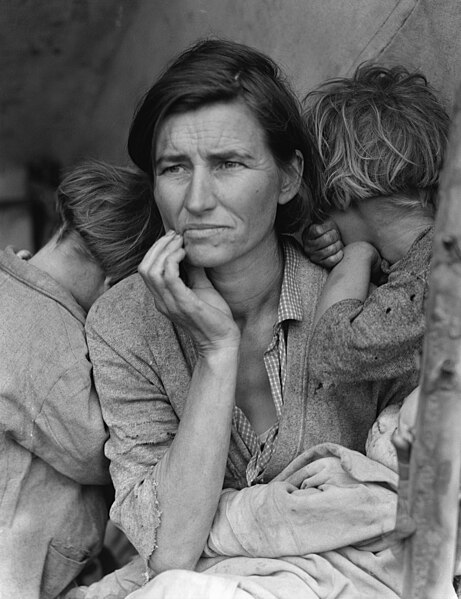
Today I watched a PBS documentary on the federal government program that sent photographers out to chronicle rural poor during the Depression, an undertaking that resulted in 160,000 images (the most famous of which, Dorothea Lange's "Migrant Mother" is to the right) that are housed in the Library of Congress and considered a national treasure. The project was conceived by a member of FDR's inner circle, and the president not only gave the go-ahead, but fought battles with Congress, which sought to defund the program because members felt the realistic and sad images reflected badly on the US.
Today, most historians consider FDR in the company of Lincoln and Washington as America's greatest presidents, and back in 2000 Time magazine chose Roosevelt as runner-up (to Albert Einstein) as the most important person of the 20th century. Despite the consequences of his paralytic illness, FDR stood up against fascism abroad and economic injustice at home. He fought the good fight like few presidents before or since. Now, in the midst again of war and economic uncertainty, I'd like to see President Obama stand tall and forcefully against the short-sighted, narrow-minded and self-serving opponents to his agenda of change.
Now, Obama does not have FDR's disposition and the economic mess he inherited, while serious, is not the Great Depression (and therefore, drastic action is harder to implement). More than that, however, times have changed since the 1930s and 1940s, and maybe there's no bigger example than the breadth and scrutiny of the media, evidenced by disproved lies, like Obama not being a citizen, getting significant play while an actual fact, that FDR was confined to a wheelchair, was hushed by the press of his day.
Those who have grumbled about Obama being socialist and the most radical occupant ever of the White House are ignoring that the current president is nowhere near as far to the left as Roosevelt, who quickly and forcefully empowered the government to help the "third of the nation" that was "ill-housed, ill-clad, ill-nourished," actions which had him labeled "a traitor to his class."
Today I watched a PBS documentary on the federal government program that sent photographers out to chronicle rural poor during the Depression, an undertaking that resulted in 160,000 images (the most famous of which, Dorothea Lange's "Migrant Mother" is to the right) that are housed in the Library of Congress and considered a national treasure. The project was conceived by a member of FDR's inner circle, and the president not only gave the go-ahead, but fought battles with Congress, which sought to defund the program because members felt the realistic and sad images reflected badly on the US.
Today, most historians consider FDR in the company of Lincoln and Washington as America's greatest presidents, and back in 2000 Time magazine chose Roosevelt as runner-up (to Albert Einstein) as the most important person of the 20th century. Despite the consequences of his paralytic illness, FDR stood up against fascism abroad and economic injustice at home. He fought the good fight like few presidents before or since. Now, in the midst again of war and economic uncertainty, I'd like to see President Obama stand tall and forcefully against the short-sighted, narrow-minded and self-serving opponents to his agenda of change.
Saturday, April 4, 2009
Global recession
 The demise of The Boston Globe may be closer than most of us thought. According to Boston.com, the New York Times Company, which bought New England's largest paper in 1993, has threatened the Globe's unions with a shutdown in 30 days if the employees don't agree to $20 million in concessions.
The Globe is apparently losing more than $1 million a week, and the Times Co. says it can no longer subsidize Boston's broadsheet, which was founded in 1872 and has won 20 Pulitzer Prizes. The Globe, the country's 14th biggest newspaper, has cut scores of jobs in recent months, but this hasn't been enough to get the paper out of the red.
Like most newspapers around the country, advertising and readership are both down. Dailies in Denver and Seattle shut down in recent weeks, while the two Detroit papers cut back on the number of publication days. Losing the Globe would be a blow to the city. The debate on civic matters would be that much less robust and fewer eyes would be keeping tabs on government at all levels. However, even if the unions go along with the move, it's hard to see how the overall trends get reversed.
Monday, March 30, 2009
"Your country needs you now"
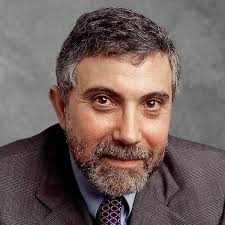 I don't know about you, but Paul Krugman has become the voice I trust most when it comes to navigating the economic morass we find ourselves in. An unyielding critic of George W. Bush's policies -- fiscal and otherwise -- Krugman has of late been skeptical of parts of the Obama Administration's economic policies. This week he's on the cover of Newsweek.
A Nobel Prize-winning economist, academic at Princeton and New York Times columnist, Krugman thinks that the stimulus package was too small and that nationalizing the large, faltering banks is the only way out. About the banking plan proposed by Treasury chief Tim Geithner, Krugman wrote, "...it fills me with a sense of despair."
Krugman can frequently be found opining on television. I see him on the NewsHour or as part of the roundtable on Sunday morning's This Week. I get a kick out of how uncomfortable he looks on camera. His Times' column runs Monday and Friday, and I also check his blog every day for his latest comments and explanations.
And now Krugman has really been cast into popular culture by a video bouncing around on YouTube. A guy named Jonathan Mann wrote and recorded a song call "Hey Paul Krugman (A song, A plea), " which is hilarious -- and more than a little true. The tune is a bit catchy, and the best part of the lyrics is when Mann sings:
For Godsakes man you won the Nobel PrizeOuch.
Timothy Geitner uses Turbo Tax
Friday, March 20, 2009
Seeing one tree and not the forest
 "Suppose you were an idiot," Mark Twain once wrote, "and suppose you were a member of Congress. But I repeat myself." This bit of Twain's wisdom comes to mind at times like this week, when members of Congress are tripping over themselves to find a microphone where they can express outrage, and even in an instance like this, when outrage is appropriate, any and all reasonable thought is quickly abandoned so as not to be seen on the wrong side of an issue that is clearly resonating with the public.
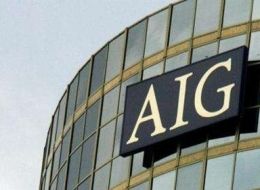
The A.I.G. bonuses look terrible -- and they are terrible -- but the week-long furor they incited distracted all of us from a number of other items that are as important, if not more so. I didn't hear a single member of Congress weigh in on the high-ranking Bush Administration official who said that the government and the military under the former president knew from day one that most of those held as enemy combatants at Guantanamo Bay were innocent. Hundreds were held for up to seven years, and some are still there! Where is the outrage?
On the financial front, economists repeat the warning that the Obama Administration has not adequately addressed the banking crisis and that the recovery will not begin in earnest until then. The bonus debacle, in fact, makes it much less likely that the public will tolerate any more attempts at anything that can be tagged with the term "bailout," and Congress has rarely shown the nerve to stand up and do what needs to be done in the face of widespread public disapproval.
When I look at the bonus issue from a broader view, my reaction is to wonder if all these people shouting have been paying attention to our economic system and the inherent disparities lo these many years. This is what capitalism does: resources and people are exploited for the benefit of a small class of individuals. It's worked that way from the start -- and now, suddenly, there's an uproar over a tiny piece of the inequity?
Friday, February 27, 2009
Implementing change
 Two of the main reasons that I voted for Barack Obama were to bring an end to the war in Iraq and to shrink the disparity of wealth in America. In the past 36 hours the president has made major steps in both of those directions.
Today, before an audience of Marines, Obama announced that combat troops would be out of Iraq by next summer, with all troops out by the end of 2011. Admittedly, those of us on the left would like to see American troops back home even sooner -- and we're also leery of the announced buildup in Afghanistan -- but I believe this president to be a man who listens to others and thinks before making decisions, so I am confident that Obama believes that this is the best course of action.
Yesterday, the White House released its proposed budget for fiscal 2010, and -- from what I've read and heard -- Obama hopes to cut wasteful programs, close unnecessary loopholes, raise taxes on the very wealthy and increase spending on his priorities, like health care, green energy and education. I agree with all of those steps. Some are calling the budget a redistribution of wealth, and I say, "Hurrah!" to that.
This is what I sent Obama to Washington to do. The work has just begun, but I am glad to see him doing it.
Tuesday, February 24, 2009
A pair of deuces
Though it seemed that Sal DiMasi's departure from the State House would signal a new day for advocates of bringing casino gambling to Massachusetts, a couple of obstacles have been tossed into the fray.
First, the economic downtown makes developers and potential customers harder to find. Second, a ruling today by the Supreme Court undoes the status of the Middleborough land purchased by the Mashpee Wampanoag tribe. Without the land being placed in a federal trust, the tribe does not have the right to bypass current state law and go forward with its plans.
Of course, the state legislature could still vote to legalize casinos, the governor could sign the bill into law and the economy could bounce back, but for now the excitement of those in favor of the move would seem to be in a state of limbo.
First, the economic downtown makes developers and potential customers harder to find. Second, a ruling today by the Supreme Court undoes the status of the Middleborough land purchased by the Mashpee Wampanoag tribe. Without the land being placed in a federal trust, the tribe does not have the right to bypass current state law and go forward with its plans.
Of course, the state legislature could still vote to legalize casinos, the governor could sign the bill into law and the economy could bounce back, but for now the excitement of those in favor of the move would seem to be in a state of limbo.
Thursday, February 19, 2009
Free market high priest backs bank takeover
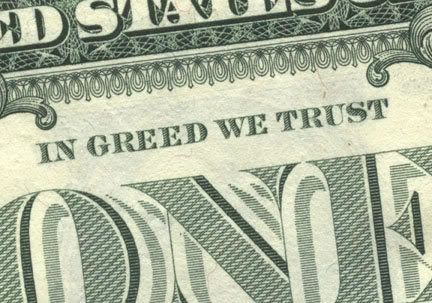 Alan Greenspan -- the former longtime chairman of the Federal Reserve Bank and a staunch free-market, laissez-faire capitalist -- has said publicly that the US may need to nationalize parts of the banking system to turn around the current economic crisis. This is like the Red Sox walking over to the Yankees' dugout during a baseball game and asking to use their opponents' bats because they are superior.
Greenspan, one of the architects of US fiscal policy during his nearly two decade reign as Fed chair, has been cited by Nobel Prize-winning economist and New York Times columnist Paul Krugman as the individual most responsible for the current economic crisis. A couple of months ago Greenspan sat before a Congressional committee and admitted that he was wrong in assuming that banks and other financial institutions would regulate themselves.
There seems to be a general feeling building that nationalization is inevitable and that what has prevented it from happening so far is public opinion. The price tag is likely to be more than a trillion dollars. Do such numbers even matter any more? Has the value of the dollar become meaningless? Will the situation become as bad as the Great Depression? Is all of this an admission that the basic tenets of capitalism are all wrong?
Speaking of the economy, I watched "Inside the Meltdown" on PBS's Frontline a couple days ago, and the program detailed how the economic crisis unfolded and how Ben Bernanke, current Fed chair, and Hank Paulson, former Tresury secretary, walked into a meeting with Congressional leaders and showed them that the entire US economy was standing on a cliff.
And in a recent issue of The New Yorker there is an article called "The Ponzi State," which details the collapse of Florida's housing market in an economy that is based almost completely on outsiders moving in. In effect, says writer George Packer, the Sunshine State is one giant Ponzi scheme. Could this be true of the nation's -- nay, the world's -- economy?
Tuesday, February 17, 2009
Budgetary quake rattles Golden State
The state of California is close to fiscal collapse. A story in the New York Times describes the huge budget shortfall, massive layoffs, tanking bond rating and legislative gridlock that has the nation's most-populous state on the brink of bankruptcy.
Gov. Arnold Schwarzenegger seems powerless as his Republican colleagues in the state legislature refuse to vote for some sort of financial remedy. California has a deficit of some $41 billion.
Is this a harbinger of things to come all across America? We know that Massachusetts, like many other states, has a budget shortfall, and the Times also has a brief story on Kansas's state government running out of cash. There is money for the states in the stimulus package that President Obama will sign tomorrow, but not enough to completely bail them out.
In his Times column yesterday, Paul Krugman said that the US is in "deeper trouble, I think, than most people realize." There will apparently be much more pain and much more government spending before we are even treading water again.
Gov. Arnold Schwarzenegger seems powerless as his Republican colleagues in the state legislature refuse to vote for some sort of financial remedy. California has a deficit of some $41 billion.
Is this a harbinger of things to come all across America? We know that Massachusetts, like many other states, has a budget shortfall, and the Times also has a brief story on Kansas's state government running out of cash. There is money for the states in the stimulus package that President Obama will sign tomorrow, but not enough to completely bail them out.
In his Times column yesterday, Paul Krugman said that the US is in "deeper trouble, I think, than most people realize." There will apparently be much more pain and much more government spending before we are even treading water again.
Sunday, February 15, 2009
A little outrage
Congressman Michael Capuano went off on eight bank CEO's at a House Financial Services Committee hearing last week. The representative from the 8th District, which includes East Boston, told the bankers that he refuses to put any of his money in their banks and that he is surprised they haven't been prosecuted criminally for their misdeeds.
These guys need to be humiliated more often. You can watch Capuano's tirade here on YouTube.
These guys need to be humiliated more often. You can watch Capuano's tirade here on YouTube.
Thursday, January 22, 2009
Relearning the lessons
A number of serious people are arguing that the best -- and maybe only -- way out of the current financial crisis is the nationalization of some of our largest banks. Things are that desperate.
We've reached a point, they say, where Citibank, for example, is actually insolvent, but is still afloat with the belief that the US government will and must step in because it is too big an entity to fail. As a result, the stock price has not collapsed; however, this means that Citibank will have to be propped up at some point by the Treasury because the other option -- that it falls off the cliff -- would be catastrophic.
One point I feel strongly about is that no business should be "too big to fail." The size and span of corporations should be limited so that their power to negatively impact our economy is greatly diluted. Greed has put us at the mercy of the conglomerate.
My second thought is that this is another death knell in the complete faith in unfettered free markets, a movement that returned under the presidency of Ronald Reagan. By 1980, the lessons of the Great Depression and its causes had been lost -- or conveniently forgotten by those looking for quick riches -- and so some of the checks and balances instituted by the New Deal were abolished, and then things accelerated under George W. Bush. And here we are, learning the same lessons again.
Finally, at what point do I pull my money out of the bank and stuff it in the mattress?
We've reached a point, they say, where Citibank, for example, is actually insolvent, but is still afloat with the belief that the US government will and must step in because it is too big an entity to fail. As a result, the stock price has not collapsed; however, this means that Citibank will have to be propped up at some point by the Treasury because the other option -- that it falls off the cliff -- would be catastrophic.
One point I feel strongly about is that no business should be "too big to fail." The size and span of corporations should be limited so that their power to negatively impact our economy is greatly diluted. Greed has put us at the mercy of the conglomerate.
My second thought is that this is another death knell in the complete faith in unfettered free markets, a movement that returned under the presidency of Ronald Reagan. By 1980, the lessons of the Great Depression and its causes had been lost -- or conveniently forgotten by those looking for quick riches -- and so some of the checks and balances instituted by the New Deal were abolished, and then things accelerated under George W. Bush. And here we are, learning the same lessons again.
Finally, at what point do I pull my money out of the bank and stuff it in the mattress?
Subscribe to:
Posts (Atom)