Sunday, August 21, 2011

Road trip

The endless cornfields of southern Illinois.

Something that I learned in the last ten days: Much of Illinois is populated by corn. Something else: The quality of rest areas varies from state to state.

Between August 11th and 18th I put 3,000 miles on my car -- and flattened countless insects on my windshield, front grill and side mirrors. I visited the cities of Buffalo, South Bend, Chicago, Memphis, Knoxville and Asheville on a road trip that was fun, interesting and exhausting.

I have friends in Chicago and decided in the spring that I would drive out to see them this summer. I also decided that I didn't want to make the entire trip in one day, as I had with a friend, eight years earlier. Finally, I wanted to take a different route home to see some places I hadn't seen before. After a while I roughed out the route in my head, though I didn't make preparations until the day before leaving -- and only for the first half of the trip.

I-90 begins in East Boston and it would be my home for the first few days. The 450 miles from here to Buffalo is fairly scenic the entire way, with trees and rolling hills. It took me seven hours to complete that first leg, including stops at rest areas. Generally, I chose places to stay based on their proximity to places I wanted to eat. In Buffalo I wanted to visit a Belgian-style pub called Blue Monk, in the vibrant Elmwood Avenue section of the city. There was a fantastic beer selection and I had a charcuterie plate (cured meats) and some poutine, a dish of French Canadian influence that I was introduced to years ago in Maine. Dinner was followed by a cup of "sipping chocolate" at Chow Chocolat. I spent the night at a nearby bed and breakfast called Beau Fleuve, which was delightful.

A rest area off I-90 in Ohio.

After a light breakfast and good conversation with other guests, I went to visit an old church that was converted a few years ago into the headquarters of Righteous Babe Records, the label of Ani DiFranco, a singer-songwriter who is a favorite of mine. I just walked in and an employee was nice enough to show me the offices, performance space and art gallery that are now part of the building. From there I was off and back on I-90. The rest area that I stopped at in Ohio is big, bright, clean and modern -- possibly the nicest I've ever seen. I fueled up on Starbucks espresso and continued westward. As the road passes through Cleveland, the number of cars and exits increases and the route twists and turns. Driving through big cities is where things get a little anxious for a driver in new surroundings, but soon I was beyond the suburbs and the road straightens and thins out. There had been some small farms and vineyards in upstate New York, but west of Cleveland is where the agriculture really begins: miles of cornfields on each side. Ahead , in the distance, a farmhouse or a barn and a few trees and, once beyond that, more corn.

This continues to a lesser degree in Indiana, where the road is noticeably less well-kept and the rest areas are smaller and less modern. After about seven hours and 460 miles I was in South Bend, home of Notre Dame. I got a bit lost on local streets, but eventually found the Jameson Inn, which had been right next to my exit all along. This was my most mediocre lodging as well as my most mediocre dining experience. A friend who graduated from ND suggested I eat at the Fiddler's Hearth, so I made my way over there. The Irish pub was crowded and loud. I stood by the doorway for quite a while as the waitstaff walked past me, and eventually I had to approach one of them. I asked to sit outside where it was quieter. The bangers and mash that I ordered was OK.
Wind across the flags at Chicago's Navy Pier.

On Saturday morning I made the 90 minute drive into Chicago. Though I had been close the night before, my hosts in the Windy City pointed out that traffic during rush hour the night before would have been terrible, so pulling in mid-morning on the weekend was the way to go. My friends live in the northern suburb of Northbrook, which is nice and quiet -- though the straightness of every road out there was freaking me out a bit. That night we went into the city to meet another friend at Cafe Iberico, a downtown tapas bar. The food and sangria were excellent, and afterwards we walked around, seeing the only structures not burned down by the famous 1871 fire. On Sunday my friends took their kids and we went to the Navy Pier, a redeveloped pedestrian mall with eateries and attractions on Lake Michigan. The wind was blowing furiously, but we had a nice afternoon, including lunch at the Billy Goat Tavern -- famous for the "Cheeseburger, cheeseburger" SNL skit. We also visited a piece of public art officially called Cloud Gate, but known to locals as The Bean. It's a good spot to take photos.


  Sunset over the Mississippi River in Memphis.


From Chicago I drove the length of Illinois -- and it is really just cornfields for hours, with some soybeans sprinkled in -- and slipped into Missouri and then Arkansas for a bit before arriving in Memphis, at the west end of Tennessee. This was the most difficult drive, not only because it was nearly ten hours and 550 miles, but because the road was generally straight and the scenery was unchanging for much of the trip. The Holiday Inn in Memphis, however, was the nicest room -- more generic than the two non-chain places I stayed, but it was a roomy suite. The hotel is in a quiet neighborhood directly across the street from the University of Memphis. The place I wanted to visit for dinner happened to be closed on Monday, but in Memphis there are many options for barbecue -- and that is why I was in that city. I went to Central BBQ, and while the food (ribs and pulled pork) was good, it wasn't amazing and the staff was a bit indifferent. After eating, I went down to the shoreline of the Mississippi River and watched the sun set from a riverside park area.


On my way out of town I decided to stop by Graceland. I confess that I have never been much of an Elvis fan, but it happened that I was in Memphis on the anniversary of his death, so I thought I'd take a look. The expected big crowd wasn't there -- at least not at 9 a.m. A sign said it was $10 to park and I wasn't about to pay that, so I took a self-portrait by the big sign off the road, and as I was doing so a passerby volunteered to take my photo, which was even better. I then hopped on I-40 east. I wasn't sure if I was going all the way to Asheville, NC -- a small city in the Blue Ridge Mountains that has a reputation as a hotbed of art and culture -- or if I would stop at Knoxville, the largest city in eastern Tennessee. I decided not to push myself and to opt for Knoxville, and it was an excellent decision.

Market Square in Knoxville.

While western Tennessee retains the character of the Mississippi River valley, the eastern part of the state is in the Appalachians. The foothills and then the mountains roll away from the road in all directions. After six hours and 400 miles I pulled into downtown Knoxville -- for the first time showing up in a city without a place to stay. I quickly found the local visitors' center, which not only provided friendly information, but had a little cafe so I could sit, have a beverage and figure out a game plan. I quickly found that the Oliver Hotel, a quirky, newly renovated place, was right next to Market Square, the pedestrian mall that was the center of the reborn Knoxville. I booked a room and got cleaned up. I had dinner at the Downtown Grill and Brewery, and I spent some time wandering around the city center.

One of my favorite novels, Cormac McCarthy's Suttree, is set in Knoxville, which was the main reason I wanted to stop there. I walked over the Gay Street Bridge, which crosses the Tennessee River, to look down at the spot from which the body of a suicide is pulled from the river in the book's opening pages and, further down, to the presumed area where the title character, Cornelius Suttree, docks his houseboat. Afterwards, I grabbed an excellent espresso at Coffee and Chocolate while chatting with the friendly barista. Over in Market Square there was a jazz trio playing on a stage at one end and a street musician playing cello at the other. One of the most inspiring sights of my entire trip was a child, perhaps three years old, playing in a small public fountain in the middle of the square. She approached the water, which came up from ground level and made a small but graceful arc, with curiosity and excitement each time, put her hands or head or torso into the spray, and then laughed with pure joy as she toddled back to her mother, who was right behind her. This went on for ten minutes and the girl never tired or lost her enthusiasm.

Public art in Asheville.

The next day brought the most beautiful stretch of driving, as I wound my way through the Great Smoky Mountains into North Carolina on I-40. After about 120 miles and two hours -- which was, by that part of my journey, a quick side trip -- I was in Asheville, a city of 80,000 that has recently been voted one of the best places to live in the US and one of the world's must-see destinations. In recent years it has developed a reputation as a center of Appalachian culture, music and art. I walked around the city's downtown and had lunch at the highly regarded Tupelo Honey Cafe. The made-from-scratch black bean burger was very good, and the complimentary biscuit, with jam, was incredibly delicious.

I wanted to see more of Asheville, but I also needed to think about getting back to Boston. I had 15 hours separating me from home, and I didn't want to do that all in one day, so I got back on the road with the goal of getting as far north as I could before dark, thereby making the next day's final journey as reasonable as possible. I took I-26 to I-81 north and made it to Harrisonburg, Virginia, by twilight, knocking about five hours off the rest of my trip. There was a Holiday Inn at the end of the off-ramp and later I found a small sandwich place to hold me over.

At 6 a.m. the next morning, AC/DC woke me up. The previous guest in my room had apparently set the alarm clock using the radio feature. My first reaction was confusion -- What is happening right now? -- which was followed by annoyance. When the radio began blaring again in five minutes I realized I had only hit the snooze button the first time. Now I veered toward anger, jumping up and pulling the plug out of the wall. Later, I growled at the hotel staff, but getting an early start on the long drive home was actually a good idea. I followed I-81 through the rest of Virginia, into West Virginia, Maryland and Pennsylvania. In Scranton I switched to I-84 and continued on through New York State and Connecticut, and then in Massachusetts I picked up the Mass Pike. The final leg was, with stops, more than 11 hours, but driving home adds extra motivation to keep going.

It's a big country out there, and I've still only seen a small slice of it. The distances and time spent on the road might seem overwhelming, but driving can be enjoyable as well. When hitting the road solo there is plenty of time for reflection; plus, NPR was a constant companion everywhere I went. Also, it is amazing how much religious radio there is in this country. I listened to it for a stretch here and there, and I have to report that some of it is completely insane. Another thing you'll find outside New England: large amounts of shredded tire on the road shoulders.

We can sometimes fall into cynicism and worse when confronted by the world's problems -- or even our own little struggles to survive and find satisfaction in this sometimes complex, often frustrating world. However, we are surrounded by great beauty, and if we fail to seek it out and embrace it, we alone are to blame. I think of that child in the fountain in Knoxville and how, after seeking reassurance from her mom, she walked back toward the cool and refreshing arc of water, each time allowing herself to be surprised, excited and filled with joy at something so wonderful, yet so simple.

Saturday, August 6, 2011

Asleep at the wheel

It was 10 years ago today that President George W. Bush was handed a morning security briefing titled "Bin Laden Determined to Strike in US." Bill Clinton's transition team later reported that the Bush Administration never seemed too concerned about terrorism, and 36 days after that aptly titled briefing, four planes were hijacked and, well, we all know the rest.

Bush managed to deflect most of the criticism on this issue, but can you imagine if Al Gore was in the White House when 9/11 happened? I am positive that he would have been impeached by Republicans in Congress.

Tuesday, August 2, 2011

The awful debt-ceiling deal

The tunnel named after the late Tip O'Neill is apparently leaking quite a bit these days, but the legacy of the former Massachusetts Congressman is more impressive to me than ever in the current political landscape. O'Neill served 10 years as Speaker of the House, much of it when Ronald Reagan ("the most ignorant man who had ever occupied the White House," according to O'Neill, who died before George W. Bush came on the national scene) was president. Reagan, and other Republicans elected in 1980, went to Washington to "make government smaller" -- GOP-speak for lowering taxes on the wealthy and dismantling the New Deal safety net. O'Neill, ridiculed publicly by arrogant conservatives as being old and overweight, used strength and charm to stand up against Reagan and his cohorts, virtually single-handedly absorbing the blows and holding the line.

Alas, O'Neill is gone and the Democrats seem to have no one like him in a leadership role. (Nancy Pelosi, House majority leader, is probably closest, but she doesn't run the House any more.) President Obama appears to get his clock cleaned by Republicans on every contentious issue. His natural inclination to compromise has been repeatedly taken advantage of by an opposition that is virtually unwilling to give any ground -- and therefore all "agreements" give the far right almost everything they want. It's discouraging.

The debt-ceiling agreement that leaders on both sides are touting today -- and which passed the House last night and will likely get Senate approval today -- is a complete capitulation to a group of elected officials who were willing to sacrifice the stability of the nation and the global economy to make sure that the rich in American don't have to pay a single penny more in taxes. Joe Nocera in The New York Times calls them "terrorists" who are "waging jihad on the American people." This group of Tea Partiers and their enablers in Congress -- only several dozen members -- give the impression that they will go to any length, including national crisis, to get what they want. It's like playing chicken against a crazy person: you have to get out of the way because he will take you both down.

This all reminds me of the story in the Old Testament where two women come to King Solomon, both claiming that they are the mother of a particular child, and the wise king declares that the child will be split in two. Of course, the strategy was that the child's actual mother wouldn't want to see any harm come to the boy, and so when one of the women cries out, "No! Let her have him!" the king knows she is the true mother. The Democrats keep flinching and crying out. They are not willing to let the country default in its fiscal obligations as of midnight tonight, and so they gave in. The Republicans, whose reasonable elements are shouted down by the far right, are willing to burn the entire Republic to the ground. As a result, the deal voted on today requires sacrifices from the poor, the elderly, the young, the sick and the hard working, while those at the top of the economic pyramid have to give up nothing.

Despite the political rhetoric, the deal will hurt the economy. In the meantime, our biggest national crisis -- millions of unemployed -- goes unaddressed. In times like this government needs to spend more, not less. The stimulus back in Obama's first year needed to be two or three times bigger, but he gave in to the right. Now the economy will suffer more, and the GOP will pin it on Democrats in 2012. It's hard to see an upside here.

Thursday, July 28, 2011

Getting serious

For weeks the word was that Wall Street was not panicking about Washington's inability to raise the debt ceiling because it was understood that, in the end, some kind of deal would be reached. After all, the thinking went, the leadership of both parties knows how potentially serious and far-reaching the consequences would be of default. In the past few days, however, markets around the world have started to drop and there is now a real feeling that "these guys could screw this thing up." We are, indeed, in interesting times.

One article that most still cling to is that the US will not default -- in other words, miss payments on the debt to creditors. Because of what would certainly be the cataclysmic results of the world's safest asset suddenly unable to pay its obligations, the widely held view is that even if no agreement is reached the Treasury would first pay the $90 billion due to bondholders. After that, the government would need to prioritize, as incoming tax dollars only cover 40% of outlays. More than half of government would not be funded: Social Security or homeland security or troop salaries or Medicare, etc. Some essential programs would be on hold.

This assumes that, absent a Congressional vote, President Obama doesn't invoke the 14th Amendment to the Constitution, which some Democrats are publicly pushing him to do. Obama, a Constitutional law professor, has said that his Administration's lawyers have reviewed the 14th Amendment -- part of which reads, "The validity of the public debt of the United States ... shall not be questioned." -- and concluded that it is not "a winning argument." Using such a tactic spuriously, some say, could lead to impeachment.

What has many analysts concerned is that even if an agreement is reached and the debt ceiling is raised this entire dramatic and drawn-out episode has already done its damage. Though the mounting total of US government debt -- currently $14.3 trillion -- has always been in plain sight, investing in that debt through US Treasury bonds was still considered the safest bet in the financial world. Now, the spotlight is on and some may start to second guess the wisdom of such an investment, for even if obligations are met this time the idea that there could come a time when this is not so is beginning to creep into worldwide financial markets. And the idea that the Tea Party segment of the political spectrum is actually playing chicken with America's financial affairs and that this most unstable and irresponsible movement may grow in power and is even looking to take the White House -- well, such a possibility could, right now, cause investors to panic and ratings agencies to lower the AAA rating of American debt.

Coupled with the current flat recovery from the Great Recession, it seems that we are forging new economic ground. The Tea Party and its lackeys in Congress think they know what they're doing, but we have seen how their conception of reality is not fact-based. We can only hope that saner heads step in and quickly fix this mess.

Thursday, July 21, 2011

Library gets go-ahead

The city has announced that it will go ahead with the construction of East Boston's new library branch despite a failure to receive state funding this year. Though it appeared for a bit that the project would have to wait an extra year, Mayor Menino said, "Under no condition are we going to stop on this project," according to Boston.com.

The library, which will be located at one end of Bremen Street Park, will be nearly 15,000 square feet. Construction is scheduled to begin next spring and the library could be open by the fall of 2013.

Photo courtesy of Boston.com.

Monday, July 18, 2011

DC snub could be Bay State gain

President Obama today announced his nomination to head-up the new Consumer Financial Protection Bureau -- and it isn't, unfortunately, the woman who had the original idea for the agency and has been overseeing its set-up. Elizabeth Warren, a Harvard law professor, is smart and tough, with unquestionable integrity, and you would think that these qualities would make her a no-brainer for the top spot in the CFPB, which is supposed to provide information to consumers and to keep an eye on banks, credit-card companies and other financial institutions -- all with the goal of protecting all of us from lies, schemes and predatory practices.

The Republican Party, of course, has a problem with any tactic that prevents their friends, and themselves, from getting richer. GOP senators made clear that Warren would not pass confirmation, so the president nominated an underling, Richard Cordray (whose nomination, it appears, will also be held up). While, again, I wish that Obama would fight back against the morons in Congress, there may be a bright side to this for those of us who live in Massachusetts. Warren's name has been tossed around as a possible Democratic challenger to Senator Scott Brown in the 2012 election. Warren said today that, with her work in DC done, she is returning to Massachusetts "to do more thinking" about a possible Senate run.

Warren would be an excellent candidate, and she would immediately have my support. I'm hoping she throws her hat in the ring.

Saturday, July 16, 2011

Good time for a good cause

I had a nice time last night at the DeVeau Family and Friends Summer Beach Party at the Orient Heights Yacht Club. The annual event raised more than $20,000 for the Jimmy Fund. Ed DeVeau is a former Savio student of mine and there were a number of other former Savio students on hand, including guitar hero Joe Maraio, who played a set for the crowd.

Wednesday, July 6, 2011

Car accident


I came across the scene of a two-car accident moments ago at the corner of Bennington and Moore streets in East Boston. No one appeared to be hurt badly, though I saw a young woman with a scratched face. One car had smashed into a pole outside Carlo's Market while the other was splayed across the median strip. I took the photos above.

Monday, July 4, 2011

In Congress, July 4, 1776


“We hold these truths to be self-evident, that all men are created equal, that they are endowed by their Creator with certain unalienable Rights, that among these are Life, Liberty and the pursuit of Happiness. That to secure these rights, Governments are instituted among Men, deriving their just powers from the consent of the governed…”

Tuesday, June 28, 2011

The sounds of summer

ZUMIX kicks off its Summer Concert Series on Sunday with the Seaport Festival, "a free afternoon of music, arts, crafts, games and prizes," this Sunday, July 3, at Piers Park. The event runs from 3 to 6 p.m. and will feature Smokin' Joe and the Henchmen, a classic-rock and soul band. Also on the bill are the ZUMIX Jazz All-Stars, a group of young people I saw play a few weeks ago.

The Summer Concert Series will offer live music every Tuesday and Sunday throughout the summer at Piers Park and Bremen Street Park. For information on the schedule, check out the ZUMIX web site.

Tuesday, June 7, 2011

Sound and fury

It happens every spring. The storm windows go up, the screens comes down and the air conditioner goes in -- and, as a result, the outside world once again seeps into my apartment. What had been a buttoned-up fortress, with double-pane windows plus the storms, is now a porous divider between me and everything going on outside along Bennington Street.

By "everything," I mostly mean the noise: the planes, the sirens, the motorcycles, yes....but also every car that wooshes past, the screeches of children playing, and even people just talking in normal voices as they walk past my windows. I hear every bit.

And then there are the car horns. I hear quite a few of those in any given stretch. Sometimes it's from impatient drivers at the nearby red light, but more often there are people arriving to pick someone up and they lay into the horn without a moment of thought about how that act can disturb everyone else. At the top of the pyramid, for me, is a horn that regularly beeps around 4 a.m. directly across the street from me. Once the nice weather comes the obnoxious beeper frequently wakes me up -- as happened this morning. I tried valiantly, but was unable to fall back to sleep.

This has actually been going on for three years. On some occasions I have gone outside to yell at the beeper. Once I ran over and began screaming at him. The beeping, however, continues. Maybe it is a different person, or various people. Why anyone thinks it is OK to disturb everyone on a city block in the wee hours is beyond me. Doesn't the driver own a cell phone? Can't the passenger be ready at the appointed time?

I spoke to an officer at the East Boston police station and he suggested I get the license plate of the vehicle, so that is what I will attempt to do, though rousing oneself from bed and running outside is tough to do at 4 a.m. We'll see how it goes.

Update (6/8): Well, the horn woke me up again. At 3:50 a.m. I immediately dragged myself out of bed, threw on my sandals, grabbed paper and pen, and marched outside. I took down the license plate of a big SUV as it sat running, and then I walked up to the front of the vehicle. The driver rolled down the window, and I told him he woke me all the time with his horn and that I had his license-plate number. He was around 30, looked to be heading to work and he apologized. If this happens again I will call in his plate to the police.

Saturday, June 4, 2011

30 years later

I'm just back from my 30th high school reunion and it was a good night. I graduated from Savio in 1981 in a class of 89 guys. Only 20 showed up tonight, but after 30 years people are living all over the place and have family obligations. It was good to see those who did come out.

As I was telling some of the guys tonight, I was a dorky kid from East Boston, but among my classmates I always felt like I could wander form group to group -- the athletes, the rock music rebels. the guys that came from East Boston Central Catholic with me, the guys from Revere, and everyone else -- and I was always accepted. Those were good days at Savio -- and I got a good education.

It's strange to see people virtually every day for four years and then to never see them again. That often happens after high school. At least tonight I got to touch base one time with some of the guys who -- no matter where we go or what we do -- will always be my friends.

Tuesday, May 31, 2011

Transportation notes

*The construction of the new Chelsea Street Bridge begins the next stage tomorrow "with demolition of the existing bridge and construction of the remaining portions of the new lift structure," according to the state's Department of Transportation blog. This necessitates the closing of the bridge for six months, beginning tomorrow. The site says that, "The project is scheduled to be completed in spring 2012."

*City Hall is reminding cab drivers that people headed into East Boston, with the exception of those getting off at the airport, cannot be charged the tunnel fair. I rarely use taxis in Boston, but the last time I took one to come home, the driver attempted to tack on a few bucks for the toll. He didn't argue with me when I told him that doing so was illegal, but he would have got me if I didn't know better. The City asks that people report if cabbies attempt to charge the extra fee.

Photo of Chelsea Street Bridge courtesy Massachusetts DOT blog.

Monday, May 30, 2011

Glory and remembrance

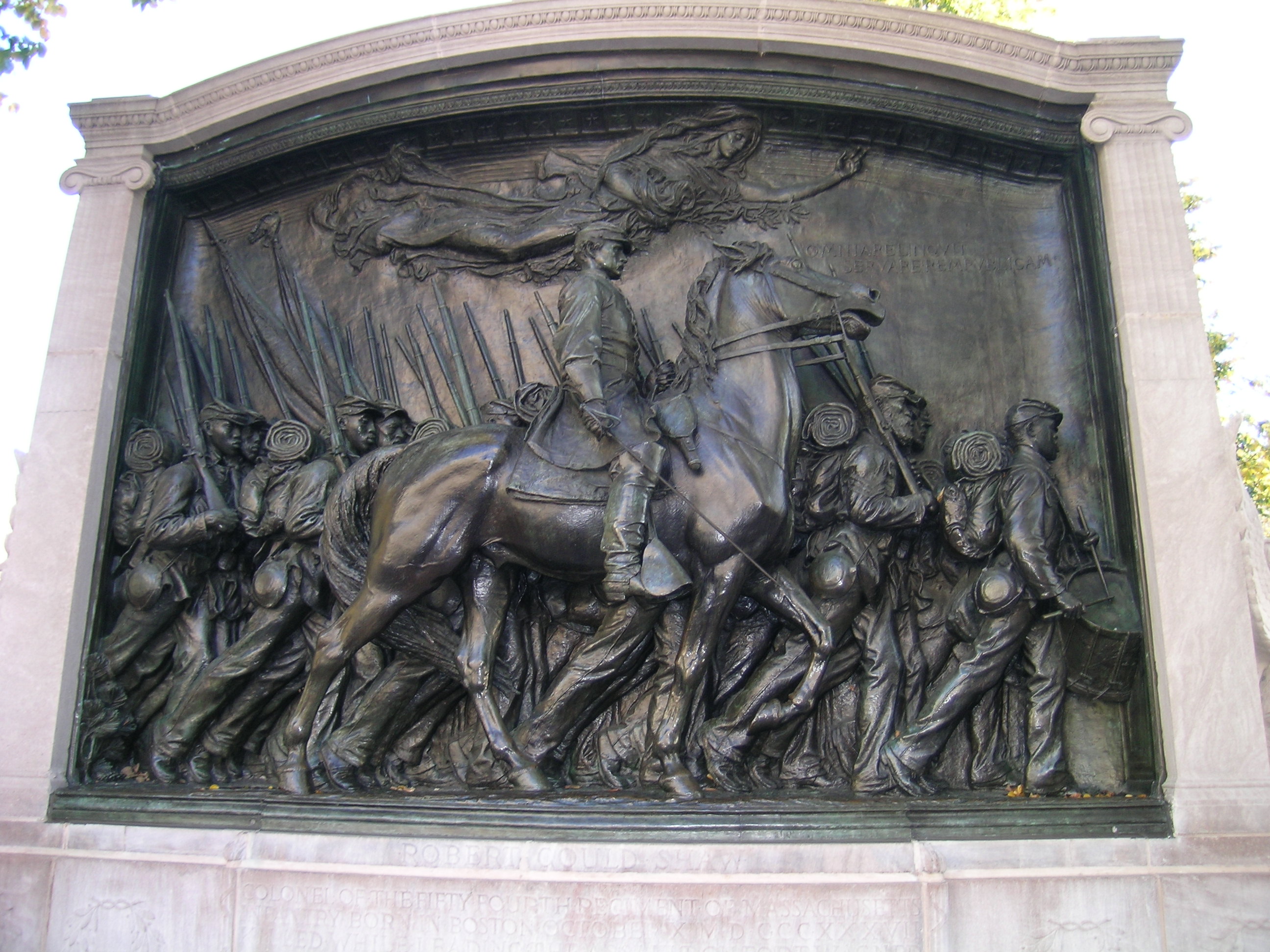
On Memorial Day in 1897, a work of art was unveiled to the public at the edge of the Boston Common, across from the State House. It was a bronze bas-relief by the American master Augustus Saint-Gaudens commemorating the 54th Massachusetts Volunteer Infantry Regiment and its leader, Colonel Robert Gould Shaw. The 54th was one of the first units composed of black soldiers to fight in the Civil War, and Shaw was from a Boston abolitionist family.

Considered by many to be the finest piece of public art in Boston, as well as one of Saint-Gaudens' masterpieces, the work depicts the 54th on May 28, 1863, marching down Beacon Street and off to war, with Shaw on horseback and an angel floating above. Shaw and 29 of his men died in South Carolina less than two months later, but throughout the war, the 54th fought with distinction. The regiment was portrayed in the Oscar-winning 1989 film Glory.

Tuesday, May 3, 2011

Choosing our own future

Osama Bin Laden is dead. Good riddance. Don't believe Joe Scarborough or other moronic pundits who claim that President Obama went against his supporters on the left by taking out the head of Al-Qaeda. None of us are shedding a tear for Bin Laden. He got what he deserved.

Bin Laden was evil -- but he wasn't stupid. A realistic assessment of his actions suggest that he accomplished some of what he set out to do. The goal was to entice the US into a protracted ground war in Afghanistan in order to bankrupt America and to radicalize the Muslim world against the West. And the result? The US military is approaching a decade in Afghanistan, plus eight years in Iraq, and together those campaigns have cost two or three trillion dollars. Meanwhile, there has been some radicalization of small groups of Muslims.

We're still here, of course, and we can ensure that Bin Laden's goals are not fully accomplished if we wrap things up in Iraq and Afghanistan, and if we use our military a bit more sparingly in the future. This is not a call for demilitarization or isolationism, but only for wisdom and foresight. America cannot go on spending as much as all other countries combined on the military, and America cannot go on deploying its forces all over the world.

Let us regroup at home and lead by example so that the US once again occupies the moral high ground. If America had invaded Afghanistan after 9/11 with a smart plan and an exit strategy and if the country hadn't taken its eye off the ball by getting wrapped up in Iraq, then thousands of lives and trillions of dollars might have been saved. We might have had to wait for a small team of soldiers to take out Bin Laden 10 years after the fact, but that is what happened any way.